
Dark Academia Cat Names: 23 Ideas from Augustus to Victor
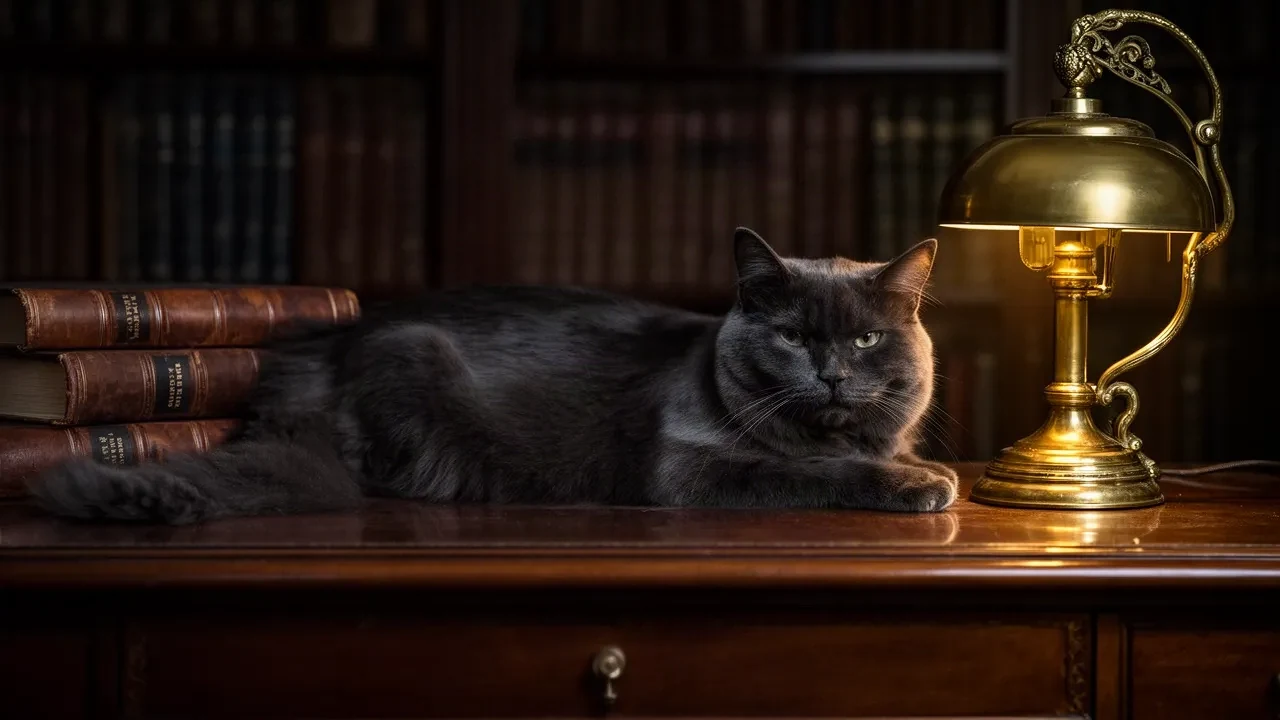
Dark academia is a mood before it is a name list: old libraries, wool coats, a cat asleep on a stack of books. The names that carry it have some history behind them, usually Latin or Greek with a little Gothic on top. Dante, Minerva, and Poe are the three that hold up best, and all of them are short enough to call across a room.
There is a trap here. A lot of the names on campus mood boards are famous rather than usable. Heathcliff, Byron, and Dorian are real names and you can put them on a tag, but they are long and they arrive with an entire novel attached. The list below leans toward names that sound good out loud first and literary second.
Dark academia borrows from a few eras at once. The Latin names come from Rome by way of the schoolroom, the Gothic ones from nineteenth-century novels, and the Germanic ones from old poetry and opera. You can mix them, but a household with a Caesar, a Klaus, and a Dorian starts to sound like three different classes in one room. Most homes are better off staying in one lane.
Quick Picks: Dark Academia Cat Names
Dante — enduring, DAN-tay; two heavy beats that suit a solemn cat.
Poe — peacock, one syllable, POH; short, black-coffee energy, easy to call.
Minerva — intellect, mi-NER-vah; the Roman goddess of wisdom, and a name for a cat who watches everything.
Jasper — treasurer, JAS-per; a solid Victorian-sounding boy name, two beats.
Felix — happy, lucky, FEE-liks; Latin, warm, and a nice contradiction for a grumpy-looking cat.
Oscar — God spear, OS-kar; Irish, dignified, and short.
Augustus — majestic, venerable, aw-GUS-tus; three beats, so try the shortened Gus first.
Ophelia — helper, oh-FEE-lee-ah; four syllables of Shakespeare, and a name you will almost certainly shorten.
Dark Academia Names for Female Cats
Bellatrix — female warrior, BEL-ah-triks; Latin, three beats, and a real star as well as a Potter name. Shorten it to Bella at your own risk, because half the neighborhood already has a Bella.
The dark academia shelf is thin on girl names that are both literary and easy to yell. If the reference matters more than the sound, Bronte, Austen, and Woolf work as surname-names, and Lenore carries the Poe connection. All of them are a mouthful at the door, so they suit a quiet indoor cat better than a loud one.
There is also a plain option worth considering, which is a name that sounds scholarly without the reference. Marcus, Felix, and Jasper carry the mood on their own. You do not need a novel to make a cat look like he belongs in a library.
Dark Academia Names for Male Cats
Caesar — hairy, SEE-zer; the Latin word for a full head of hair, and an odd fact to carry for fifteen years.
Marcus — polite, shining, MAR-kus; a Roman name with a clean, formal sound.
Titus — title of honor, TY-tus; short, imperial, and uncommon.
Nero — strong, vigorous, NEER-oh; a two-beat name with a heavy historical echo.
Victor — conqueror, VIK-ter; plain, strong, and easy at the vet.
Milo — merciful, MY-loh; gentler than the rest of this group, and a good fit for a soft cat.
Hugo — mind, intellect, HOO-goh; a French-literary name that stays short.
Etienne — crown, garland, ay-TYEN; three syllables, so decide now whether he becomes Steve.
Klaus — victory of the people, one syllable, KLOWS; Germanic and brisk.
Claude — limp, stuttering, one syllable, KLOD; an old etymology, not a description. Pick it for the sound.
Ivan — God is gracious, ee-VAHN; Russian, two beats, and a good fit for a big, calm cat.
A house full of Romans gets old fast. Caesar, Augustus, Marcus, Titus, and Nero together is a seminar every time someone new walks through the door. Pick one imperial name, then let the other cats have something plainer.
Unique Dark Academia Cat Names
The unusual end of this list is really the dark-noun end: a gem, a bird, and a shadow. None of them are literary in the strict sense, but they fit the palette.
Onyx — black gemstone, ON-iks; unisex, glossy, and a natural for a black coat.
Raven — dark bird, RAY-ven; the Poe bird without saying Poe, and unisex.
Shadow — shadow, SHAD-oh; the honest version of the name, for a cat who follows you from room to room.
These three also share a practical advantage: everyone can spell them on the first try. Onyx, Raven, and Shadow do not need a pronunciation guide, and they read clearly on a tag. In a theme full of Etiennes and Ophelias, that counts for something.
How to Choose the Right Dark Academia Cat Name
The mood is easy; the tag is the hard part. A name like Augustus or Etienne looks wonderful in a notebook and then loses a syllable every time you call it. Test the full name from another room before you commit. If it collapses to Gus or Steve, decide whether you are happy with the short version, because that is the name the cat will learn.
It also helps to know what the name actually means, since these are old words. Caesar is hairy. Claude is limp and stuttering. Poe is peacock. If those are the kind of facts you enjoy, the name gets better. If they would embarrass you at the front desk, pick a different one. The Name Generator can filter by origin or personality if you want to keep looking. For the book-character version of this theme, literary cat names is the closer list, and witchy cat names covers the familiars and herbs.
Think about the literary association before you commit. A cat named Heathcliff will get a Wuthering Heights comment at every visit, and a cat named Dorian will get a picture of the painting. If you enjoy that, the name gets richer. If it would wear you out, choose a name whose story is quieter, like Jasper or Milo. The name is with you for fifteen years, so pick one you can hear in a stranger’s voice.
The clinic is the real test. A long name gets shortened whether you want it or not, and the short version is what ends up on the chart. Augustus becomes Gus, Ophelia becomes Lia, and Etienne becomes Steve. If you are happy with that, the full name is decoration. If not, pick a name that is already short.
Match the name to the cat, not to the bookshelf. A scholarly name on an aloof cat can be funny in a good way, but a nervous cat does not want to carry a Caesar or a Nero. Milo and Felix are the softer end of the list, and they suit a cat who spends most of the day under the bed. Save the imperial names for the cat who already runs the household. Dark academia does not require a black cat, either. A ginger tabby named Oscar or a grey cat named Minerva carries the theme perfectly well, because the association lives in the name rather than the coat.
Frequently Asked Questions
What is a good dark academia name for a cat?
Dante, Minerva, and Poe are the three that hold up best. Dante is enduring, two syllables, DAN-tay. Minerva is intellect, three beats, mi-NER-vah. Poe is peacock, one beat, POH. Say each one out loud before you commit, because a mood-board name and a called name are not always the same thing.
Does Caesar mean emperor?
No. Caesar comes from a Latin word for a full head of hair, and hairy is the meaning that sits on the tag. The emperor association is historical rather than linguistic. If you want a name that still sounds imperial, Augustus means majestic and venerable, though it runs to three syllables.
Can I name a cat Heathcliff?
Yes. Heathcliff is a real literary name and a fine choice for a moody-looking tom, even though it is long and arrives with Wuthering Heights attached. Byron, Dorian, and Rochester work the same way. Use the whole name only if you are happy to say it in full, because it will get shortened.
Are dark academia names too long for the vet?
Some are. Ophelia is four syllables, and Minerva, Augustus, Etienne, and Bellatrix are three. Klaus, Claude, and Poe are one beat. Cats learn the sound you use most, and the desk writes what it hears. If you will shorten Ophelia to Lia by Thursday, start with Poe or Felix instead.
Should I use this page or literary cat names?
This page is the library-and-scholar mood: old words, old gods, and a few Gothic favorites. Literary cat names is the book-character list, and vintage cat names covers the old-fashioned people names that overlap most. Felix and Oscar appear in both searches.