
Are My Cats Playing or Fighting? 6 Ways to Tell
Updated
On this page (11 sections)
- The 6-Factor Play vs. Fight Comparison Matrix
- Factor 1: Claws and Biting Force (Sheathed vs. Weaponized)
- Factor 2: Vocalization (Silence vs. Hissing and Screaming)
- Factor 3: Role Reversal (The Reciprocal Tag-Team Metric)
- Factor 4: Ear Position and Body Posture
- Factor 5: Mutual Pauses and Breath Breaks
- Factor 6: Post-Interaction Behavior (Napping vs. Patrolling)
- The 2023 Nature Study: Decoding the “Intermediate” Gray Zone
- How to Safely Interrupt an Escalating Fight
- When to See a Veterinarian or Behaviorist
- Frequently Asked Questions
To tell if your cats are playing or fighting, look for the signs of healthy social play: vocal silence, sheathed claws, and reciprocal role reversal. Forward-facing ears and natural mutual pauses complete the picture. True fighting looks very different, with loud hissing or screaming, unsheathed claws, and one-way relentless chasing. You will also see flattened ears and tense post-fight avoidance. Track feline life stages with our Cat Age Calculator, decode posture with our cat tail language guide, or use the comparison matrix and observation guide below.
The 6-Factor Play vs. Fight Comparison Matrix
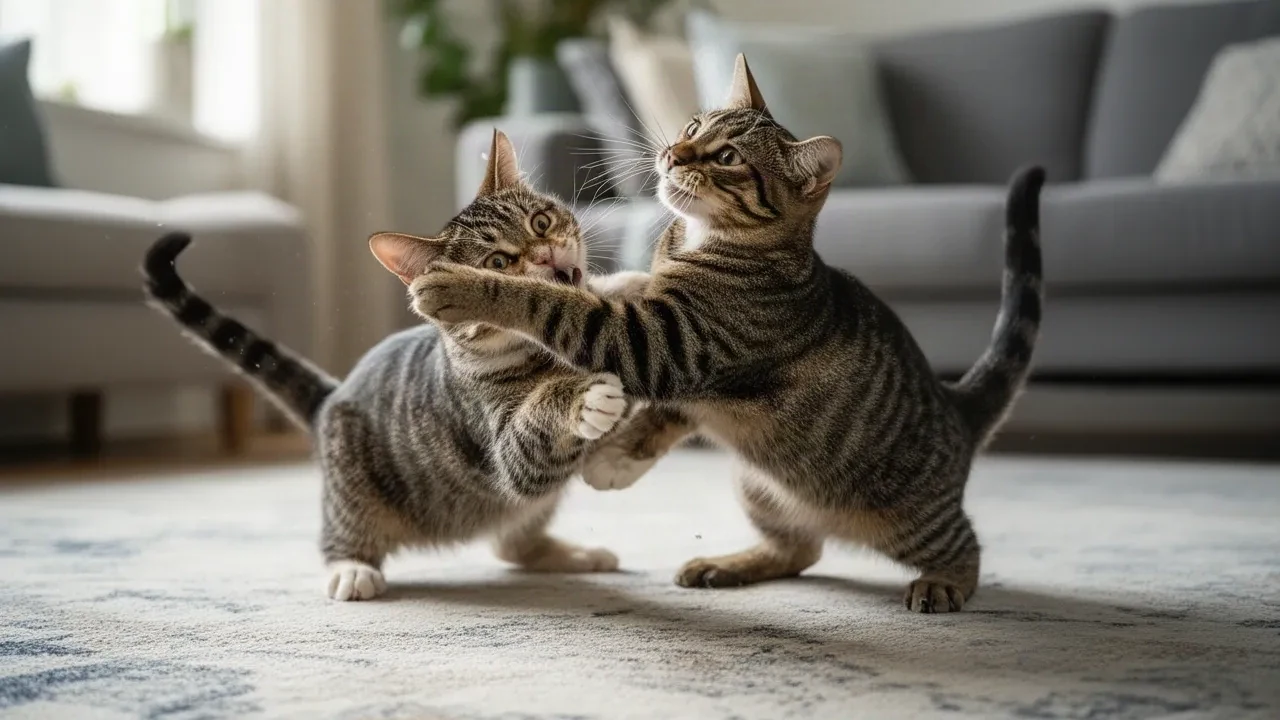
Feline play can look intense, especially when young cats tumble at high speeds or rabbit-kick each other with their hind paws. Use this 6-factor behavioral rubric to assess your cats’ interactions in real time:
| Behavioral Factor | True Mutual Social Play | Intermediate Tension (Watch Closely) | True Agonistic Fighting (Intervene) |
|---|---|---|---|
| 1. Claws & Bite Force | Claws fully sheathed; soft, inhibited play bites | Occasional brief claw snag; moderate mouth pressure | Unsheathed claws; deep skin-puncturing bites; flying fur |
| 2. Vocalization | Completely silent or gentle, quiet chirps | Intermittent warning hiss or annoyed growl | Loud shrieking, prolonged guttural yowling, spitting |
| 3. Role Reversal | Reciprocal tag-team; chaser and runner swap roles | One cat dominates chases, but victim still wanders freely | One-way relentless pursuit; cornering; trapped victim |
| 4. Ears & Body Posture | Ears forward or relaxed; loose, bouncy side-rolling | Ears swiveled outward; tense posture; twitching tail | Ears pinned flat back (“airplane”); puffed tail; rigid crouch |
| 5. Mutual Pauses | Frequent 3–5 second breath breaks; self-grooming | Brief hesitations before one cat resumes unwanted pouncing | Zero pauses; unblinking predatory stare; relentless attack |
| 6. Post-Bout Behavior | Shared grooming, eating side-by-side, or joint napping | Cats separate calmly; mild avoidance for 15–30 minutes | Victim hides in terror; aggressor patrols and blocks doorways |
Factor 1: Claws and Biting Force (Sheathed vs. Weaponized)
The physical mechanics of contact provide the most immediate distinction between social recreation and genuine aggression. During friendly wrestling, cats exhibit remarkable voluntary motor control known as bite and claw inhibition.
In true play, a cat’s front paws remain soft and rounded. While they may bat rapidly at each other’s faces or wrap their arms around a companion’s neck, the claws remain safely retracted inside their sheath pockets. Similarly, play bites are mouthing maneuvers that do not pierce the skin. You will see cats grab a companion’s throat or leg with open jaws, but they release pressure instantly without tearing tissue.
In a real fight, claws are fully extended weapons used to hook, pull, and puncture. Aggressive biting involves clamping down with full jaw force, accompanied by head shaking designed to inflict structural damage. If you see tufts of fur floating in the air, notice bloody scratches, or hear a cat shriek from physical pain, the interaction has crossed decisively into true aggression.
Factor 2: Vocalization (Silence vs. Hissing and Screaming)
Human owners often expect play to be noisy, but in feline social dynamics, silence is the hallmark of friendly wrestling. True play is almost eerily quiet. The only sounds you should hear are the physical thud of bodies hitting the carpet or an occasional friendly trill.
When a cat vocalizes during an interaction, the tone reveals their emotional arousal. A single brief hiss from one cat simply communicates a clear boundary, meaning “you played too hard, back off.” If the playmate respects that signal and steps back, the interaction remains healthy.
In contrast, true agonistic conflict is accompanied by loud, unmistakable auditory distress. Deep, vibrating guttural growls, drawn-out operatic yowls, and high-pitched defensive screams signal extreme sympathetic nervous arousal and fear. A screaming cat is in intense distress and requires immediate, safe human intervention.
Factor 3: Role Reversal (The Reciprocal Tag-Team Metric)
Reciprocal role reversal is the gold standard metric used by veterinary behaviorists to confirm mutual consent during animal play. In healthy social play, both cats take turns being the hunter and the prey.
Watch who is chasing whom across the living room. In a healthy dynamic, Cat A chases Cat B under the dining table; moments later, Cat B turns around, pounces on Cat A, and chases them back toward the hallway. During wrestling, the cat pinned on their back will effortlessly flip the position to become the top wrestler. This continuous exchange proves that both participants are enjoying the game voluntarily.
When an interaction lacks role reversal, one cat is always the pursuer while the other is always fleeing, hiding, or cornered against walls. If your resident cat continuously corners a new cat without ever relinquishing the offensive role, the dynamic has devolved into targeted harassment rather than play. If you are integrating a new feline companion, review our complete roadmap on how to introduce cats.
Factor 4: Ear Position and Body Posture
Feline body language communicates emotional intent clearly once you learn to read subtle anatomical adjustments. During friendly wrestling, cats maintain loose, curved spine postures and frequently roll onto their sides or backs, exposing their soft bellies in relaxed submission.
Ears tell the most critical story:
| Ear Position | Meaning |
|---|---|
| Upright and Forward | Playful, curious, or relaxed |
| Twitched to the Side | Mild annoyance or assessing distance |
| Pinned Flat Backward (“Airplane Ears”) | Extreme fear or ready to fight |
During mutual play, a cat’s ears remain upright, facing forward or swiveled slightly to track movement. In a real fight, fear and defensive instincts cause both cats to rotate and pin their ears tightly against their skulls to protect the delicate cartilage from claw lacerations.
Combined with arched backs, bristled tails (piloerection), and unblinking stares, flattened ears confirm that the cat is in a defensive survival state. For a deeper understanding of feline communicative signals, read our complete guide on cat body language poses.
Factor 5: Mutual Pauses and Breath Breaks
Healthy feline play contains organic rhythms characterized by frequent, natural pauses. During an energetic wrestling match, you will notice both cats suddenly freeze for three to five seconds, break eye contact, casually lick a paw, or look out the window before diving back into the game.
These micro-breaks serve an important psychological function: they allow adrenaline levels to stabilize, ensuring that physical arousal does not boil over into panic or aggression. When both cats voluntarily step back and reset their emotional tempo, they demonstrate mutual trust.
In true aggression, pauses do not exist. The aggressor maintains an intense, unbroken predatory lock on the target. If the victim attempts to step away, the aggressor immediately lunges, cuts off escape routes, and escalates physical pressure without offering any opportunity for de-escalation.
Factor 6: Post-Interaction Behavior (Napping vs. Patrolling)
What your cats do after the physical interaction concludes provides undeniable proof of their relationship status. Their post-encounter behavior reflects their resting neurochemistry.
After a vigorous session of mutual social play, both cats will typically walk calmly to their food bowls, engage in mutual allogrooming (licking each other’s ears and heads), or curl up together on the sofa for a shared nap. Their muscles are loose, their breathing is slow, and they display zero lingering apprehension.
After a true aggressive fight, the emotional atmosphere remains tense and volatile for hours or days. The victim cat will typically sprint to a high shelf, under a bed, or into a dark closet, remaining hyper-vigilant and trembling. Meanwhile, the aggressor will pace the territory, patrol doorways, or guard access to litter boxes and food stations. If persistent hostility continues, consult our deep dive on resolving cat aggression.
The 2023 Nature Study: Decoding the “Intermediate” Gray Zone
For decades, cat owners and trainers debated whether inter-cat conflict was a simple binary choice between play and fighting. In 2023, a team of veterinary researchers led by Dr. Noema Gajdoš-Kmecová at the University of Veterinary Medicine and Pharmacy in Košice, Slovakia, published a landmark peer-reviewed study in Scientific Reports (Nature) that transformed our understanding of feline interactions.
The researchers analyzed 565 video recordings of inter-cat physical interactions across 1,278 domestic cats, evaluating precise behavioral variables including vocalization, wrestling frequency, chasing duration, and resting postures. The study revealed that feline interactions fall into three distinct scientific categories:
- Playful Interactions (40% of cases): Characterized by high wrestling frequency, soft physical contact, complete vocal silence, and frequent role reversal.
- Agonistic / Aggressive Interactions (28% of cases): Characterized by vocal shrieks, hissing, intense chasing, prolonged non-contact staring, and lack of wrestling.
- The Intermediate Category (32% of cases): A complex behavioral state where play and social friction overlap. In this category, one cat often attempts to initiate playful wrestling, while the second cat exhibits mild irritation, vocalizing or swatting while still remaining in the room.
The study highlighted that the “Intermediate” category is especially common in households pairing cats with mismatched energy levels. A high-energy, athletic breed like a Bengal or Abyssinian will frequently overwhelm a laid-back, docile companion like a Ragdoll or Persian. Recognizing intermediate friction allows owners to step in early with environmental enrichment and structured wand play before minor annoyance escalates into full-blown territorial hostility.
How to Safely Interrupt an Escalating Fight
When play turns into real fighting, human instinct often urges owners to scream, clap loudly, or physically grab the aggressive cat. Grabbing a fighting cat with your bare hands is extremely dangerous and almost always results in severe human injury.
Cats in high fight-or-flight arousal experience redirected aggression instantly. A bite from a frightened cat easily introduces Pasteurella multocida and other oral bacteria deep into human tissue, creating rapid cellulitis, severe infection, and nerve damage requiring emergency medical care and intravenous antibiotics.
To interrupt a fight safely without risking injury or escalating household fear:
- The Sofa Cushion Drop: Grab a large sofa pillow, couch cushion, or wide sheet of cardboard. Slide or drop the cushion directly between the two cats to physically block their line of sight. Once they can no longer see each other, the emotional arousal loop breaks immediately.
- The Soft Blanket Toss: Gently toss a large, lightweight bath towel or fleece blanket over the aggressor. The sudden darkness disorients the attacking cat for several seconds, allowing the victim cat to escape safely into another room.
- Create a Distant Auditory Distraction: Drop a heavy book on the floor ten feet away, or shake a treat jar. Do not shout at the cats, as shouting adds emotional tension to the room.
- Enforce a Cooling-Off Quarantine: Guide the cats into separate rooms with closed doors and allow them to decompress in total quiet for several hours before permitting them to share space again.
When to See a Veterinarian or Behaviorist
While behavioral friction can often be managed through environmental adjustments, sudden aggression between previously bonded cats is frequently triggered by undiagnosed medical discomfort. When a cat experiences chronic pain—such as arthritis, spinal spondylosis, dental disease, or feline hyperesthesia—they become physically defensive. A playful nudge from a housemate can trigger severe pain, causing the hurting cat to lash out aggressively.
Schedule a veterinary evaluation if you observe any of the following signs:
- A previously bonded pair suddenly begins fighting with zero obvious environmental trigger
- One cat growls or hisses when touched on their hips, back, or joints
- Visible bite wounds, abscesses, limping, or missing patches of skin
- House-soiling or litter box avoidance following an altercation
If medical conditions are ruled out and violent fighting continues, work with a certified feline behaviorist (IAABC) to develop a customized re-introduction and environmental modification plan.
If you notice any of these signs, consult your veterinarian. This article is for informational purposes and does not replace professional veterinary advice.
Frequently Asked Questions
Why do my cats play nicely and then suddenly start fighting?
Cats often transition from play to fighting due to sensory overstimulation. During vigorous wrestling, a cat’s adrenaline and nervous arousal can exceed their tolerance threshold, causing play to flip into genuine defensive aggression in a split second. Providing frequent brief breaks with wand toys prevents overstimulation.
Is it normal for cats to rabbit-kick each other during play?
Yes, rabbit-kicking with the hind legs is a natural instinctual motor pattern derived from predatory hunting behavior. During play, cats use their hind paws to push their partner away gently with sheathed claws. As long as the claws remain retracted and the receiving cat does not shriek or flee in panic, rabbit-kicking is normal play.
Should I let my cats establish a dominance hierarchy through fighting?
No, domestic cats do not possess a rigid, linear pack hierarchy like wolves or dogs. Forcing cats to fight in the hopes of establishing dominance causes severe territorial trauma, fear, and chronic stress. Peaceful feline relationships are built on abundant resources and gradual positive associations, not physical submission.
What should I do if one cat constantly chases the other?
If chasing is purely one-way and the pursued cat hides or hisses, interrupt the dynamic immediately using a wand toy or visual barrier. Create vertical highways with cat trees and wall shelves to give the timid cat safe escape routes, and provide structured interactive exercise to drain the energetic cat’s excess stamina.
Written by Max
Max is a lifelong cat owner and runs CuteCatsHQ. Health and care guides are checked against the veterinary sources listed with each article.
Keep reading

Multi-Cat Household Harmony: Managing Cat Relationships
Manage a peaceful multi-cat home: social structure, resources, territory, and slow introductions. Learn to troubleshoot conflict and when to get help.
How to Introduce Cats: The Step-by-Step Guide
Learn how to introduce cats successfully: a proven 5-phase method using base camps, scent swapping, mealtime door feeding, and gradual visual integration.

Why Do Cats Knead? 4 Biological Reasons for Biscuits
Why do cats knead blankets, pillows, and laps? Discover the 4 biological reasons for making biscuits, the early weaning connection, and claw-safe advice.