
Cat Tail Language: Deciphering Swishes, Quivers & Puffs
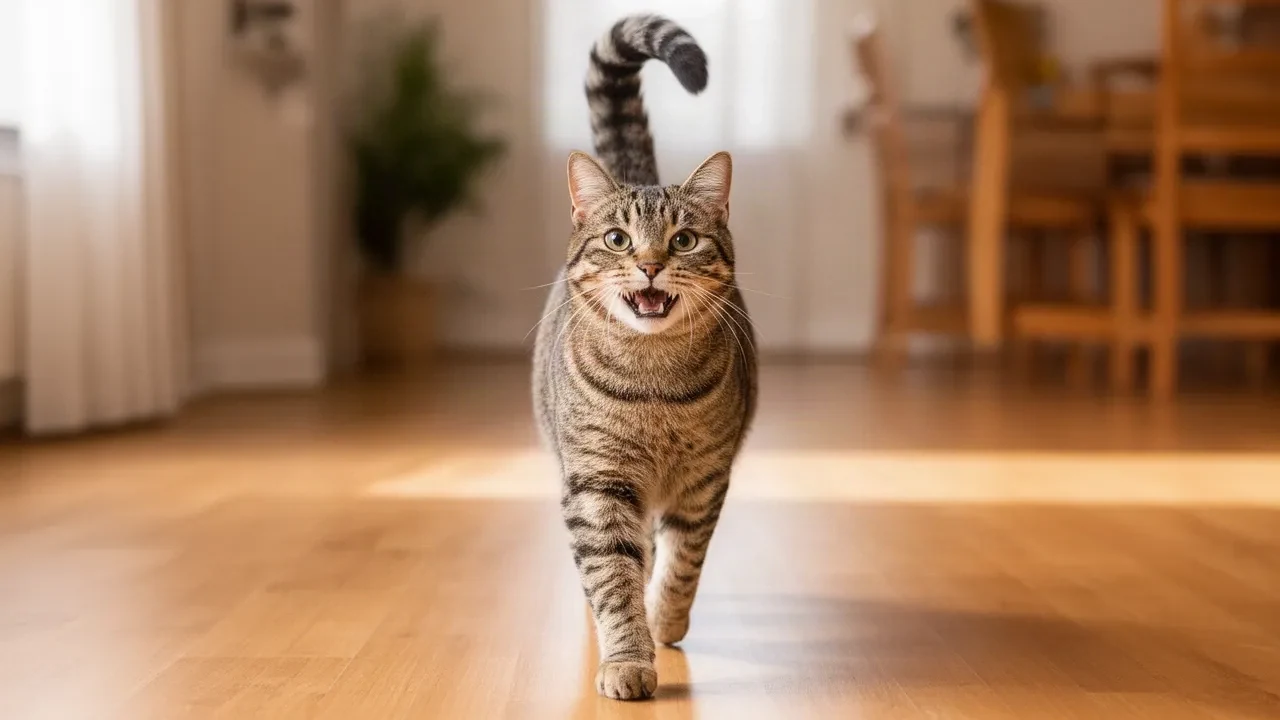
Cat tail language is one of the most expressive and reliable communication systems in the animal kingdom. Unlike dogs, who frequently wag their tails to signal open friendliness, a cat’s tail serves as an emotional barometer reflecting spinal nerve arousal, internal conflict, territorial confidence, and social affection. While an upright tail with a soft question-mark curve signals a happy greeting, a broad sweeping swish warns of rising agitation. Read our complete guide below to decode twelve distinct tail signals, or explore our companion guide on cat body language poses to read your cat from nose to tail tip.
Why Cats Move Their Tails: Anatomy & Communication
A cat’s tail is a direct structural extension of their vertebral column. It typically contains between 18 and 23 individual caudal vertebrae, enclosed by an intricate network of six paired muscle groups, tendons, and delicate spinal nerves.
This anatomical design gives the feline tail extraordinary mobility and fine motor control. Cats use their tails mechanically for dynamic counterbalance while sprinting across narrow fences, leaping onto high shelves, or twisting mid-air to land on their paws.
Beyond physical balance, the caudal appendage serves as an involuntary broadcasting system for the autonomic nervous system. When a cat experiences emotional shifts—whether intense curiosity, sudden startle fright, predatory focus, or warm social affection—neural impulses travel down the caudal nerves to adjust muscle tension in milliseconds. Because tail movement is closely tied to autonomic arousal, it often reveals a cat’s genuine emotional state before their vocal chords make a sound.
The 12 Essential Cat Tail Positions & What They Mean
Decoding your cat’s tail requires observing the height, speed, stiffness, and direction of movement. Below are twelve foundational tail postures and their underlying behavioral meanings.
1. High Upright with a Curved Tip (The “Question Mark”)
An erect tail carried vertically with a soft, gentle curve at the top resembling a question mark is the universal feline sign of confident, friendly engagement. Your cat is in an approachable, cheerful mood and welcomes gentle petting or playtime. In multi-cat households, cats use the upright question mark to signal peaceful social intentions when entering a shared room.
2. The Rapid Greeting Quiver
When a cat approaches you with their tail held straight up, vibrating with a rapid, high-frequency shudder from base to tip, they are expressing peak happiness and excitement. You will most commonly see this greeting quiver when you return home after work or when you open a can of favorite wet food in the kitchen.
3. The Bottlebrush Halloween Puff
When a cat experiences sudden terror, shock, or a severe territorial threat, the piloerection reflex instantly erects every hair along the tail and spine, making the tail resemble a bristly bottlebrush. By doubling the visual volume of their tail and arching their back, the cat attempts to look larger and more intimidating to potential predators.
4. The Slow Rhythmic Swish
A tail that sweeps smoothly and slowly from side to side like a steady pendulum indicates deep mental concentration or mounting emotional ambivalence. You will frequently see this deliberate swish when your cat sits by a window intently tracking a sparrow in the garden or deciding whether to jump across a wide gap between furniture.
5. The Low Horizontal Thump
When a cat lies on their side or perches with their tail beating forcefully against the floor, carpet, or sofa with an audible thump, they are experiencing acute irritation and rising anger. This is an explicit behavioral warning to cease whatever activity is taking place—such as unwanted grooming or prolonged petting—before defensive swatting occurs.
6. The Tucked Tail
A tail pulled tightly underneath the abdomen, clamped firmly between the hind legs, signals intense fear, submissiveness, or physical pain. By tucking the tail, the cat protects vulnerable anal scent glands and genitals while making their body profile as compact as possible to avoid drawing attention.
7. The Subtle Tip Twitch
When a cat appears otherwise resting or observing quietly, but the final two inches of their tail flick rhythmically, they are processing mild sensory stimulation or light impatience. It often signals that their mind is actively analyzing sounds, scents, or visual motion while their physical body remains at rest.
8. The Tail Wrap / Feline Hug
When your cat walks beside your ankles and gently curves their tail around your shin, or intertwines their tail with a bonded feline companion, they are engaging in affiliative social bonding. This tactile gesture deposits soothing facial and caudal pheromones, expressing deep affection and mutual trust.
9. The Low Droop with Raised Base
A tail that starts stiffly horizontal near the hips and then droops toward the floor reflects tentative caution or mild defensiveness. Cats adopt this stance when investigating an unfamiliar object in the hallway, such as a delivered cardboard box or a newly arrived guest’s luggage.
10. The Horizontal S-Curve
Carrying the tail parallel to the spine with a slight undulating serpentine curve indicates active predatory stalking. The low horizontal profile minimizes visual detection by prey while keeping muscles coiled for an explosive forward pounce.
11. The Fast Whip Lash
A tail snapping violently back and forth through the air with rigid, sharp reversals signals dangerous overstimulation and defensive fury. A cat exhibiting a whipping tail has completely exceeded their emotional tolerance and will likely strike or bite if approached.
12. The Neutral Rest
A tail hanging naturally relaxed behind a standing cat, or resting softly alongside a sleeping cat with zero muscular tension, signifies baseline physiological equilibrium and total domestic comfort.
Complete Cat Tail Movement Decoder
To interpret your cat’s mood accurately, pair their tail movement with facial expressions, ear angles, and pupil dilation using this reference matrix:
| Tail Movement & Position | Primary Emotional State | Accompanying Ear & Eye Signals | Best Human Response |
|---|---|---|---|
| Upright Question Mark | Confident, friendly, welcoming | Ears forward, soft relaxed pupils | Offer gentle head scratches and friendly verbal greeting |
| Rapid Vertical Quiver | Extreme joy, affectionate excitement | Ears alert, eyes wide and bright | Engage in enthusiastic petting and offer attention |
| Bottlebrush Fluff | Acute fright, defensive panic | Ears flat back, pupils dilated | Step back, eliminate the trigger, and give the cat quiet space |
| Low Rhythmic Thump | Frustration, mounting anger | Ears rotated outward, tight jaw | Immediately stop touching the cat and allow them to walk away |
| Tucked Under Abdomen | Terrified, submissive, painful | Ears flattened, body crouched low | Speak in soothing tones; investigate for environmental threats or pain |
| Subtle Tip Flick | Curious, mildly stimulated | Ears swiveling, eyes focused | Observe quietly; avoid sudden hands-on interruptions |
| Tail Wrap Around Legs | Affectionate bonding, mutual trust | Ears relaxed, slow blinking | Return affection with gentle strokes along the chin and cheeks |
| Fast Violent Whip Lash | Extreme overstimulation, rage | Airplane ears, narrow gaze, hissing | Back away immediately; do not attempt to touch or scoop up |
To understand how tactile tail signals fit into feline bonding, read our guide on how cats show affection.
Greeting Quiver vs. Urine Spraying Quiver
One of the most critical behavioral distinctions for cat owners is differentiating between a happy greeting quiver and a territorial urine spraying quiver. While both actions involve a vibrating, vertically held tail, the surrounding body posture and environmental context are entirely distinct.
When a cat performs an affectionate greeting quiver, their rear quarters remain relaxed, their hind feet stay planted comfortably on the floor, and their head is oriented toward you with a friendly chirp or headbutt. No liquid is expelled, and the behavior occurs in open living areas when welcoming human companions.
In contrast, a urine spraying quiver involves a stiff, raised hind end with the cat deliberately backing up against a vertical surface such as a wall, baseboard, door frame, or curtain. The cat will often perform a rhythmic treading motion with their back paws, twitch their tail base rapidly, and release a fine horizontal spray of pungent territorial scent. Recognizing this distinction prevents owners from mistaking a warm social greeting for a litter box transgression.
The Petting Overstimulation Countdown
Petting-induced aggression is one of the most common reasons owners receive sudden nips during quiet couch cuddles. Cats possess dense sensory nerve endings at the base of their hair follicles. Repetitive stroking across the spine and tail base can rapidly transition from pleasurable tactile stimulation to intense physical discomfort.
Fortunately, cats almost always broadcast an overstimulation countdown through progressive tail movements before resorting to teeth or claws:
First, your cat’s tail will transition from a relaxed, motionless rest to a subtle, intermittent twitch of the extreme tip. This is the yellow warning light indicating that sensory nerves are becoming saturated.
Next, the movement travels up the tail shaft into a deliberate, sweeping side-to-side swish. The swish will begin to tap or thump against the floor or your leg, accompanied by subtle outward rotation of the ears (“airplane ears”) and skin rippling along the spine.
Finally, if petting continues, the tail snaps into a rapid, rigid whip lash. Within two to three seconds of a whipping tail, the cat will deliver a defensive nip or swat to force your hand away. By learning to stop stroking the moment that first subtle tip twitch appears, you respect your cat’s physical boundaries and eliminate petting bites entirely.
If your cat struggles with impulse control or boundary sensitivity, review our practical management strategies in how to handle cat aggression.
How Tailless & Bobtail Cats Communicate
Natural bobtail and tailless breeds—such as the Japanese Bobtail, Manx, Cymric, and Pixie-Bob—possess shortened caudal vertebrae resulting from genetic mutations. Because these cats lack a full-length tail to signal mood, they have evolved compensatory body language cues.
Tailless cats rely heavily on ear rotation, facial micro-expressions, whisker angles, and full-body weight shifts to express their internal state. A Japanese Bobtail will rotate their ears outward and shift their center of gravity forward when alert, while using their expressive pom-pom tail nub to convey subtle quivers of excitement during greetings.
Owners of bobtail breeds should pay closer attention to pupil dilation, vocal chirps, and back-muscle tension to read emotional nuances accurately. You can also estimate your cat’s life stage milestones with our Cat Age Calculator.
When Tail Behavior Indicates Pain or Medical Distress
While most tail movements are behavioral, sudden alterations in tail carriage or mobility can signal serious medical conditions requiring veterinary intervention.
Cauda Equina Trauma & Tail-Pull Injuries
The nerves controlling a cat’s bladder, bowel, and hind-limb coordination pass directly through the base of the tail within the cauda equina nerve cluster. If a tail is accidentally caught in a closing door or pulled forcefully by a young child, the resulting nerve traction injury can cause permanent tail paralysis, fecal incontinence, and urinary retention. A limp, unresponsive tail that hangs lifelessly must be evaluated by a veterinarian immediately.
Feline Hyperesthesia Syndrome (Rolling Skin Disease)
Cats with feline hyperesthesia syndrome experience sudden episodes of extreme neuromuscular agitation. Symptoms include violent tail twitching, aggressive tail chasing, biting at the tail base, loud vocalization, and rippling skin along the lumbar spine. This neuropathic condition can be managed effectively with veterinary-prescribed medication.
Stud Tail & Flea Allergy Dermatitis
A waxy, greasy buildup of sebaceous gland secretions along the dorsal surface of the tail base (stud tail) can cause skin inflammation, hair loss, and painful scabs that make cats resent any touch near their rear end. Similarly, flea allergy dermatitis concentrates severe itching and crusting around the tail head. If your cat obsessively bites, chews, or over-grooms their tail, schedule a veterinary checkup to resolve the underlying dermatological issue.
If you notice any of these signs, consult your veterinarian. This article is for informational purposes and does not replace professional veterinary advice.
How to Respond to Your Cat’s Tail Signals
An upright, question-mark tail is an invitation, so greet your cat with a relaxed voice and offer a hand for a sniff or a gentle chin scratch. If the tail begins to swish or thump while you are petting, stop touching and give them room to walk away. A slow, rhythmic swish is a sign they are thinking; let them finish before you interrupt.
A tucked tail means your cat is frightened or hurting. Crouch to their level, soften your voice, and check for whatever startled them, whether that is a loud noise or an unfamiliar visitor. Do not scoop up a tucked-tail cat from behind, since that can deepen the fear.
When the tail puffs into a bottlebrush, back off and remove the trigger rather than approaching. Give the cat a clear escape route and quiet time to settle before you attempt any contact again.
Frequently Asked Questions
Why do cats wag their tails while purring?
Cats can purr and swish their tails simultaneously when they are experiencing conflicting emotions. While purring often signals contentment, cats also purr to self-soothe when stressed, overstimulated, or in pain. If your purring cat begins thumping their tail against the couch, they are requesting an end to physical contact.
What does it mean when a cat hits you with its tail?
When a cat walks past you and drapes or lightly taps their tail against your leg, they are performing a feline social marking gesture. It is an affectionate way of saying hello and affirming your shared household bond.
Why does my cat’s tail twitch when they are sleeping?
Subtle tail tip twitches during sleep occur during the Rapid Eye Movement (REM) dream stage of the feline sleep cycle. Just like twitching paws or fluttering whiskers, minor tail twitches reflect involuntary brain activity as your cat dreams.
Why does a cat’s tail puff up when playing?
Kittens and young cats frequently puff their tails during high-intensity play wrestling or zoomies. In a playful context with relaxed ears and a bouncy gait, the puffed tail reflects harmless predatory arousal and mock-fighting excitement rather than genuine fear.