
Japanese Bobtail Cat Breed Guide: Personality & Care
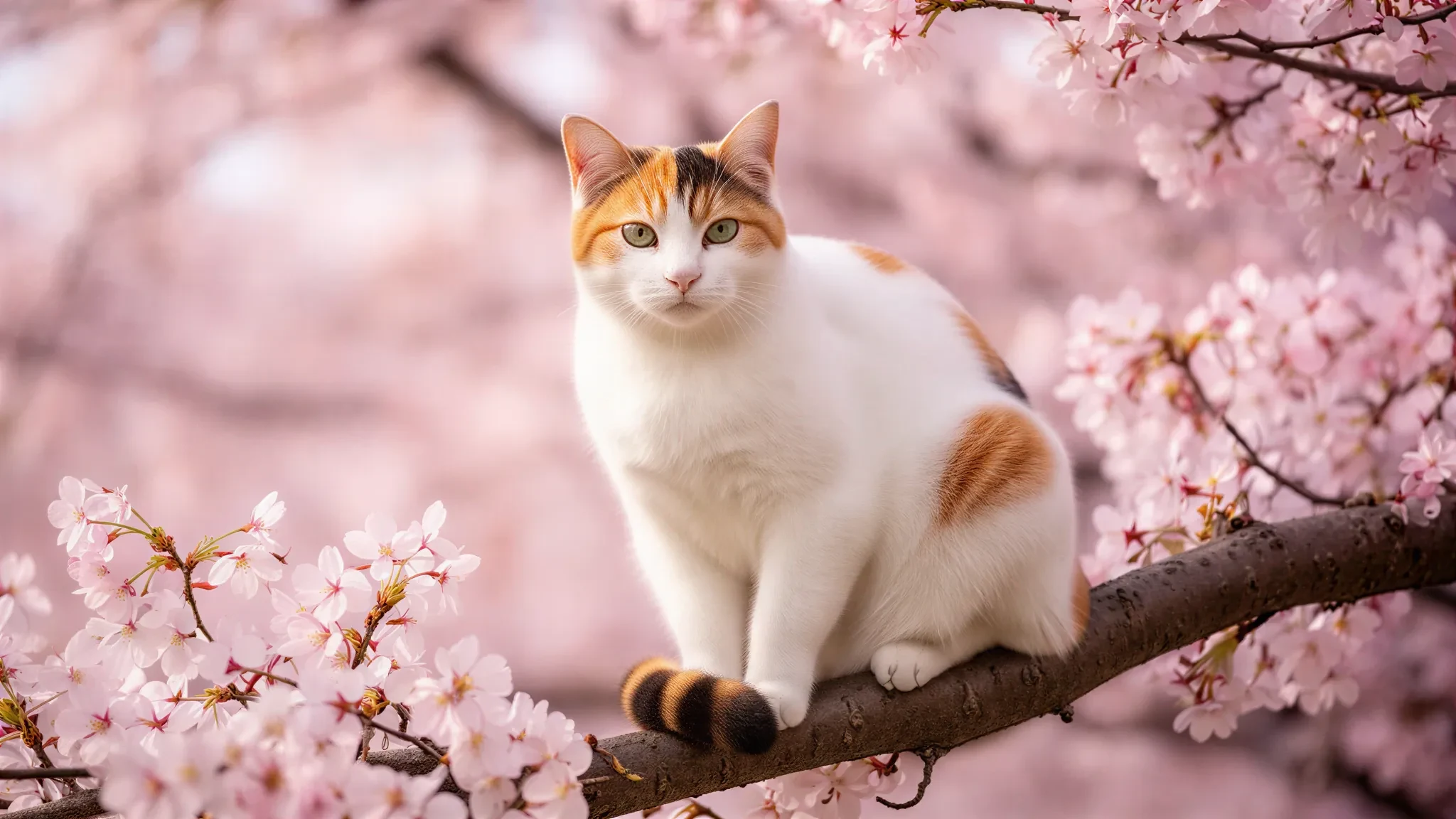
A Japanese Bobtail is a medium cat with clean lines, a triangular head, and a short tail that looks like a pom-pom and moves differently on every cat. The tail is a natural mutation, not something a breeder designed, and the breed behind it is an old Japanese street and farm cat that kept rodents out of silk and rice. Japanese Bobtails tend to be vocal, friendly, and intelligent, with a short coat, low care needs, and a 15–18 year lifespan. If you wanted a quiet, low-energy lap cat, this is the wrong page. If you want an interactive cat that plays hard, learns fast, and talks softly while it does it, read on.
The short tail is the feature people notice first, and it is also the one most often described incorrectly. A Japanese Bobtail is not a tailless cat like a Manx, and the tail is not a man-made cosmetic choice. It is a naturally occurring mutation the cat has carried for a very long time. You can compare breeds and filter for activity level in our breed explorer before you go further.
Quick Facts
| Attribute | Detail |
|---|---|
| Origin | Japan |
| Size | Medium (long, lean, and muscular rather than massive) |
| Coat | Short-to-medium, soft and silky, with no noticeable undercoat; a longhair division also exists |
| Personality | Vocal, friendly, intelligent |
| Lifespan | 15–18 years |
| Care level | Low |
| Health to ask about | Kneecap dislocation; no known abnormalities tied to the tail |
History & Origins
The Japanese Bobtail is not a product of a Victorian drawing room. It is an old working cat. CFA’s breed history describes a street and farm cat that earned its keep by killing the vermin threatening Japan’s silk industry and its grain stores, and CFA’s breed article says bobtailed cats appear across much of the Orient, which suggests the mutation is prehistoric. One theory places the cats in Japan from the sixth century, brought from Korea to protect manuscripts from mice. Another describes a 16th-century exodus after the silk trade collapsed, when the cats spread through the country and interbred with street cats until the bobtail became part of the look of many Japanese cats. The cats also found their way into the imperial court, and into Japanese art.
The mutation itself is not fully explained, but its inheritance is. CFA describes the gene that produces the distinctive tail as recessive, meaning both parents must carry it. That is why the breed cannot simply be recreated from two ordinary cats with short tails, and why CFA allows no outcross to any other breed. The tail length is also the one place the standard is strict: the tail bone cannot extend more than three inches from the body, and a tail bone that is absent, or a tail that lacks the pom-pom, disqualifies a cat from the show ring.
The American chapter is recent. In August 1968 Elizabeth Freret, an Abyssinian breeder and attorney, took delivery of three kittens from Judy Crawford in Yokohama, who had bred some three dozen to select the best possible foundation stock. Other breeders, including CFA judge Lynn Beck, imported cats through Tokyo. CFA accepted the breed for registration, granted provisional status in 1971, and gave the shorthair full championship status in 1976. The longhair division followed, reaching championship status in 1993. Because the gene pool is small and outcrossing is barred, CFA notes that United States breeders have always been able to import Japanese street cats to widen it, and that genetic testing is used to head off problems in planned matings.
Recognition is not universal. CFA recognizes the Japanese Bobtail, and so does TICA. The Governing Council of the Cat Fancy in the United Kingdom does not. GCCF lists the Japanese Bobtail on its unrecognised breeds page with Amber status, which it reserves for breeds based on a physical anomaly that may affect some members, and it says genetic and veterinary information would be required before recognition. That is a welfare caution, not evidence that the breed is unhealthy, and CFA’s own position is that the tail causes no known problems. Both statements are true at the same time, and a buyer should know which registry they are dealing with.
Personality & Temperament
CFA calls the Japanese Bobtail an inquisitive, intelligent problem-solver. The breed is playful and agile enough that CFA notes its members excel at feline agility, a sport built on a cat choosing to run a course rather than being handled through it. It is a cat that wants a puzzle, a chase, and a finish line, and it has a high activity level with a short attention span. You get a busy, funny cat, and you also get one that needs somewhere to put the energy.
The voice is softer than the personality might suggest. CFA describes a cat with a soft voice that produces a variety of sounds and provides “conversation without being noisy,” which is a useful distinction from the loud, demanding Siamese type. The breed is vocal, but the volume is conversational rather than operatic. Many Japanese Bobtails keep up a running commentary on whatever you are doing.
This is a social cat that wants its people. CFA says the breed gets along well with dogs and children of all ages, which is unusual, and that other cats sometimes need extra time to accept a new housemate that appears to be missing a tail. It requires a fair amount of attention and interaction and will ask for it if you do not provide enough, which is a polite way of saying it will make its own entertainment otherwise. If you are out of the house for long stretches, either add vertical space and a second cat or expect the cat to be busy when you get home.
None of this is a guarantee about an individual cat. Breed tendencies are trends, not a script, and a quiet or reserved Japanese Bobtail exists. The traits are strong enough to plan around, but the individual cat is the authority on itself.
Physical Characteristics
The CFA standard asks for a medium cat with clean lines and bone structure, well-muscled but straight and slender rather than massive. That last phrase is deliberate: this is not a cobby cat, and a short, round head or a heavy build is penalized. The torso is long, lean, and elegant rather than tubular. The hind legs are noticeably longer than the front, but they are deeply angulated so that the torso stays nearly level rather than rising at the rear, and that conformation produces the breed’s distinctive, springy gait.
The head is almost a perfect equilateral triangle, not counting the ears, with gentle curves, high cheekbones, and a noticeable whisker break. The nose is long and defined by two parallel lines from tip to brow. The ears are large and upright, set wide but at right angles rather than flaring, and tilted slightly forward at rest. The eyes are large and oval, set with a pronounced slant in profile, and the standard allows blue eyes and odd eyes.
The coat comes in two divisions. The shorthair coat is medium in length, soft and silky, with no noticeable undercoat. The longhair coat is medium-long to long, also soft and silky with no noticeable undercoat in the adult, with a frontal ruff and fuller britches and tail. Both divisions are recognized by CFA, and the local profile lists the breed as short-coated, which is the common show picture. Neither coat needs the work a double coat demands.
Colors are open. CFA states plainly that no color or pattern is preferred over any other, and that solids, bi-colors, tabbies, smokes, and parti-colors all compete equally. The famous one is the tri-color called mi-ke, pronounced mee-kay and literally “three-fur”: black, red, and white. In Japan the tri-color cat is traditionally linked with good fortune, and the beckoning maneki-neko figure is often a Japanese Bobtail. The point is worth stating: a solid black or a tabby Bobtail is not a lesser cat, and a breeder selling “the lucky color” as a premium is selling folklore.
The tail is the breed signature and the one part that is unique in every cat. CFA describes it as composed of one or more curves, angles, or kinks, or any combination, carried in any direction, flexible or rigid, and harmonizing with the rest of the cat. The furthest extension of the bone from the body must be three inches or less, and the hair must fan out to create a pom-pom that hides the bone. CFA’s disqualifications make the boundaries clear: a tail bone that is absent, a bone extending more than three inches, a tail without the pom-pom, or a delayed bobtail effect where an inch or two of normal tail precedes the pom-pom. The standard is also explicit that no single tail type is preferred, because the tail is unique to each cat. What it is not is a Manx-style absence of tail, and the two should never be confused.
Care Requirements
Grooming
The short coat is close to self-maintaining. CFA describes it as medium in length, flat-lying, smooth, and silky, and its history notes that the shorthair coat requires minimal grooming. A weekly pass with a fine brush or a rubber grooming glove collects loose hair and keeps the coat smooth, and the rest is routine: nails, ears, and teeth. The longhair division is more work, closer to any other semi-longhaired cat, with a comb through the ruff and britches. Neither coat has a dense undercoat, so neither behaves like a Persian.
The tail needs a specific habit rather than a specific tool. CFA notes that parts of the tail are usually fused and that it is sensitive, so it should be handled gently. That means no grabbing, no tugging, and no letting a child use it as a handle. The fused vertebrae are normal for the breed, but they are not designed to take load. Clip the nails on schedule, because a cat that will not tolerate a firm tail grip is a cat that can still scratch if a trim goes wrong.
Everything else is ordinary cat maintenance. Check the ears, brush the teeth, and keep the litter box clean.
Feeding
A Japanese Bobtail is a medium, active cat, so the goal is a lean body that can still move. There is no breed-specific diet; portions should follow body condition, weight, age, and activity. Measure rather than free-feed a food-motivated cat, and use How Much Should I Feed My Cat? for the math. A cat built for agility pays a real price for extra weight, because every extra ounce is load on joints and on the hind legs that do so much of the climbing.
Wet food helps with water intake, and any cat that spends its day in motion still needs to drink. Split the daily ration across a couple of meals, and consider a puzzle feeder for part of it, because this is a cat that benefits from working for food. Kittens need a growth plan from a veterinarian, not a number from a webpage.
Exercise & Enrichment
High activity plus short attention span is the exercise brief. CFA points to feline agility as a natural outlet, and you can build a version of that at home: a clear run, a jump, a tunnel, and a wand they can ambush. Short sessions that end well beat one long session, because a cat with a short attention span disengages before you notice. Rotate the toys so the challenge stays novel.
Height matters for this breed. A long, athletic, curious cat will use a tall tree, shelves, or a cat wall, and a home with none of those gets the top of the refrigerator instead. Indoor Cat Enrichment has the longer setup for a cat that needs a job. The goal is not to tire the cat out once; it is to give it enough to do that it stops inventing its own games.
This is a poor fit for a household that wants a cat to sit on a windowsill and watch the world. If you are away for most of the day and cannot add a second cat or daily play, a calmer breed is the better choice.
Health Concerns
CFA’s breed page is unusually direct on this point: there are no known abnormalities associated with the breed’s distinctive tail, and the Japanese Bobtail is a sturdy, natural breed with no specific health concerns. That is the first thing to say, because the short tail invites fear about spinal or bowel problems, and CFA does not support that fear. The concern that GCCF raises about physical anomalies is a precaution about the tail mutation in general, not a diagnosis for the breed. A cat with a bobbed tail should be able to urinate, defecate, and move normally, and anything that changes is a veterinary problem.
Luxating patella
Kneecap dislocation, or luxating patella, is the condition most often raised as a question for this breed. It is not unique to the Japanese Bobtail, and Cornell’s Feline Health Center does not single the breed out on its page. What Cornell does explain is useful: the kneecap is supposed to slide in a groove at the lower end of the thigh bone, and in a luxating patella it slips to the inside or outside of the leg. The typical signs are lameness, a skipping hop on the affected leg, and an unwillingness to jump. The condition is graded one to four, diagnosed by physical exam and confirmed by x-ray, and a veterinarian decides whether it needs surgery. A cat that starts skipping on a back leg, or stops jumping onto the shelf it used a week ago, should be checked rather than waited out.
The tail is not a disease
The bobbed tail itself is not a health condition, but it is a body part that deserves respect. CFA says the fused bones make the tail sensitive, and that is the whole hygiene note: handle it gently, teach children not to pull it, and do not allow a cat to be lifted by the tail. A short tail is normal for the breed. A change in the tail, such as new swelling, a reluctance to let it be touched, or a change in litter box behavior, is a reason to call a veterinarian.
A Japanese Bobtail that stops urinating or defecating normally, struggles to walk or jump, or suddenly refuses to move needs a veterinary visit. This page is for information only and does not replace professional veterinary advice; consult your veterinarian about your cat.
Is a Japanese Bobtail Right for You?
The Japanese Bobtail fits an owner who wants an interactive, playful, busy cat and will make time for games. It suits a household with children or dogs, because CFA says the breed gets along with both, and it works in an apartment as long as the cat gets height and daily play. It is also a good fit for someone who likes a talking cat but not a loud one, since the voice is soft and running rather than demanding. The low grooming load is a genuine advantage.
Who should choose a different cat? You should, if you wanted a quiet lap cat that sleeps most of the day; a Ragdoll or a British Shorthair is closer to that brief. You should, if the house is empty for long hours and there is no plan for enrichment or a companion cat, because this breed asks for interaction and will make its own if you do not provide it. You should, if you want a cat in the United Kingdom that can be shown through the GCCF, because the breed is not recognized there. You should, if you want a cat you can casually pick up by the tail or let small children haul around; the fused tail is sensitive. And you should, if a breeder cannot answer basic questions about the cats’ health and temperament and you were going to shrug it off.
If the short tail is what drew you in, the Manx is the truly tailless breed and a different animal entirely, and What Breed Is My Cat? is the place to start if you are looking at a rescue with a short tail and no papers.
Finding a Japanese Bobtail
The Japanese Bobtail is not a common breed, and CFA’s no-outcross rule means its gene pool is maintained partly by imports of Japanese street cats. A responsible breeder can speak to that history and to how they choose matings, and will have health records rather than assurances. Ask to meet the adults, because the type, the gait, and the voice are what you are buying, and a kitten shows you none of them clearly.
Rescue exists, and so do Bobtail mixes. A short-tailed shelter cat is not automatically a Japanese Bobtail, because short tails occur in other breeds and in random-bred cats. Without papers or a DNA test, a bobbed tail is a coincidence, not a pedigree. If the tail is your reason for choosing the cat, be honest with yourself about whether it is the tail or the breed you want.
Two red flags are breed-specific. A seller who claims the short tail guarantees good luck, or who prices a mi-ke as a premium color, is selling folklore rather than the cat. A seller who cannot explain the inheritance of the tail, or who tells you the breed is recognized everywhere, is guessing. Adopting vs. Buying from a Breeder covers the general decision; this page is the Bobtail filter on top of it.
Popular Japanese Bobtail Names
Short, clear names suit a cat that will hear them across a room and answer. A few that fit the breed’s Japanese origin or its busy, friendly streak, with meanings from the same name data as the generator:
Sakura — cherry blossom; the name most people picture for a Japanese cat
Yuki — snow; clean and bright on any coat
Hiro — generous; a warm boy name for a friendly cat
Lucky — fortunate; an honest nod to the mi-ke good-fortune tradition
Kenji — second son; steady and traditional
Kai — sea; one clean beat that carries
Sora — sky; calm against a bold coat
Hana — flower; two soft syllables
Akira — bright or clear; confident without being hard to say
Taro — great son; a classic that stays simple
Explore more in Japanese Bobtail cat names, browse Japanese cat names for the wider vocabulary, and see the look in the Japanese Bobtail gallery.
Frequently Asked Questions
Is the Japanese Bobtail the same as a Manx?
No. The Manx is tailless, while the Japanese Bobtail has a short, visible pom-pom tail built from one or more curves or kinks. The Cat Fanciers’ Association treats them as separate breeds and even notes that early breeders worked to distinguish the two. The bobtail gene is a natural mutation, and the breed has no allowable outcross in CFA.
Why does a Japanese Bobtail have a short tail?
It is a natural mutation, not a man-made trait. The gene is recessive, so both parents must carry it, and the Cat Fanciers’ Association describes the mutation as ancient and appearing across the Orient. The tail must stay under three inches and look like a pom-pom; a cat with a tail bone longer than that does not meet the standard.
What is a mi-ke Japanese Bobtail?
Mi-ke, pronounced mee-kay, means three-fur: a tricolor of black, red, and white. In Japan the tri-color cat carries a long good-fortune association, and the beckoning maneki-neko figure is often shown as a Japanese Bobtail. The cat’s coat does not change its personality, and every other color competes equally in the show ring.
Do Japanese Bobtails have health problems?
The Cat Fanciers’ Association calls the breed sturdy and natural with no specific health concerns, and says there are no known abnormalities tied to its distinctive tail. Kneecap dislocation, or luxating patella, is sometimes raised as a question to ask a breeder; it is a general cat joint issue that a veterinarian can check. The tail is sensitive and should be handled gently.
Are Japanese Bobtails good with children and dogs?
Usually. The Cat Fanciers’ Association says they get along well with dogs and children of all ages, though other cats may need time to adjust to a housemate with no tail. They need a fair amount of attention and play. Very young children should be taught to leave the tail alone, because the fused bones make it easy to injure.