
Why Do Cats Show Their Belly? Trust Greeting vs Belly Trap
Updated
On this page (8 sections)
- The Classic Human-Cat Misunderstanding
- The Evolutionary Biology & Vulnerability of the Feline Abdomen
- Trust Greeting vs. The 4-Claw Defensive Bunker
- The Feline Petting Zone Heatmap
- The 3-Second Rule & Safe Belly Etiquette
- Breed Variations in Belly Tolerance
- When to See a Vet
- Frequently Asked Questions
When a cat rolls onto their back to show their belly, they are offering an ultimate display of social trust and relaxed contentment—not an invitation for a belly rub. Because a cat’s soft abdomen holds vulnerable internal organs without a protective ribcage, touching it triggers an involuntary defensive survival reflex, causing them to clamp down with front paws and bunny-kick with back claws. Read our complete guide below, or explore our companion article on cat body language poses to decode your cat from nose to tail.
The Classic Human-Cat Misunderstanding
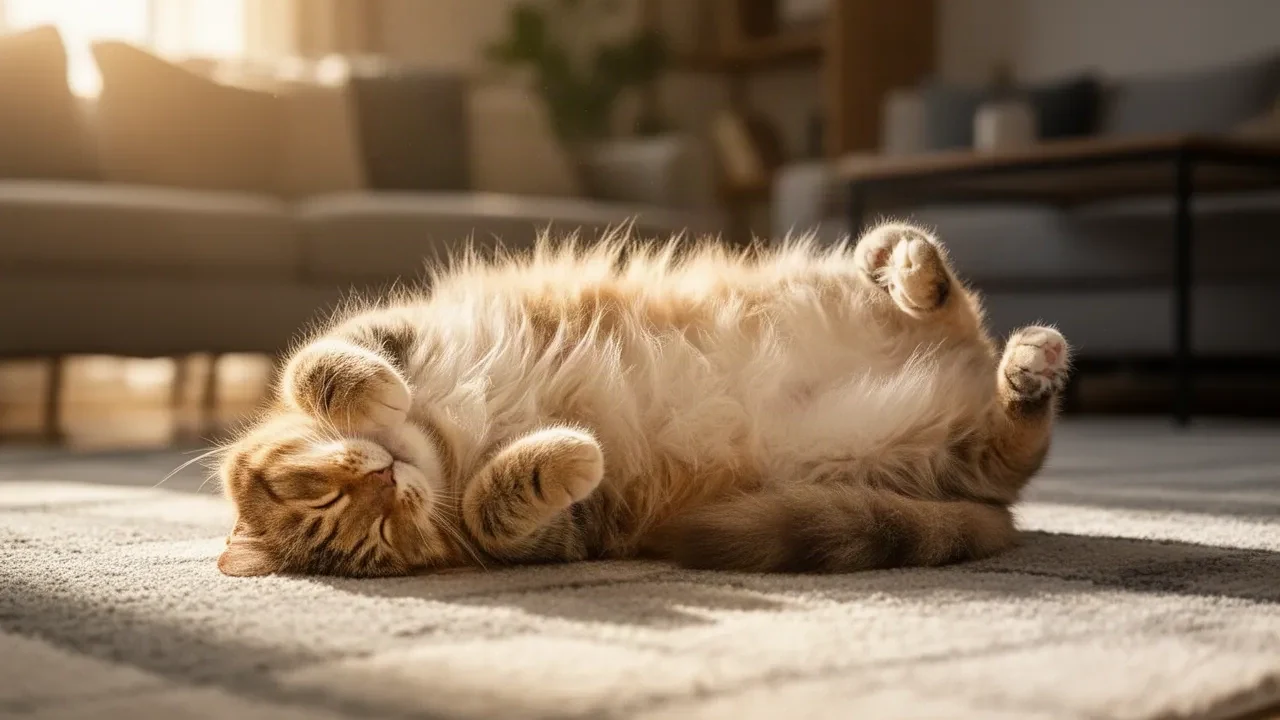
The scenario is universal in cat ownership: your cat saunters into the living room, chirps cheerfully, flops onto the rug, and stretches out luxuriously on their spine. With their fluffy stomach fully exposed, their paws softly curled, and their eyes squinting peacefully, the pose looks like an irresistible invitation for a tummy scratch.
You reach down to rub that soft, cloud-like belly fur. For one brief second, all seems calm. Then, in the blink of an eye, the trap springs: your cat’s front paws wrap tightly around your wrist, their teeth sink into your knuckles, and their hind legs begin rapidly bunny-kicking your forearm with unsheathed claws.
Confused and nursing minor scratches, many owners conclude that their cat is fickle, deceitful, or aggressive. In reality, this painful clash stems from a fundamental misunderstanding of feline evolutionary biology and canine versus feline social signals.
In my thirty years living with and observing cats, I have learned that the exposed belly is a visual compliment to be admired with your eyes—rarely a green light for human hands.
The Evolutionary Biology & Vulnerability of the Feline Abdomen
To understand why touching a cat’s belly triggers an explosive physical response, you must look at feline anatomy and predatory survival mechanics.
1. Lack of Skeletal Protection
In mammalian anatomy, the thoracic cavity (housing the heart and lungs) is shielded by a rigid cage of ribs and the sternum. The abdominal cavity, however, enjoys no such bony armor.
Beneath that soft layer of belly fur lies a cat’s most important and fragile internal organs: the stomach, intestines, liver, spleen, and kidneys. In the wild, a single deep puncture wound or claw laceration to the unprotected abdomen is universally fatal, resulting in rapid internal hemorrhage or peritonitis. Felines have evolved an acute, hardwired survival instinct to defend their soft underbelly at all costs.
2. The Primordial Pouch
Many adult cats have a loose, saggy flap of skin and fat hanging along their lower belly between their rear legs, known anatomically as the primordial pouch. While often mistaken for excess weight, the primordial pouch serves three important evolutionary functions: it stores fat reserves for scarce hunting periods, provides loose flexibility for full sprinting extension, and acts as an extra layer of shock-absorbing padding to protect abdominal organs during territorial fights.
3. Tactile Nerve Overstimulation
Even when a cat trusts you completely, their belly fur is biologically hypersensitive. The hair follicles across the feline abdomen are surrounded by a dense web of sensory nerve endings designed to detect tactile vibrations and approaching predators.
While stroking a cat’s chin or cheeks stimulates pleasant pheromone release, stroking the sensitive belly follicles quickly overloads the nervous system. Within two to three strokes, the tactile sensation transitions from gentle affection to intense static-like discomfort, triggering an involuntary reflex to remove the offending object.
Trust Greeting vs. The 4-Claw Defensive Bunker
Not every cat lying on their back is happy. In feline ethology, an exposed belly can represent two diametrically opposed emotional states: a blissful Trust Greeting or a weaponized Defensive Combat Bunker.
Distinguishing between these two postures is essential for household safety:
| Visual Feature | The Trust Greeting (Affectionate) | The 4-Claw Bunker (Defensive Combat) |
|---|---|---|
| Facial Expression | Soft eyes, slow blinking, relaxed brow | Dilated round pupils, tense jaw, staring hard |
| Ear Position | Ears forward, neutral, and relaxed | Ears pinned tightly flat against the skull |
| Spine & Muscles | Body stretched long, loose, and fluid | Spine coiled tight, tense, and spring-loaded |
| Claws & Paws | Claws sheathed, paws soft and limp | Claws unsheathed, all 4 paws primed to strike |
| Vocalizations | Quiet purrs, soft chirps, or silence | Low guttural growls, sharp hisses, or spitting |
| Tail Posture | Tail still or giving a lazy, soft tip flick | Tail lashing violently or tucked against flank |
| What It Means | “I feel secure enough to let my guard down.” | “I am cornered. Touch me and I will defend myself.” |
When an outdoor cat or a frightened feline is cornered by a larger predator, rolling onto the back is not an act of submission (as it often is in dogs). It is a formidable combat stance. By lying on their spine, a cat frees all four weaponized limbs and a full set of teeth to fight simultaneously.
To learn how whole-body tension reveals your cat’s mood, read our guide on how cats show affection.
The Feline Petting Zone Heatmap
To keep petting sessions enjoyable and avoid sudden bites, follow the established feline tactile preference map:
🟢 Green Zones (High Pleasure & Bonding)
These are the sweet spots where cats naturally prefer to be touched. Concentrated around the facial scent glands, gentle stroking here triggers the release of calming pheromones and deep relaxation. The base of the lower jaw and under the chin, the corners of the mouth and cheekbones, and the sparse-furred area between the eyes and ears are where most cats lean into your hand.
🟡 Yellow Zones (Moderate & Conditional)
These areas are generally tolerated by most cats but call for a little attentiveness so you don’t overload the nervous system. Gentle, long strokes down the crown of the head and the back of the neck work for nearly every cat, while light stroking along the spine from shoulders to mid-back is fine as long as you watch for skin twitching. Side flanks are acceptable in short, gentle passes.
🔴 Red Zones (Do Not Touch / High Risk)
These areas carry high sensory sensitivity and trigger defensive or overstimulation reflexes in most cats. The soft underbelly violates a cat’s core anatomical boundaries and overstimulates the hair follicles. The paw pads are packed with sensory receptors a cat relies on to feel the ground and their surroundings, so holding or squeezing paws triggers reflexive pulling away. The base of the tail is a cluster of highly sensitive nerves, and heavy patting there frequently causes sudden agitation.
The 3-Second Rule & Safe Belly Etiquette
When your cat rolls over and presents their soft stomach, you do not have to ignore them—you simply need to speak their behavioral language.
Follow this simple protocol to acknowledge their trust without triggering the bunny-kick trap:
First, acknowledge the visual compliment. When your cat exposes their belly, make gentle eye contact and offer a slow, relaxed double-blink. In feline communication, slow blinking conveys safety and love without physical invasion.
Second, redirect your touch to a Green Zone. Rather than reaching for their stomach, reach toward their chin, cheek, or forehead. Stroke the top of their head gently while verbally praising them in a soft tone. Your cat will get the affection they crave while their vulnerable belly remains untouched and safe.
Third, if your hand gets caught in a belly clamp, do not pull away rapidly. Pulling away instinctively mimics fleeing prey, causing the cat’s canines to bite deeper and claws to dig in harder. Instead, freeze completely and let your hand go limp. Without motion to fight against, the predatory reflex quickly de-escalates, allowing you to gently unhook your hand or distract them with a soft toy.
Breed Variations in Belly Tolerance
While the vast majority of cats strictly enforce a “no belly rub” rule, individual personalities and certain placid breeds can occasionally develop a genuine fondness for gentle tummy strokes.
Large, docile breeds with famously mellow temperaments—such as the Ragdoll and Ragamuffin—are more likely to relax in their owners’ arms and occasionally tolerate soft, slow belly strokes when completely relaxed. Even then, it depends on the individual cat, and a belly presentation is often an invitation to play rather than pet.
However, even with the most placid Ragdoll, belly petting should always be tested cautiously and kept brief. You can learn more about how genetics and age influence feline behavior with our Cat Age Calculator.
When to See a Vet
A relaxed cat sprawled on their back with loose, soft muscles is very different from a cat guarding a painful abdomen, and learning to read the difference matters. A cat in pain will often lie on their side or back but keep their abdomen tensed, resist any touch near the belly, and may breathe faster than normal. Guarding behaviors like flinching, hissing, or biting when your hand comes near the stomach—combined with a reduced appetite, hiding, vomiting, or changes in litter box habits—point to an internal problem rather than a personality quirk. Conditions that cause abdominal pain in cats range from constipation and urinary blockages to more serious organ disease, so a sudden change in how your cat reacts to belly touch deserves a professional look.
If you notice any of these signs, consult your veterinarian. This article is for informational purposes and does not replace professional veterinary advice.
Frequently Asked Questions
Why does my cat roll on their back when I walk through the front door?
When you return home, your cat rolls onto their back as a joyful greeting ritual. It combines an expression of absolute safety in your presence with a desire to deposit scent on the floor and solicit gentle chin scratches from you.
Why do cats bunny kick kicker toys when playing?
Bunny kicking with the hind legs is a hardwired predatory motor pattern. In the wild, after capturing prey with the front paws and teeth, felines use the powerful muscles and claws of their hind legs to disembowel or immobilize prey quickly. Providing stuffed kicker toys allows cats to exercise this instinct safely without targeting human arms.
Can a cat ever learn to enjoy belly rubs?
Some individual cats, especially those raised with gentle handling from early kittenhood, do learn to enjoy soft, brief belly rubs from their primary bonded human. However, tolerance can change rapidly based on mood, so owners should always watch for subtle warning signs like a twitching tail tip or flattened ears.
Why do cats roll on their backs on rough dirt or concrete?
Rolling on textured outdoor surfaces like concrete or dusty dirt helps cats slough off loose shedding fur, scratch hard-to-reach itchy spots along the spine, and absorb warm solar heat stored in the ground.
Written by Max
Max is a lifelong cat owner and runs CuteCatsHQ. Health and care guides are checked against the veterinary sources listed with each article.
Keep reading
Cat Head Bunting: Why Cats Headbutt & Rub Their Cheeks
Why do cats headbutt you and rub their cheeks on furniture? Learn the science of head bunting, facial scent glands, colony scents, and important medical cues.

Why Do Cats Knead? 4 Biological Reasons for Biscuits
Why do cats knead blankets, pillows, and laps? Discover the 4 biological reasons for making biscuits, the early weaning connection, and claw-safe advice.
Cat Ear Positions: What Forward, Swiveled & Flat Ears Mean
Decode cat ear positions: learn what forward alert ears, independent 180-degree swivels, airplane ears, and flattened defensive ears reveal about your cat.