
Cat Ear Positions: What Forward, Swiveled & Flat Ears Mean
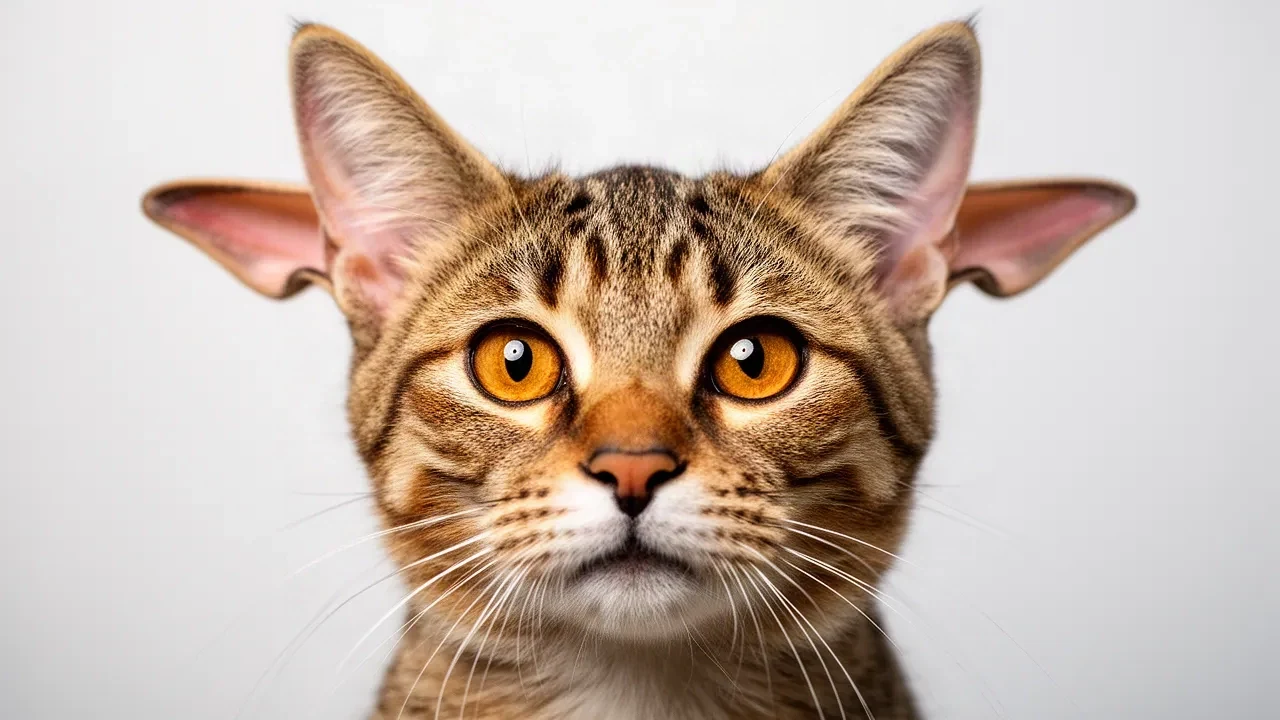
Cat ear positions are the most rapid and accurate emotional indicators in feline communication. Controlled by thirty-two individual muscles capable of 180-degree independent rotation, a cat’s ears reveal subtle shifts between curiosity, relaxation, sensory overstimulation, and defensive aggression in fractions of a second. While forward upright ears signal cheerful engagement, sideways airplane ears warn of irritation, and flattened ears signal fear. Read our complete visual decoder below, or pair it with our guide on cat tail language for a full body reading.
The Anatomy Behind Feline Ear Expressions
To appreciate why a cat’s ears move with such precision, consider the remarkable muscular anatomy powering each pinna (the external ear flap). While humans have three vestigial auricular muscles that provide negligible movement, domestic cats possess thirty-two distinct muscles in each ear.
This intricate muscular network allows each pinna to rotate 180 degrees independently of the other. A cat can track a rustling mouse in the grass with their left ear pointed forward while swiveling their right ear backward to monitor footsteps in the hallway.
Cats hear an astounding acoustic range spanning from 48 Hz up to 85 kHz, far exceeding the human ceiling of 20 kHz and outperforming dogs in the ultrasonic spectrum. In the wild, small rodents communicate using ultrasonic chirps between 40 kHz and 70 kHz. Feline ears evolved as precision satellite dishes engineered to locate these high-frequency distress squeaks within three inches of accuracy at a distance of thirty feet.
Anatomy Box: What Is Henry’s Pocket?
If you inspect the outer lower edge of your cat’s ear flap, you will notice a distinct slit forming a small open pouch. Known anatomically as the cutaneous marginal pouch, or colloquially as “Henry’s pocket,” this fold of cartilage and skin serves a specialized acoustic purpose.
Behavioral acousticians believe Henry’s pocket acts as a sound attenuator. By dampening lower ambient background rumbles, the pouch helps isolate and amplify high-pitched ultrasonic frequencies, giving predators the pinpoint directional hearing needed to ambush prey in dense brush.
The 6 Core Cat Ear Positions Decoded
Researchers using the Facial Action Coding System for Cats (CatFACS) have cataloged how subtle muscular adjustments of the pinnae reflect internal autonomic arousal. Below are the six fundamental ear postures every cat owner should recognize.
1. Neutral Alert (Forward & Upright)
When a cat’s ears point naturally forward, angled slightly outward with zero visible muscular tension at the base, the cat is in a state of calm confidence, baseline contentment, or pleasant curiosity.
You will see this relaxed posture when your cat lounges on a sunny rug, watches you prepare food, or approaches for a gentle head scratch. In social groups, forward-facing ears signal peaceful, non-threatening intentions.
2. The Radar Scan (Independent Swiveling)
When one ear faces forward while the other twists sideways or backward, or when both ears alternate directions like scanning radar dishes, your cat is processing complex multi-directional auditory input.
The cat is not alarmed, but their brain is actively mapping the sounds around them. You will often see this asynchronous scanning when your cat rests on a perch while listening to birds outside and family members moving through adjacent rooms.
3. Airplane Ears (Horizontal Spread & Sideways Angle)
When a cat lowers their ears and rotates them out to the sides like the wings of a small aircraft, they are exhibiting classic “airplane ears.” In feline ethology, this horizontal orientation signals rising annoyance, sensory overstimulation, or nervous ambivalence.
Airplane ears frequently appear during prolonged petting sessions when sensory nerve endings in the skin become saturated. It is a clear behavioral request for space. If you continue stroking a cat displaying airplane ears, the annoyance will typically escalate into a warning swat or a defensive nip.
4. Flattened Back Against the Skull (Fearful Defense)
When both ears are pulled tightly backward and pressed flat against the contour of the skull, the cat is experiencing acute fear, anxiety, or terror.
This flattening serves an essential self-preservation function in feline anatomy. By tucking the delicate pinnae flat against the cranium, the cat shields thin cartilage and vulnerable blood vessels from teeth and claws during potential combat. A cat with flattened ears feels cornered and may strike defensively if approached.
5. Pinned Down and Rotated Forward (Offensive Aggression)
In rare instances of offensive, confident aggression—such as an intact territorial tomcat confronting a rival—the ears are held low and pinned flat, but the openings are rotated outward and slightly forward rather than pressed flush against the neck.
Accompanied by direct unblinking eye contact, constricted pupils, a raised rear end, and a low guttural growl, this posture indicates an active willingness to attack and dominate a territorial intruder.
6. The Subtle Ear Tip Twitch (Flicker)
A sudden, sharp flick or twitch of one ear tip while the ear remains otherwise upright indicates mild irritation or sensory overload.
If your cat is lying next to you and their ear flicks every time you speak or stroke their back, they are signaling that the sensory input is becoming intrusive. However, if ear flicking occurs continuously alongside head shaking, it may indicate physical discomfort inside the ear canal rather than an emotional signal.
Cat Ear Movement and Mood Matrix
Because feline communication relies on whole-body context, always evaluate ear orientation alongside pupil dilation, whisker position, and tail movement:
| Ear Position | Emotional State | Eyes & Pupils | Whiskers & Tail | Recommended Response |
|---|---|---|---|---|
| Forward & Upright | Content, friendly, curious | Normal pupils, soft slow blinks | Whiskers relaxed; tail held high with question mark | Offer gentle chin scratches or engage in social play |
| Independent Radar Scan | Attentive, tracking sounds | Wide eyes, scanning gaze | Whiskers forward; tail still with occasional tip flick | Allow cat to listen without sudden startling interruptions |
| Horizontal Airplane Ears | Overstimulated, irritated, uneasy | Slightly dilated or narrow gaze | Whiskers pulled back; tail thumping against floor | Immediately pause petting and allow the cat to decompress |
| Flattened Back Flat | Terrified, defensive, panicked | Fully dilated black pupils | Whiskers pinned to cheeks; tail tucked tightly | Step back slowly; remove stressors and provide an escape route |
| Pinned Down & Outward | Offensively aggressive, dominant | Constricted pupils, hard stare | Whiskers bristling; tail stiff with raised base | Do not approach; use a physical barrier if separation is needed |
| Rapid Ear Flicking | Sensory overload or ear irritation | Half-closed or blinking eyes | Whiskers tense; skin along spine potentially rippling | Stop handling; inspect ear canals for mites or wax buildup |
For a complete overview of how facial expressions match whole-body gestures, explore our guide on cat body language poses.
The “When to Stop Petting” 3-Second Ear Cue
One of the most valuable skills for any cat owner is recognizing the subtle ear shift that precedes petting-induced aggression. In my decades of working with sensitive felines, almost every cat provides a precise three-second behavioral countdown before delivering a warning bite.
During a pleasant couch cuddle, watch the outer edge of your cat’s ears closely. When their sensory threshold is reached, you will notice a subtle fifteen-degree backward tilt and a minor flattening of the ear base.
This micro-expression appears approximately two to three seconds before the tail begins to thump and the skin along the spine starts to ripple. The moment you see that slight backward ear rotation, immediately lift your hand away. By respecting this silent biological boundary, you build lasting trust and eliminate overstimulation scratches entirely.
Breed Variations: Folded and Curled Feline Ears
While standard domestic cats possess upright, highly mobile pinnae, genetic variations in certain pedigreed breeds alter external ear cartilage.
The Scottish Fold
The Scottish Fold possesses an autosomal dominant genetic trait affecting cartilage development (osteochondrodysplasia), causing their ears to fold forward and downward over the skull. Because their pinnae are permanently bent, reading ear positions requires extra attention.
Owners of Scottish Folds must rely on the muscular tension at the base of the ear fold rather than the tip direction. When irritated or frightened, a Scottish Fold will still pull the base of their folded ears tightly backward against the skull.
The American Curl
The American Curl displays an opposite genetic mutation that curves the ear cartilage gracefully backward in an arc away from the face. The firm, rigid cartilage of the lower pinna restricts full folding, but the ear base remains fully mobile, rotating forward during curiosity and swiveling sideways when processing noise.
You can learn more about how genetics shape breed personality and temperament using our interactive Cat Age Calculator and breed explorer.
When Ear Movements Indicate Medical Problems
While ear postures usually communicate mood, persistent or abnormal ear behaviors often indicate underlying veterinary health issues requiring medical treatment.
Otodectes Cynotis (Ear Mites)
Ear mites are microscopic parasites that infest the feline ear canal, causing severe itching, dark crumbly discharge resembling coffee grounds, and inflammation. Cats with ear mites will frequently flatten their ears, shake their heads violently, and scratch their ears with their hind paws.
Otitis Externa (Bacterial or Yeast Infections)
Infections of the external ear canal produce red, swollen, hot pinnae accompanied by yellowish discharge and a sour odor. A cat suffering from an ear infection will often hold the affected ear tilted downward or flattened to relieve throbbing pressure.
Aural Hematomas
If a cat shakes their head vigorously due to mites or allergies, fragile blood vessels inside the ear flap can rupture. Blood accumulates between the cartilage and skin, creating a painful, swollen, fluid-filled bulge known as an aural hematoma. Hematomas require prompt veterinary drainage and surgical tacking to prevent permanent “cauliflower ear” scarring.
If you observe persistent head shaking, dark discharge, foul odors, or localized heat in your cat’s ears, consult your veterinarian for diagnostic cytology and targeted treatment.
If you notice any of these signs, consult your veterinarian. This article is for informational purposes and does not replace professional veterinary advice.
How to Respond to Your Cat’s Ear Signals
When you spot airplane ears or a low tail thump mid-petting session, the right response is to stop what you are doing and give your cat space. Lift your hand away, break eye contact, and let them decide whether to stay or leave the room. Pressing for one more stroke is exactly what turns mild irritation into a warning swat.
Forward, upright ears invite interaction. That is your green light for chin scratches, slow blinks, or a short wand-play session, since your cat is telling you they are open to contact. If the ears swivel outward into radar-scan mode, hold still and let them finish tracking whatever sound caught their attention rather than startling them.
For flattened ears, the priority shifts to safety. Step back slowly, avoid direct eye contact, and remove or identify the stressor, whether that is a visiting dog, a sudden loud noise, or a trapped feeling. Never corner a cat whose ears are pinned flat, because that posture often precedes a defensive strike. Give them a clear escape route and quiet time to recover.
Frequently Asked Questions
Why do cats turn their ears backward when they eat?
Cats often angle their ears slightly backward while lowering their heads into food bowls to maintain situational awareness. Because their eyes are focused down on their meal, pointing their ears backward allows them to listen for approaching threats or other pets behind them.
Can cats move each ear independently?
Yes. Thanks to thirty-two specialized auricular muscles per ear, cats can rotate, swivel, and twitch each ear in completely different directions simultaneously to track multiple distinct sound sources in their environment.
Why does my cat flatten their ears during energetic play?
During high-intensity play wrestling or stalking a toy, cats often pull their ears back momentarily right before pouncing. This is a functional predatory instinct designed to protect ear cartilage from counter-attacks by simulated prey.
What does it mean if one ear stays permanently tilted down?
A single drooping or tilted ear that does not return to an upright position usually indicates a physical medical issue, such as an ear infection, polyp, ear mite infestation, or trauma. Schedule a veterinary examination to inspect the deep ear canal with an otoscope.