
Scottish Fold Cat Breed Guide: Personality & Care
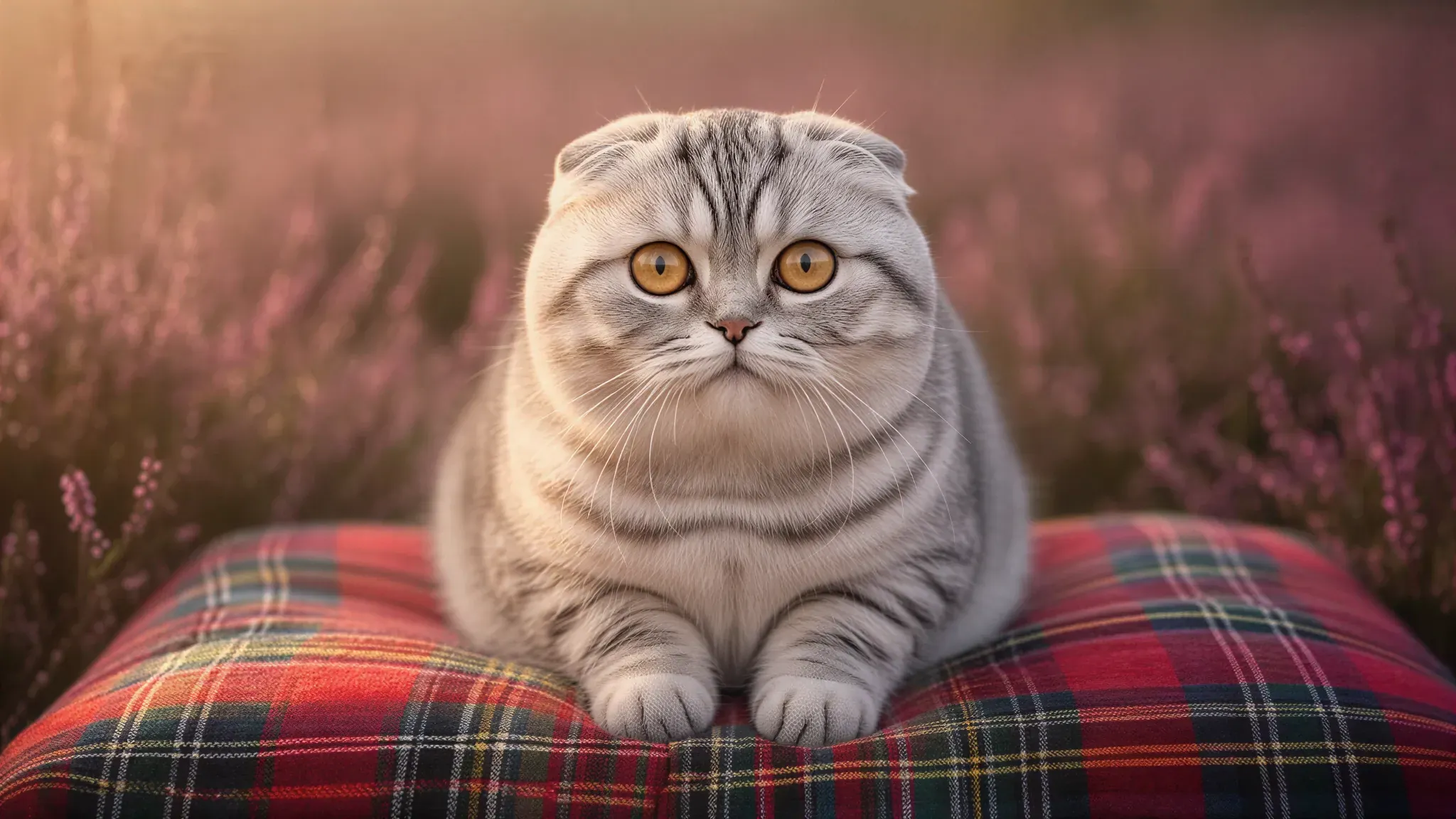
A Scottish Fold is a medium, rounded cat whose folded ears came from a farm mutation in Scotland, and whose cartilage does not stop at the ear. The breed’s temperament is gentle, calm, affectionate, and playful, with a medium care level and a lifespan of about 11 to 14 years. Osteochondrodysplasia and hypertrophic cardiomyopathy are the two health questions to raise with a breeder. The Cat Fanciers’ Association’s version of the breed starts with Susie, discovered by William and Mary Ross, and requires fold-to-straight pairings, a flexible tail, and a cat who may sit up like a prairie dog when something interesting happens. If you wanted round without the fold, that is the British Shorthair. If you wanted the American outcross look without the ear, that is the American Shorthair.
Three things decide whether a Fold is a good fit: the tail test, the pairing rule, and whether you can treat the folded ear as a cartilage mutation rather than a costume.
Quick Facts
| Attribute | Detail |
|---|---|
| Origin | United Kingdom (Scotland) |
| Size | Medium (rounded; females may be slightly smaller) |
| Coat | Short to medium-short dense, or longhair division |
| Personality | Gentle, calm, affectionate, playful |
| Lifespan | 11–14 years |
| Care level | Medium |
| Health to ask about | Osteochondrodysplasia, HCM |
| Common names | Bella, Oliver, Luna, Charlie |
History & Origins
CFA: a spontaneous mutation in farm cats in Scotland. All bona fide Scottish Fold cats trace to Susie, discovered by William and Mary Ross. The breed was established by crosses to British Shorthair and domestic cats in Scotland and England. In America the outcross is the American and British Shorthair.
CFA will show folded ears, straight ears, longhair or shorthair in the appropriate class. Straight is not a consolation prize. Straight is how you do not stack the mutation on both sides.
CFA recognizes the breed and shows folded, straight, longhair, and shorthair cats in the appropriate class. Other associations set their own rules, and some have restricted or stopped recognizing the breed. Ask which registry’s papers you are buying.
Longhair Folds exist in CFA and are the same breed. If the kitten has a plume, you are choosing a coat length, not a different cat.
Personality & Temperament
Gentle, calm, affectionate, playful. CFA: comfortable, charming homebodies who enjoy but do not crave human interaction. Quiet but not placid. They will fetch. You can trust them not to start a game at three in the morning. Sometimes reserved with strangers and other cats — who may read folded ears as hostility — and affectionate when the attention is respectful.
Intelligent. Basic tricks. People-oriented. They will follow you around the house in quiet, polite conversation and rarely get in the way. They do not do well left alone for long. That last sentence is the apartment test. Calm is not a cat who employs himself for ten hours.
Kids: CFA says even temperaments, usually patient with children. An adult still owns the house. Ears are cartilage. Best Cat Breeds for Families with Kids is the family-fit owner.
The prairie-dog sit is CFA’s image: they may sit up straight if something new captures attention. Cute is not a health warranty. Watch them sit down. Watch them walk away. Watch the tail when you run a hand down it.
A week in the house: a cushion they chose, a fetch if you start it, a person in the room, not a 3 a.m. zoomie. If you wanted a Siamese conversation, this is the wrong quiet. If you wanted a Ragdoll flop, that is a different page and a different cartilage story.
Indoor Cat Enrichment still applies. Bringing Home a New Cat still applies. A Fold in a bathroom will wait. That is not the same as thriving alone later.
Physical Characteristics
CFA describes a medium, rounded cat, even from shoulder to pelvic girdle, with a solid body and medium bone. There should be no hint of thickness or shortened mobility from coarse, stubby legs, and females may be slightly smaller. Meet the adult walking rather than relying on a weight range.
Head well rounded, firm chin and jaw, rounded whisker pads, short neck, prominent cheeks, jowly males. Eyes wide open, sweet expression, large, well rounded, separated by a broad nose. Nose short with a gentle curve; a brief stop permitted; profile moderate. Palpable nose break disqualifies.
Folded ears: fold forward and downward, small, tightly folded preferred over a loose fold and a large ear, caplike set, rounded cranium, rounded tips. Straight ears: medium to small, rounded tips, set well apart.
Tail: medium to long, in proportion, flexible and tapering. Longer tapering tail preferred. Disqualify: kinked tail, foreshortened tail, tail lacking flexibility because of abnormally thick vertebrae. That last line is the health exam you can do in a living room. A stiff tail is not “just how Folds are.” CFA wrote it as a disqualify.
Shorthair coat: dense, plush, even, short to medium-short, standing away from the body from density, not flat. Longhair: medium-long to long, britches, plume, toe tufts, ear furnishings, ruff desirable. Any genetically possible color and pattern.
Care Requirements
Grooming
Shorthair is a rubber brush a couple of times a week, more in shedding season; the dense coat sheds. Longhair needs a comb in the places that mat: armpits, britches, and ruff. Folded ears need regular checking, because the fold limits airflow and can trap wax. If an ear smells or the cat shakes its head, that is a vet visit.
Nails and teeth need the same attention as any cat. A medium care level is not the same as no work, even if it is easier than a Persian.
Feeding
A rounded body is the standard, but extra fat is a real tax on joints in a breed whose mutation already involves cartilage. Use How Much Should I Feed My Cat? to set portions, weigh your cat regularly, and adjust. A cat who stops jumping may be sore rather than lazy, so don’t free-feed the problem away.
Exercise & Enrichment
Fetch is CFA’s game. Moderate play. Stable perches — they are not a Bengal on a bookcase. Watch the landing. A cat who hesitates at the sofa height is telling you something about the joints. Believe them.
They do not do well alone for long. A second calm cat can help. A second Fold is still two cartilage questions.
Quiet is not pain. A Fold who used to fetch and now watches the toy needs a veterinarian, not a mellowing breed. CFA’s even temperament makes joint trouble easy to miss. Keep a record of the jumps they still take. Weight is a joint tax, and the rounded body in the standard is not a license to let the middle go.
Straight-eared kittens in a Fold program still need the same heart screening. HCM is a breed concern, not only a concern for folded cats. The ear is the mutation people come for; the heart is the one they forget to ask about. Ask both. A flexible tail and a clean echocardiogram are the visit; a tight fold and a shrug are a photograph. Write those two checks down before you go, and do not skip the walk. Watch them land, then watch again. A pretty face on a cat who will not jump is the whole ethical argument in one room. Keep that picture in mind for a day before you decide, not the owl photo from the listing.
Health Concerns
Osteochondrodysplasia is the cartilage disorder that comes with the fold. Signs include stiffness, reluctance to jump, lameness, and a tail that does not flex. There is no at-home cure; pain needs a veterinarian. CFA’s mitigation strategy is fold-to-straight breeding, DNA testing for pairings, and a flexible tail on the cat you take home. Mitigation is not a promise of zero arthritis. Anyone who says the ear is only an ear is selling a photo.
Hypertrophic cardiomyopathy is also a breed concern. Cornell’s cardiomyopathy page is the general reference. Ask for heart scans on breeding cats. Breathing difficulty, hiding, or a cat who stops playing all warrant a vet visit.
Polycystic kidney disease is not an established Scottish Fold condition. Persian ancestry is not evidence of it unless a source on this breed names it.
Look at the walk. Look at the tail. Look at whether they take the jump they took last month. Cute is not a gait.
Is a Scottish Fold Right for You?
This breed fits people who want a round, quiet, people-nearby cat and will ask harder questions about cartilage than about Instagram. Households that can be home. People who will take a straight-eared kitten if that is the healthier pairing in the litter.
Who should pick a different cat: you, if you wanted the fold as a decoration. You, if fold-to-fold “more fold” was the sales pitch you liked. You, if you cannot pay for joint care. You, if you needed a cat who lives alone and likes it. You, if a British Shorthair or an American Shorthair would have done the round job without this mutation.
Apartments work if you are in them. First cat: possible if you will watch the tail; worse than a mixed cat if you needed easy joints. Allergies: still a cat; visit.
Finding a Scottish Fold
A serious breeder breeds fold to straight, talks DNA, shows you walking adults, and lets you flex a tail. Ask who the straight parent is. Ask what they do when a kitten’s tail is stiff. Ask about hearts.
Rescue gets Folds and Fold mixes. An adult whose gait you can watch is better information than a kitten with tight ears.
Red flags: two folded parents, no tail talk, kittens at six weeks, “they all get a little stiff,” ears as handles, a British sold as a cheap Fold because it is round.
Adopting vs. Buying from a Breeder still applies.
Meet the adult walking, sitting, and jumping onto a chair they actually use. If the tail does not flex, leave. If they never come closer, believe them. The prairie-dog sit is optional. The gait is not.
Fold-to-fold is the pairing CFA is trying to keep out of the living room. Two folded ears in the pedigree is not “more type.” It is more cartilage stacked on cartilage. Straight-eared cats in the same litter are not waste; they are the other half of a legal pairing, and CFA will show them. If the only kitten the seller wants to send home is the tightest fold in a two-fold litter, they are not choosing for the cat’s health. They are choosing a photo.
Longhair exists. Shorthair exists. The ear is the mutation either way. A Highland-looking kitten is still a Scottish Fold if the papers say so. A British round head with straight ears and no Fold papers is a British. Do not pay Fold money for a round mixed cat because the ears “might go down later.” Ears that are going to fold usually tell you in kittenhood. Ears that never fold are still this breed in CFA. Ears that fold and a tail that will not are the wrong combination.
Watch them get onto the sofa, and off it. Watch them use the litter box without a hitch. Watch whether they hesitate at a height they used ten minutes ago. Stiffness that looks like “calm” is how joint pain hides in a quiet breed. CFA’s 3 a.m. fetch line is cute. The disqualify on a non-flexible tail is the sentence that should run the visit.
Other cats may read the fold as a threat. CFA wrote that. Introductions are slower than with a British who has normal ears. A Fold who lives alone all day is still the “do not do well” cat. Round and quiet is not a stuffed animal you can leave on the couch until 7 p.m.
Popular Scottish Fold Names
These names are deliberately ordinary, and Daisy is a good fit if you want one that leans into the round face. The cat does not need to be named Owl.
Bella — Italian, beautiful
Oliver — English, olive tree
Luna — Latin, moon
Charlie — English, free man
Daisy — English, day’s eye
Milo — German, merciful
Leo — Latin, lion
Sophie — Greek, wisdom
Felix — Latin, happy, lucky
Iris — Greek, rainbow
Zoe — Greek, life
Max — Latin, greatest
More on Scottish Fold cat names and the Name Generator.
Frequently Asked Questions
Are folded ears just cosmetic?
No. CFA traces every bona fide Fold to Susie, a farm mutation in Scotland. The fold is cartilage. CFA’s future page says responsible breeders only breed fold-eared cats to straight-eared cats to minimize arthritic and bone conditions, and that DNA testing matters for pairings. A well-bred Fold has a flexible tail and a normal gait. Ask to see both.
Is a straight-eared Scottish Fold still this breed?
In CFA, yes. They can be shown with folded ears or straight ears, longhair or shorthair, in the appropriate class. Straight ears are not a failed Fold. They are how the program avoids fold-to-fold. If you only wanted the owl photo, say that out loud before you pay for a mutation.
What health tests should a Scottish Fold breeder show me?
Ask about osteochondrodysplasia and hypertrophic cardiomyopathy, the two conditions linked to this breed. Ask how they prove fold-to-straight pairings. CFA wants a flexible tail and no thickness in the legs. A stiff tail, a hitch, or a kitten who will not jump means a veterinarian and a different seller. Polycystic kidney disease is not an established Fold condition, so don’t accept it as a given.
Are Scottish Folds good with children?
CFA says cuddly and loving with their special people, even temperaments, usually patient with children. An adult still owns the house. Folded ears are not handles. A toddler who grabs cartilage is a conflict you supervise. They do not do well left alone for long.
Should I just get a British Shorthair instead?
If you wanted round and dense without the fold mutation, that page exists. British Shorthairs are a CFA outcross for Folds in America, alongside American Shorthairs. Same neighborhood of look, different ear, different health sentence. Meet both adults. Do not buy a Fold to decorate a bookshelf.
Meet the adult walking. Then run a hand down the tail. The Scottish Fold gallery is here if you want the round face before you book the visit. A second visit, after they have chosen a chair, is the joint-care version of a temperament test.