
Best Cat Breeds for Families with Kids
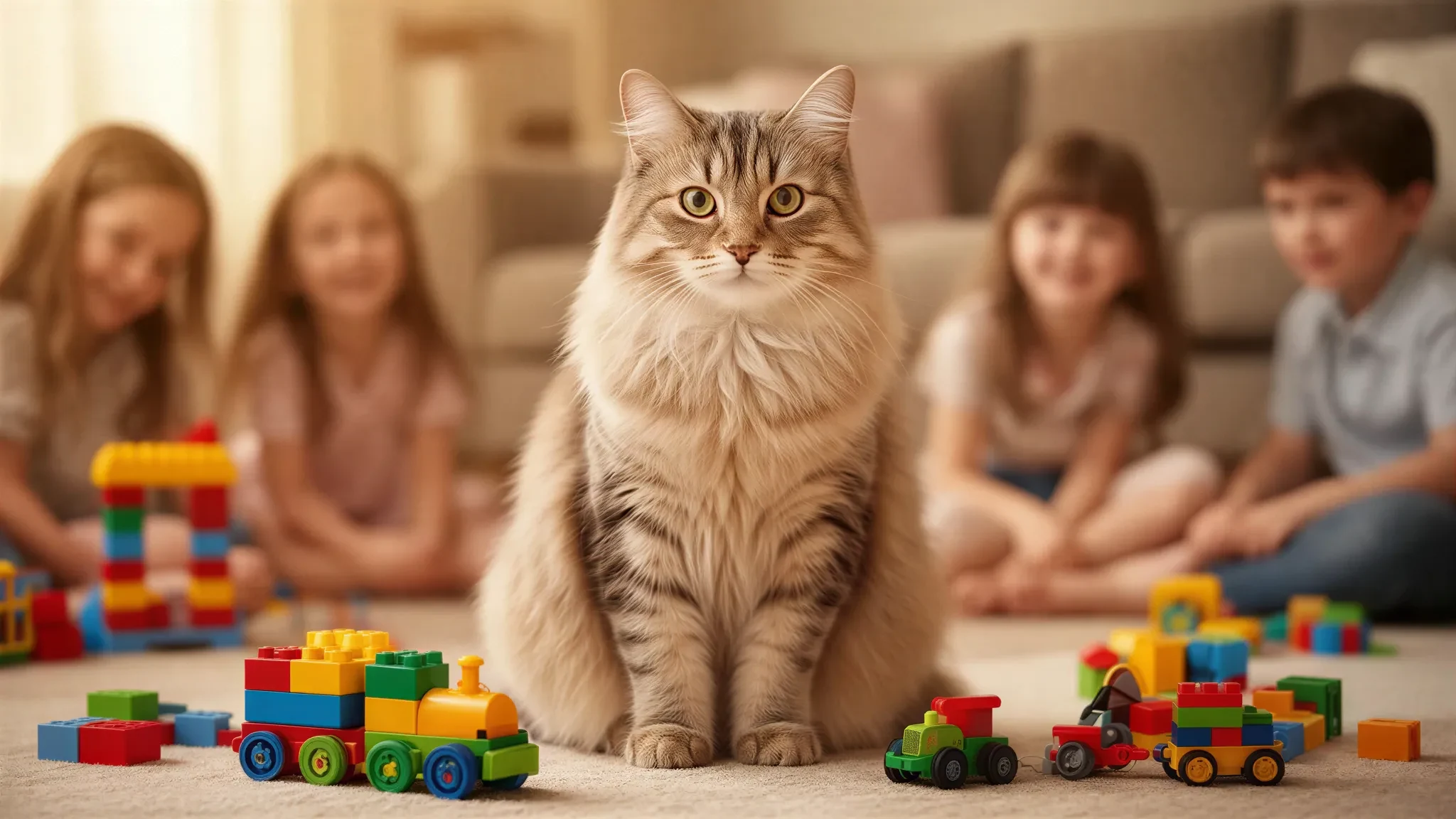
If you want a cat that still wants the sofa when the kids are loud, start with temperament, not a cute face. A Ragdoll is a large, gentle cat often described as relaxing into your arms, though individual cats vary. A British Shorthair is calmer and more independent, with a short dense coat that does not need a daily session on the grooming table. Maine Coons are friendly and playful at large-cat size, which is a different house than a Ragdoll that would rather settle against you. None of those labels beats the cat in front of you. Meet the adult. Watch how they take a clumsy hand. Then decide.
The houses that work are the ones where an adult owns the litter scoop, the vet visits, and the “leave the cat alone” call. That is also what the American Veterinary Medical Association tells families when they pick a pet: do not impulse-buy, match the animal to the household, and do not put a child in charge of daily care.
What actually matters in a house with kids
Breed lists sell a feeling. Living with a cat sells a routine. Before you fall for tufted ears or blue eyes, get honest about four things.
- An adult owns feeding, litter, vet visits, and the hard no when a child is too rough.
- This cat’s temperament, watched in person, not a paragraph on a website.
- Energy you can live with on a Tuesday when a toddler is already a lot.
- Coat and health costs you will actually pay for, year after year.
The AVMA’s family-pet page is blunt: a child cannot be solely responsible for an animal. Kids can help. They should help, under supervision, so they learn that a cat is not a toy that comes off the shelf. Help is not ownership. If the adult in the house is already stretched, a high-care coat or a high-energy breed will not “teach the kids responsibility.” It will teach everyone what neglect looks like.
Pick a cat that seeks affection rather than one you have to corner. The AVMA’s cat-selection advice is exactly that: look for a cat who wants to be near people. A Ragdoll who settles into your arms instead of stiffening is showing you that. A Russian Blue who watches from the back of a cage might be a wonderful cat in a quieter house and a miserable one in a house that never stops.
If you already have a mixed-breed cat and you are trying to reverse-engineer a label, start with What Breed Is My Cat?. Temperament is still the job.
Side by side
These seven are the ones whose profiles read as workable in a house with children: gentle, calm, friendly, or low-care enough that the coat does not become the third child. Lifespan, size, and health notes match the breed profiles on this site.
| Breed | Personality | Size | Coat | Care | Lifespan |
|---|---|---|---|---|---|
| Ragdoll | Gentle, affectionate, calm, loyal | Large | Medium | Medium | 12–17 years |
| British Shorthair | Calm, independent, gentle, loyal | Medium | Short | Low | 12–17 years |
| Maine Coon | Friendly, playful, intelligent | Large | Long | Medium | 12–15 years |
| American Shorthair | Gentle, affectionate, playful | Medium | Short | Low | 15–20 years |
| Russian Blue | Gentle, intelligent, independent, quiet | Medium | Short | Low | 10–16 years |
| Norwegian Forest Cat | Gentle, independent | Large | Long | Medium | 14–16 years |
| Domestic Shorthair | Variable, affectionate, independent, playful | Medium | Short | Low | 12–16 years |
Ragdoll
The Ragdoll is the one people mean when they say “lap cat” and actually want a large one. They are known for relaxing when picked up, the tendency the breed is named for, though plenty of individual Ragdolls would rather keep their feet on the floor. Gentle, affectionate, calm, loyal: that is the whole personality line, and it is a better fit for a house with kids than a cat who treats every sudden movement as a hunt.
They are large. Kids who want a kitten they can tote like a stuffed animal will outgrow that idea the first time a fifteen-pound cat decides the game is over. Teach them to sit and let the cat come. Medium coat means brushing, not a daily Persian session, but you will still find hair on the school backpack.
Health on the profile is hypertrophic cardiomyopathy and hip dysplasia. I am not going to tell you how to treat either. Ask the breeder or rescue what screening has been done, and take the answers to your veterinarian. Lifespan is listed at 12–17 years. Plan for the long middle, not the kitten photos.
Common names on the profile are Bella, Luna, Sophie, and Lily. If you want more of that gentle register, the Name Generator will filter it.
British Shorthair
If the Ragdoll is a sofa that follows you, the British Shorthair is a sofa that stays put. Calm, independent, gentle, loyal, and low care. The dense short coat is the point: you get the round, plush look without committing to a long-hair routine. That matters in a house where the adult already runs homework, meals, and a litter box.
Independent is the word people skip. A British Shorthair will take affection on their terms. That can be perfect with kids who need a cat that will walk away instead of enduring until they explode. It is a poor fit if you wanted a velcro cat who follows a six-year-old from room to room.
They list hypertrophic cardiomyopathy and polycystic kidney disease. Same rule as the Ragdoll: screening questions, then your vet, not a blog post. Lifespan 12–17 years.
Maine Coon
Maine Coons are the large, tufted-ear cats people point at and say “that’s a dog in a cat suit.” The profile is more precise: friendly, playful, intelligent. Not “gentle” and not “calm.” That distinction is the whole family decision. A playful large cat in a small apartment with a toddler is a lot of cat. In a house with space, a climbing tree, and an adult who likes a cat that will actually play, they earn the reputation.
Long coat, medium care, 12–15 years. Hip dysplasia and hypertrophic cardiomyopathy sit on the health line. Grooming is real: the ruff and the britches mat if you ignore them. Kids can learn to brush. An adult still has to check the job.
American Shorthair
This is the working-cat profile: medium size, short coat, low care, gentle, affectionate, and playful. Lifespan is listed at 15–20 years, which is the longest row in that table. If you want a cat the kids might still have in high school, that number is the argument.
Playful here is not Bengal-playful. It is a cat who will chase a string and then nap. Obesity is on the health list next to hypertrophic cardiomyopathy, which is a polite way of saying an American Shorthair in a snack-heavy house will take the snacks. Kids who “share” cheese will train that fast.
Russian Blue
Quiet is the word that should decide this one. Gentle, intelligent, independent, quiet, short coat, low care. A Russian Blue can be a gift in a house that already has enough noise. They can also be a poor fit for a toddler who treats every animal as a moving toy, because independent plus quiet often means leaving the room.
Lifespan is listed at 10–16 years, a shorter floor than the American Shorthair, with hypertrophic cardiomyopathy and polycystic kidney disease on the health list. If your house is a bounce house, look at the Maine Coon or a shelter adult instead.
Norwegian Forest Cat
Large, rugged, waterproof coat, bred for cold. Personality is only two words on the profile: gentle and independent. That combination is why they belong on a family list and why they are not a Ragdoll. They will take company. They do not need to be in your lap to prove it.
Medium care on a long coat means you cannot skip the brush because “they’re outdoor-bred.” The coat is the job. Lifespan 14–16 years. Health lists hip dysplasia and glycogen storage disease. Ask about the second one by name. Do not skip it because the cat looks like a postcard from Norway.
Domestic Shorthair
Most family cats in the United States are this. Mixed-breed, short coat, low care, personality listed as variable, affectionate, independent, playful. Health: “Depends on mixed heritage.” That sentence is more honest than a closed-registry brochure.
Variable is the feature. A shelter adult who already lives in a foster home with children is a better family cat than a pedigree kitten whose papers say gentle. You can see the cat. You can ask the foster what happens when a door slams. You cannot ask an eight-week-old kitten that question and get a useful answer.
Lifespan 12–16 years. If you need a name after you pick the cat, the gentle name list is a better filter than forcing a breed label onto a mixed cat.
If you are deciding between a shelter and a breeder, Adopting vs. Buying from a Breeder is the comparison. For a house with kids, the argument for a known adult is practical, not moral: you are buying information.
Who should pick a different cat
A Bengal is energetic, curious, playful, and intelligent, with a spotted coat people buy because it looks wild. That motor does not turn off because a toddler had a long day. Keep them if an adult can run play sessions and give them height and puzzles. Skip them as a first cat in a chaotic house.
A Siamese is vocal, social, intelligent, and playful. Low coat care. They will talk. If you wanted a quiet cat who naps through homework, this is the opposite animal. A busy family can still do well with one if an adult likes a chatty cat. Do not get one as “easy.”
A Persian is gentle, calm, and affectionate — and high care, with polycystic kidney disease and brachycephalic airway syndrome on the list. The flat face is the look and the veterinary bill. Daily coat work is real. Skip them if you wanted a low-effort family pet. The temperament is not the problem. The face and the comb are.
A Sphynx is friendly with high care, hairless skin, and a listed lifespan of 8–14 years. Baths and warmth are the job. Skip them unless an adult signed up for that work on purpose. A Savannah is a large, high-care cat with serval ancestry. The wild look is the marketing. They are not a starter family pet.
A Scottish Fold is gentle and playful, which is why they get advertised to families. The folded ears come with osteochondrodysplasia on the health list. I am not going to recommend a cat for a house with kids because the ears look cute. An Exotic Shorthair looks like a teddy with low coat care, then lists breathing issues and teeth problems. Treat the face like a Persian, not like an easy American Shorthair.
Kitten or adult
Get an adult if you cannot commit to a kitten. The AVMA’s cat-selection page says that in so many words, and it is the most useful sentence on this subject. Kittens are sharp, fast, and still learning bite inhibition. They should stay with their mother and littermates until at least seven to nine weeks. Pulling a kitten home at six weeks because a child “couldn’t wait” is how you get a frightened cat and a scratched kid.
An adult from a rescue already voted. They either lean into a child’s hand or they don’t. Spend time in the visiting room. Bring the kids if the shelter allows it, and watch the cat, not the kids’ excitement. If the cat hides for the whole visit, believe them.
A kitten can still be right. It is a different project. Use the New Kitten Checklist before the ride home, not after you realize you have no carrier that closes.
Kids, scratches, and the litter box
Cats scratch. That is not a breed failure. Teach kids to leave the belly, the tail, and a sleeping cat alone. Play with a toy, not fingers. If a child is too young to follow that, the adult stays in the room. The AVMA’s family advice is supervision, not a breed that “never scratches.”
Toxoplasmosis is the disease people bring up the minute a pregnancy and a litter box exist in the same sentence. Cornell’s Feline Health Center is the page to read. Direct contact with a cat is an unlikely way to get it. The parasite’s eggs need one to five days in the litter to become infectious, which is why daily scooping matters. Cover outdoor sandboxes. Wash hands after the box, after the garden, and before food. Undercooked meat and soil are the more common routes. If someone in the house is pregnant or immunocompromised, an adult who is not in that group should handle the box. That is hygiene, not a reason to rehome a healthy indoor cat.
This page is not veterinary advice. If a scratch looks angry, if a child is immunocompromised, or if you are unsure about the litter routine during pregnancy, call your physician and your veterinarian.
The first weeks at home
Give the cat a room with the door, the box, food, and a high place the kids are not allowed to raid. Let them come out on their own time. A house that dumps a new cat into a living room of shouting is asking for a cat who lives under the bed until June.
Bringing Home a New Cat is the week-by-week version of that. If another cat already lives there, do not “let them work it out” in the hallway. Keep them separated until both will eat calmly on opposite sides of a door. Slow introductions are the difference between a hiss and a long war.
Kids want to show the cat to everyone on day one. Don’t. The cat just lost every smell they knew. Your job for the first week is boring on purpose.
Frequently Asked Questions
What is the best cat breed for a family with kids?
There isn’t one. Ragdolls and British Shorthairs are the calmest starting labels if you want a gentle cat. Maine Coons and American Shorthairs add play without Bengal-level energy. Meet the individual. An adult shelter cat with a known temperament beats a fashionable kitten you have not seen handle a loud living room.
Are Ragdolls good with children?
They tend to be. Ragdolls are known for a tendency to relax when handled, and the breed profile lists affectionate, calm, and loyal. A relaxed Ragdoll is not a license for kids to haul them around, and plenty of them dislike being held. Supervise, keep play on the floor, and skip a Ragdoll if your house cannot give a large cat a quiet place to get down.
Should we get a kitten or an adult cat?
Get an adult if you cannot commit to a kitten. Kittens need months of supervision, and the AVMA says they should stay with their mother and littermates until at least seven to nine weeks. An adult from a rescue already has a readable temperament. You will know in one visit whether they flinch from a child’s hand or lean in.
Can kids catch anything from the litter box?
Direct contact with a cat is an unlikely way to get toxoplasmosis. Cornell’s feline health center says the parasite’s eggs need one to five days in the litter to become infectious, which is why daily scooping matters. Cover outdoor sandboxes. If someone in the house is pregnant or immunocompromised, an adult who is not in that group should handle the box.
Which cat breeds should families skip?
Skip a Bengal unless an adult can run that energy. Skip a Siamese if you want a quiet house. Skip a Persian or Sphynx if you want low-effort coat or skin care. Skip a Scottish Fold for the folded-ear look; the profile lists osteochondrodysplasia. Skip a Savannah. The cute face is not the job. The daily care is.
Go meet two cats this week. One pedigree if you already fell for a look, and one adult Domestic Shorthair whose foster can tell you what they do when a door slams. The second visit is usually the one that decides it.