
Exotic Shorthair Cat Breed Guide: Personality & Care
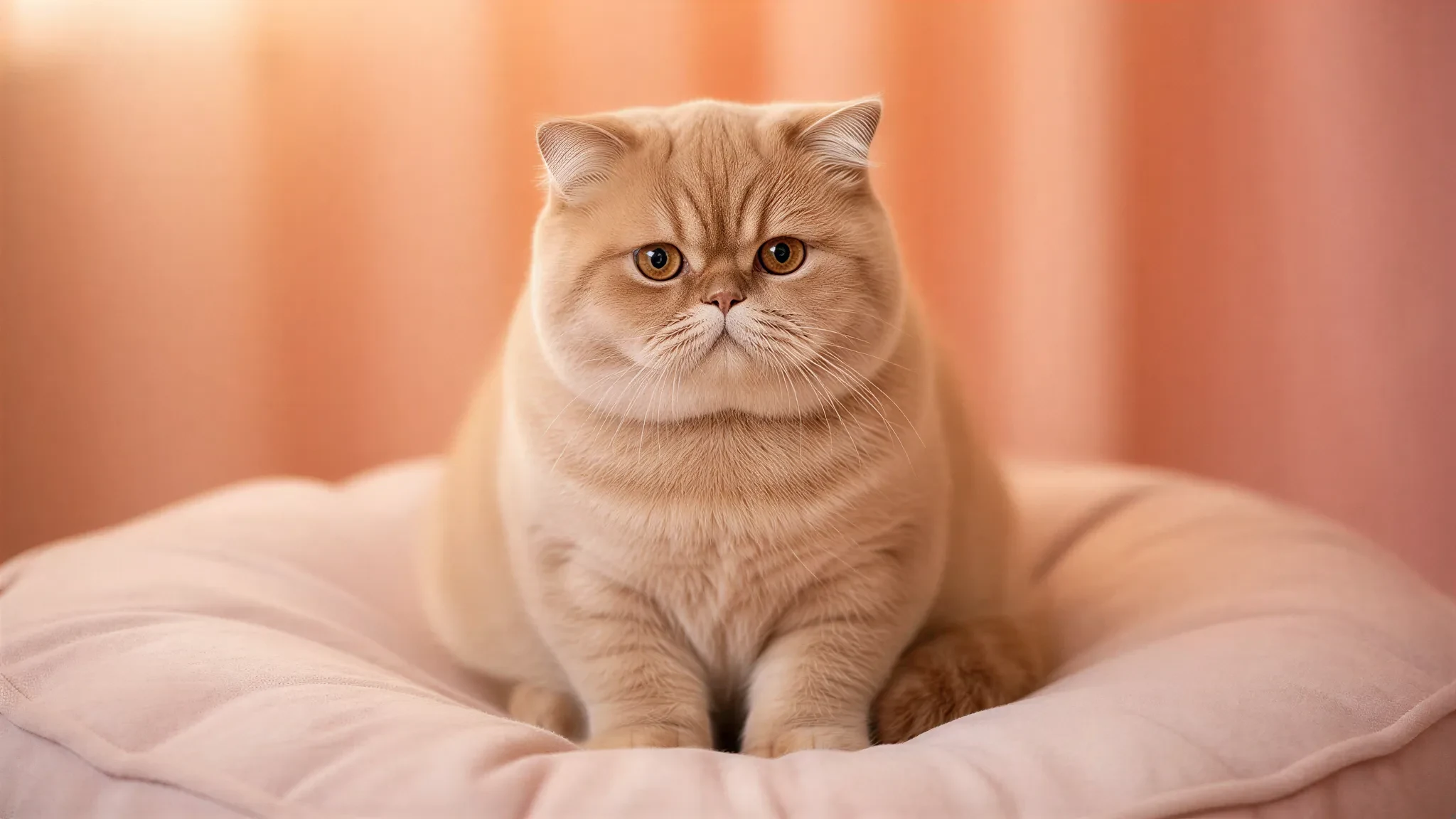
An Exotic Shorthair is a Persian with a short, plush coat. The Cat Fanciers’ Association wrote the standard that way on purpose: round head, cobby body, snub nose with a deep break, teddy-bear coat that stands off the body. The profile on this site lists them as calm, affectionate, curious, and loyal, medium size, low care, 12–15 years, with breathing issues and teeth problems on the health line. Low care is versus a Persian comb. It is not versus a Domestic Shorthair.
Quick Facts
| Attribute | Detail |
|---|---|
| Origin | United States |
| Size | Medium |
| Coat | Short, dense, plush; stands off the body |
| Personality | Calm, affectionate, curious, loyal |
| Lifespan | 12–15 years |
| Care level | Low (versus a Persian; not versus a mixed short-hair) |
| Health to ask about | Breathing, teeth; same skull conversation as a Persian |
| Common names | Pebbles, Snuggles, Gizmo, Bella |
History & Origins
West Coast Persian breeders in the 1950s crossed to American Shorthairs because short hair is dominant. They got round, cobby kittens with Persian heads and short coats. CFA’s breed page is blunt: those hybrids were controversial. They were also popular enough that CFA established them as a breed in 1966. Many of the early cats were shaded silver or chinchilla — colors that did not exist yet in other shorthair breeds — so the name was Exotic Shorthair. CFA later dropped “Shorthair” because it confused people. Championship status dates to January 1, 1967 in CFA’s registration rules. The breed is still called Exotic Shorthair in ordinary speech, including this page’s URL.
Once the short-hair gene was in, breeders took the cats back to Persians, not back to American Shorthairs. CFA says that is why personality and type now match the Persian. Jane Martinke proposed the breed to the CFA board in 1966 after watching American Shorthair type drift from those silver Persian crosses. The original proposed name was Sterling, after the silvers. The class opened to all Persian colors anyway. Early outcrosses also included Burmese and even Russian Blue in a few programs. CFA narrowed allowable outcrosses to Persian and American Shorthair in 1975, then dropped the American Shorthair in the 1987–88 season. After that, Persian only.
The early standard did not even require a nose break, because the first hybrids came off American Shorthairs that did not have one. CFA added “with break” in 1973 as type caught the Persian. In 1990 the Exotic standard was realigned to match the Persian except for coat. The teddy-bear photos you are shopping from are that later face, not the 1966 compromise.
If you want the long comb on the same skull, that is the Persian page. If you want the American Shorthair head on a short coat, that is not this cat.
Longhair kittens can appear in Exotic litters because longhair is recessive and still rides in from the Persian side. CFA’s breed article is blunt: two shorthairs can still throw longs. Breeders guess early by coat feel and by the tail — a longhair kitten’s tail starts to look like a little Christmas tree — but they wait weeks to be sure, and white kittens fool people. If you are shopping for a short teddy bear and the litter is half fluffy, that is the genetics working, not a bait-and-switch by itself. Ask which kittens are actually short, and do not take the eight-week “sure” until the coat has finished arguing.
Personality & Temperament
Calm, affectionate, curious, loyal — that is the profile, and it matches CFA’s quiet, devoted, not-intrusive cat who stays close without needing to join every task. CFA says some people find Exotics a bit more playful than Persians because nobody trained them to sit still for an hour of grooming. They speak with their eyes. Purrs are common. Meows are rare.
They can fit a house with children, CFA says, and they usually learn to live with dogs and other cats after an initial shyness. Curious on our profile is real: they will inspect. They will not usually narrate it like a Siamese.
At a show they are judged as longhair-type cats who happen to wear a short coat. CFA moved them into the longhair specialty group because the structure is Persian. That is why an Exotic next to an American Shorthair in a photo can look like a different species. The ASH is a working round. This is a break and a snub.
The families page already flagged this breed. The temperament is not the problem. The face is. A calm cat who cannot breathe well in a loud house is still a veterinary problem.
Physical Characteristics
CFA: visualize circles. Round head, round eyes, thick round body, small rounded-tip ears. Short snub nose with a deep break centered between the eyes. The Exotic should meet the Persian standard in every way except coat length. Coat is plush, dense, even, with a thick undercoat that makes it stand off the body. That stand-off coat is why people say teddy bear. It is also why they still shed.
Seven competitive divisions, identical to Persians, including pointed Himalayan pattern. Colors are a Persian menu. This is not an American Shorthair in a costume.
I am not printing a fake weight. Medium on our profile. CFA says medium to large, quality over size, short thick legs, a short tail in proportion, nostrils that should be open. Meet the cat. Look at whether the nose is a snub you can live with, not whether the Instagram crop hid the break. CFA disqualifies a break that sits level with or higher than the top of a fully opened eye. That is a show rule. It is also a reason to look at the adult’s profile in person instead of a kitten selfie taken from above.
Care Requirements
Grooming
CFA’s grooming section is the honest one. Exotics shed more than people expect, mostly seasonally. Weekly combing with a steel or Teflon comb most of the year. Shedding season may need a bath to pull the undercoat. Mats are uncommon if you do not neglect the coat. They tend to tolerate grooming because of the Persian patience. That is still a weekly job. A Domestic Shorthair is a rubber brush in spring. Do not confuse those two sentences.
Tear staining happens on flat faces. Wipe the face in the morning the way you would wipe a child’s. If the eyes look angry, that is the vet, not a new wipe. The 2021 Persian skull work also found more of the eye globe sitting outside the bony orbit as faces got shorter. That is an eye-support problem, not a makeup problem. A British Shorthair is round-headed without that snub. Do not shop an Exotic because you liked a British Shorthair photo and wanted “more cute.”
Put the comb on a weekday, not “when I remember.” CFA’s weekly comb is a calendar item. Shedding season is a second item, sometimes with a bath. That is still fewer hours than a Persian table. It is more hours than a rubber brush on a Domestic Shorthair. If you will only groom when the coat looks bad in photos, this is the wrong short-hair.
Feeding
A cobby, calm cat in a snack house gets heavy. Extra weight does not help a short airway. Use How Much Should I Feed My Cat?. I will not invent a cup amount. Wet food helps any cat drink. A flat face can make some bowls awkward; a shallow dish is a practical fix, not a medical claim.
Exercise & Enrichment
Curious, not a Bengal. Short play, a window, a low tree they can actually climb with that cobby body. Indoor Cat Enrichment still applies. They are not a sport cat. They are also not a statue. CFA’s “bit more playful than a Persian” is the ceiling, not a parkour brief.
Health Concerns
Breathing issues and teeth problems are the two lines on the profile. Both come from the skull.
The nose is short on purpose. CFA’s standard wants that break. A 2021 study of Persian skulls — the head this standard copies — found that as brachycephaly increased, more of the eye sat outside the bony orbit and the height of the nasal opening dropped. Some individual Persians overlapped with Domestic Shorthairs. The range is wide. The direction is not a mystery. Noisy breathing, open-mouth breathing, or exercise intolerance is a veterinarian visit. I am not going to tell you which surgery exists. That is their job.
Teeth: a 2018 Journal of the American Veterinary Medical Association study put 50 purebred Persian and Exotic cats under anesthesia for full dental exams and x-rays. Malocclusions in 72 percent. Crowding in 56 percent. Periodontal disease in 88 percent. Tooth resorption in 70 percent. The authors’ conclusion was that brachycephalic oral anatomy predisposes these cats to dental disease. Ask about dental care before you fall for the teddy-bear photos. This page is not a treatment plan.
CFA says genetic screening of breeding cats remains paramount. Ask what they screen. The only allowable outcross is Persian, so Persian-related questions belong in the room: kidneys, heart, and the face you can already see. I am not adding a disease that is not on this breed’s profile as a diagnosis. I am telling you to ask, and to listen to whether the answer is a test or a shrug.
Heat and humidity are harder on a short nose. That is not a lab result I ran. It is a reason not to leave this cat in a hot car while you run into the store, and a reason noisy breathing in August is worth a call.
Home dental care is brushing if they allow it, and a vet who will look under anesthesia when needed. The JAVMA cats needed full-mouth x-rays to see what the snub hid. Do not assume a cute nibble on a treat means the mouth is fine. I will not name a toothpaste. Ask the dentist-vet you actually use.
Is an Exotic Shorthair Right for You?
This breed fits people who want the Persian face and will not do Persian hours with a comb, and who will still pay for dental work and watch breathing. Quiet houses. People who like a cat that sits near them.
Who should pick a different cat: you, if you wanted an easy short-hair. That is a Domestic Shorthair or an American Shorthair. You, if the snub nose makes you uneasy on day one. It does not become a Roman nose later. You, if kids grab faces. You, if a breeder shrugs at dental and breathing questions because “they’re shorthairs.” Best Cat Breeds for Families with Kids already said treat the face like a Persian.
A British Shorthair is also round and plush and does not share this break. If the round face was the whole want, read the British Shorthair breed guide before you pay Exotic money for Persian airways. An Exotic who cannot travel well in a carrier because they panic-breathe is a real ownership cost. Practice carriers early, in air conditioning, with a vet who already knows the face. CFA says they can settle into a new home at any age. That is temperament. It is not a pass on checking how the adult breathes in August.
Finding an Exotic Shorthair
A serious breeder talks about the face on the adults, not just kitten fluff. Meet the parents breathing at rest. Ask about dental work already done. CFA registers more Exotics than Persians some years, so kittens exist; waiting for a color is normal.
Rescue gets Exotics whose people thought short hair meant cheap. An adult whose breathing you can hear is information.
Red flags: a kitten with a running nose sold as “just teary,” no adult cats on site, American Shorthair papers on an Exotic-headed cat, or a seller who says they never need dental care.
Adopting vs. Buying from a Breeder is the general fork.
Popular Exotic Shorthair Names
The profile lists Pebbles, Snuggles, Gizmo, and Bella. I would actually call a cat Pebbles or Bella. Snuggles is sticky-sweet. Gizmo is a movie joke I would not put on a tag.
Pebbles — English, small stones; one of the four profile names, and a name you might actually use
Bella — Italian, beautiful; the other profile name that exists in the data
Luna — Latin, moon; silver and chinchilla coats especially
Milo — German, merciful; soft without being a punchline
Oliver — English, olive tree
Willow — the coat movement, even short
Sophie — Greek, wisdom
Charlie — English, free man
Explore Exotic Shorthair cat names or the Name Generator.
Frequently Asked Questions
Is an Exotic Shorthair just a short-haired Persian?
That is the breeding goal. CFA set the Exotic standard to match the Persian except for coat: round head, cobby body, snub nose with a deep break. They were produced by crossing Persians with American Shorthairs in the 1950s, then breeding back to Persians. CFA recognized the breed in 1966. The short coat does not give you a different skull.
Do Exotic Shorthairs have breathing problems?
They can. The profile lists breathing issues because the face is Persian-type: a short snub nose and a break between the eyes. A 2021 skull study on Persians — the same head the Exotic standard copies — found higher brachycephaly lining up with smaller nasal openings and more of the eye sitting outside the bony orbit. Open-mouth breathing, noisy breathing, or eyes that look like they cannot blink fully are a veterinarian conversation, not a cute face.
Do Exotic Shorthairs need a lot of grooming?
Less than a Persian, more than a Domestic Shorthair. CFA calls the coat medium length, dense, standing off the body, and says weekly combing is enough most of the year, with more work and sometimes a bath when the undercoat blows. Mats are uncommon if you do not ignore them. Low care on our profile means versus a Persian, not versus an American Shorthair.
Are Exotic Shorthairs good with children?
CFA calls them an excellent pet for young children: quiet, loyal, not intrusive. Our profile is calm, affectionate, curious, and loyal. The face is still the job. Kids who grab faces and a cat who already struggles to breathe are a bad mix. Supervise. This is not the easy short-hair on the families page.
Exotic Shorthair vs Persian — which should I get?
Same type, different comb. If you love the face and will fund dental work and watch breathing, the Exotic saves you hours of coat. If you wanted low veterinary drama, neither is the answer. A British Shorthair or a mixed Domestic Shorthair is the other fork in the road.
Look at the adult’s profile in person, not the kitten. Listen to them breathe. The Exotic Shorthair gallery is here if you want the look before you book the visit.