
Maine Coon Cat Breed Guide: Personality & Care
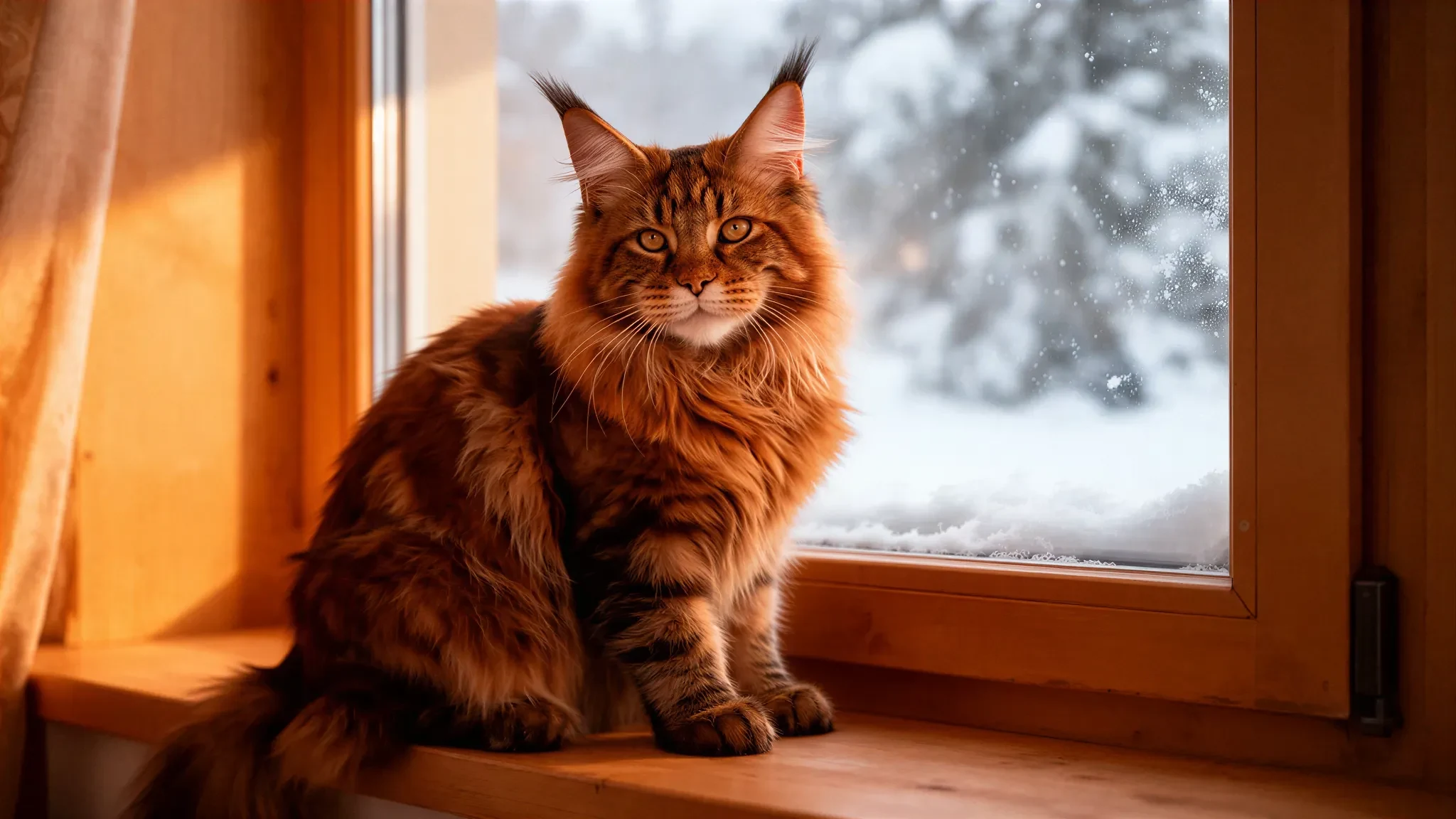
A Maine Coon is a large, shaggy, working-class American cat with tufted ears, tufted paws, and a tail that looks like it was built for snow. They tend to be friendly, playful, and intelligent, with a long coat, medium care needs, and a 12–15 year lifespan. That is a different animal from a Ragdoll that tends to settle on the sofa. If you want a cat who will follow you into the bathroom, steal a bottle cap, and still sit on the kid’s homework, keep reading. If you wanted a quiet, independent short-hair, look at a British Shorthair instead.
The Maine Coons that work in a house are the ones whose people signed up for a large, social, still-growing cat — not for a photograph of lynx tips.
Quick Facts
| Attribute | Detail |
|---|---|
| Origin | United States |
| Size | Large (CFA: medium to large; females usually smaller; slow to mature) |
| Coat | Long, heavy, shaggy; shorter on the shoulders, longer on the britches and ruff |
| Personality | Friendly, playful, intelligent |
| Lifespan | 12–15 years |
| Care level | Medium |
| Health to ask about | Hypertrophic cardiomyopathy, hip dysplasia |
| Common names | Max, Charlie, Simba, Leo |
History & Origins
Maine Coons are an American farm and ship cat, not a palace import. The Cat Fanciers’ Association calls them America’s first indigenous show cat: a dozen were already in a Boston show program in January 1878. Farmers in Maine had been bragging on them at the Skowhegan Fair in the 1860s. The brown tabby with a bushy ringed tail was common enough that people told raccoon stories. CFA is blunt: a domestic cat cannot breed with a raccoon or a bobcat. The tufted ears and the ringed tail just look like they could.
The more boring origin is also the one that fits the cat you meet. Short-haired ship and farm cats in New England mixed with later long-haired sailors’ cats. Winter did the selecting. What survived looked like a rectangular, shaggy mouser with snowshoe feet. That is why the CFA standard still starts with “originally a working cat” and “can endure a harsh climate.”
They were famous, then they nearly vanished from the show hall. A brown tabby female named Cosey won the 1895 National Cat Show at Madison Square Garden. CFA still has her silver collar. Then Persians and other pedigreed longhairs took the spotlight. CFA records a last big recorded win in 1911, decades of background noise, and a rumor in the late 1950s that the breed was extinct. It was not. The Central Maine Cat Club kept them visible in the 1950s and early 1960s. CFA granted provisional status beginning May 1, 1975, and championship status on May 1, 1976.
If you are comparing this cat to a Norwegian Forest Cat, the shared “big winter coat” look is real and the history is not. One is a New England working cat. The other is a Norwegian one. Use Maine Coon vs Norwegian Forest Cat when you are actually choosing between those two, not this page.
Personality & Temperament
Friendly, playful, intelligent is the whole personality line, and it is the part people get wrong when they shop from a “gentle giant” caption. CFA’s breed page is more useful: they are sociable and loyal, they will work out where you hid a toy, and they tend to move from lap to lap rather than picking one person and melting. Fairly independent does not mean they will amuse themselves in a closed room all day. CFA’s own warning is that people who work at home may need to shut a door.
Play is not optional decoration. A Maine Coon kitten who still has motor will treat a trailing bathrobe like prey. An adult who keeps that curiosity needs height, a puzzle, and a person willing to throw a crumpled receipt more than once. That is why they showed up on Best Cat Breeds for Families with Kids with a caveat: playful and large is a different house than a Ragdoll that would rather settle into a lap.
They get along with children and other animals in CFA’s description, with a practical note that both kids and dogs can be intimidated by the size at first. Teach the kid to sit and let the cat come. Teach the dog that a cat this big is still a cat. I have never owned a Maine Coon, so I am not going to pretend I trained one. I have owned enough large, social cats to know the house has to have a high shelf the kids are not allowed to raid.
Voice is not Siamese. CFA lists chirps, trills, and purrs, with an occasional meow, and says they are not considered a talkative breed. If you wanted a cat who narrates every cupboard opening, that is a different page.
Water is a Maine Coon cliché because it is often true. CFA says many will watch a dripping faucet, wash food or toys, or try to join you in the shower. Put a lid on the tank if you do not want a fishing expedition. That habit is false for most Persians. It is one of the paste-tests for this breed.
Physical Characteristics
CFA’s standard is the physical description that would be false on a cobby Persian or a pointed Ragdoll. The body is muscular and broad-chested, long enough to read as a rectangle, with no part exaggerated. Size is medium to large. Females are generally smaller than males. Slow maturation is written into the standard: a cat who still looks “unfinished” at a year is doing what the breed does, not failing a growth chart.
The head is slightly longer than it is wide, with a square muzzle and a strong chin. The profile has a slight concavity. A straight brow-to-nose line is not the look, and neither is a Persian break. Ears are large, well-tufted, wide at the base, and set about one ear’s width apart. Eyes are large, opened ovals, slightly oblique. Eye color runs green, gold, green-gold, or copper; white cats and cats with white may be blue-eyed or odd-eyed.
The coat is the other tell. Heavy and shaggy, shorter on the shoulders, longer on the stomach and britches, with a frontal ruff. Silky, falling smoothly. CFA penalizes a coat that is short or even all over. That uneven map is why grooming is not “brush the back and call it done.” The tail is long, wide at the base, tapering, with long flowing fur — the feature that fed the raccoon story.
Paws are large, round, and well-tufted. Five toes in front, four in back. Extra toes are a disqualification in the CFA ring. Farm Maine cats were often polydactyl. Show Maine Coons are not supposed to be. If someone is selling “true Maine Coon snowshoe extra toes” as a breed requirement, they are selling a story the standard does not support.
Colors run a long list: brown tabby is the postcard, but solids, silvers, reds, torties, bi-colors, and smokes are all on the CFA chart. Chocolate, lavender, and Himalayan pointing are treated as hybridization and disqualify. If the cat in the photo has Siamese points, you are not looking at a Maine Coon.
I am not going to print a weight in pounds. CFA says quality should never be sacrificed for size, which is the honest counter to internet photos of cats who look like they cannot jump. Meet the cat. Look at bone, not at a number a stranger typed.
Care Requirements
Grooming
Medium care on a long coat is not a free pass. The coat is built uneven on purpose: shorter shoulders, longer britches, a ruff you will find around the neck. Those longer patches are where mats start, especially where the cat cannot reach well behind the back legs. Skip the brush long enough and you will feel a clump before you see it.
This is still not Persian work. You are not washing a flat face every weekend. You are keeping a shaggy, silky coat from felting in the britches and the ruff, and you are checking the tufts between the toes because CFA put fur there on purpose. A wide-tooth comb for the longer hair and a slicker or pin brush for the rest is the usual kit. If you cannot commit to finding the mats before they need scissors, pick a short-haired breed.
Shedding is seasonal and real. Spring and fall will coat the sofa. A Maine Coon in a hot house still wears a winter design. They do not become British Shorthairs in July.
Nails and ears are ordinary cat work, with more hair in the way. The ear furnishings that make the lynx look also trap dirt. Check them. Do not dig. If you are not sure what you are looking at, that is a vet visit, not a blog tutorial.
Feeding
They are a large, slow-maturing cat. They will eat like one. The risk on the other side of that sentence is the same risk Cornell names for hips: extra weight loads a joint that may already be a weak point in this breed. The right amount depends on the individual cat. Use How Much Should I Feed My Cat? for the actual math, then look at the cat — ribs you can feel under a shaggy coat, a waist you can find with your hands, not a sausage in a ruff.
Wet food helps with water for any cat. A breed that already likes faucets still needs a bowl that gets emptied. Free-feeding kibble next to a playful, food-motivated cat is how you get the hip conversation earlier than you wanted.
Kittens of this breed take longer to look like the adult. Do not crash their food because a six-month-old still looks lanky. Ask your veterinarian what “slow maturation” means for this cat’s meals, not for a number I made up.
Exercise & Enrichment
Intelligent plus playful is a cat who will open a cabinet if the cabinet is more interesting than the toy you bought. CFA’s working-cat line is the enrichment brief: they figured out where mice hid, so they will figure out where you hid the wand. A daily play session that actually ends — hunt, catch, a little food — does more than a basket of untouched mice.
Height matters because they are rectangular and large, not because every cat “enjoys climbing.” A sturdy tree that does not sway when a big cat lands is the difference between using it and ignoring it. Indoor Cat Enrichment is the longer version of that setup.
They do not need a farm. They do need more than a studio with one windowsill if you also have a toddler and a second cat. If your space is tight, a Russian Blue or a Domestic Shorthair with a known calm temperament is the more honest fit.
Health Concerns
Two items sit on the breed profile: hypertrophic cardiomyopathy and hip dysplasia. Both are named, for this breed, on Cornell’s feline health pages. That is the whole medical claim I am willing to make here. I am not going to tell you which pill to buy.
Hypertrophic cardiomyopathy is the most common heart disease of cats. Cornell describes it as thickening of the heart’s left-ventricle walls, which can make the pump less efficient. Maine Coons are on Cornell’s list of breeds where the condition is more prevalent, alongside Ragdolls, British Shorthairs, and several others. Many cats show no signs. Others develop labored or rapid breathing, open-mouth breathing, or lethargy when fluid builds in or around the lungs. A clot that leaves the heart can block blood flow to the hind legs — sudden pain or paralysis. Sudden death is possible and, Cornell notes, relatively rare. Diagnosis is by echocardiography. High blood pressure and hyperthyroidism can thicken a heart too, and those have to be ruled out. Genetic screening tests exist; Cornell says interpret them with a veterinarian, because not every cat with a mutation develops the disease. There is no cure on that page. Treatment, if any, is a plan your veterinarian writes. CFA’s breed page names saliva tests and echocardiograms as tools breeders use to keep the gene pool healthier. Ask to see the papers. A “we don’t have heart problems in our lines” sentence is not a paper.
Hip dysplasia is a malformation of the ball-and-socket hip joint. Cornell says it is rare in cats compared with dogs, and still more prevalent in certain breeds, including Maine Coons. The ball and socket do not fit tightly; they grind; over time the joint gets shallow and painful, and osteoarthritis can follow. Signs Cornell lists: limping, avoiding activity, pain when the hip is touched, licking or chewing at the hip. Diagnosis is an x-ray. Obesity increases pressure on the supporting structures, which is why the feeding section is not a separate vanity topic. CFA names hip x-rays as part of the screening conversation. Ask for them. Do not treat a “he sits funny” shrug as a personality quirk in a large, slow-maturing cat.
If breathing changes, hind legs fail, or the cat stops jumping onto places they used, that is a veterinarian, the same day if you can. This page is not a diagnosis.
Is a Maine Coon Right for You?
This breed fits people who want a large, friendly, playful cat and will actually brush the britches, fund the echo, and give the cat height and a game. Families who already accepted that tradeoff on the families page will like them better than a Bengal and worse than a British Shorthair if the house is already loud and small.
Who should pick a different cat: you, if you wanted a calm lap fixture. That job is the Ragdoll’s. You, if you wanted low coat work. That job is the American Shorthair’s. You, if you cannot pick up a large cat when you have to get them into a carrier. You, if a studio apartment plus a toddler is already the whole budget of chaos. You, if a breeder will not show heart and hip screening and you were going to shrug that off.
Compare on purpose. The Ragdoll breed guide is the floppy-versus-playful decision. Maine Coon vs Norwegian Forest Cat is the two-winter-coats decision. What Breed Is My Cat? is for the mixed cat who only looks like this in a certain light.
Finding a Maine Coon
A reputable breeder of this breed can talk about echocardiograms, hip films, and how they socialize a slow-maturing kitten. CFA’s own health note is that those tests have helped the gene pool. Ask what they test, how often, and what happens to a cat who fails. Ask to meet the adults, because the adult is the size and the coat you are signing up for. A kitten is a rumor.
Rescue exists. Breed-specific rescues and ordinary shelters both end up with Maine Coon mixes and with pedigreed cats whose people underestimated the coat. An adult with a known temperament is worth more than a papered eight-week-old you have not seen climb.
Red flags: a seller who will not let you see where the cats live, who has kittens in a pet-store window with no health records, who insists extra toes prove the line is “old Maine,” or who tells you Maine Coons do not need heart screening because they are hardy farm cats. Hardy is the origin story. Screening is the adult conversation.
If you are still deciding adopt versus breeder in general, Adopting vs. Buying from a Breeder is that comparison. This page is only the Maine Coon filter on top of it.
Popular Maine Coon Names
The four names on the breed profile are Max, Charlie, Simba, and Leo. They are large-cat names you can actually shout up the stairs. More of that register, with meanings from the same name data as the generator:
Max — Latin for greatest; one syllable, which fits a cat who already ignores speeches
Charlie — English, free man; friendly without being small
Simba — Swahili for lion; the ruff does the rest
Leo — Latin for lion; shorter than Simba, same idea
Bear — English, large mammal; honest on this breed
Oliver — English, olive tree; a friendly three-syllable name that shortens to Ollie
Winston — English, joy stone; a little formal for a sofa emperor
Thor — Norse, thunder; use it if the cat has the motor
Loki — Norse trickster; for the cabinet-opening personality, not a sleepy one
Odin — Norse, inspiration; heavier than Loki, still a New England winter cat
Titan — Greek, giant; only if they actually are
Atlas — Greek, to carry; a large cat who rides on a shoulder
Nala — African, beloved; the female counterpart to Simba without copying the profile’s male list
Luna — Latin, moon; silver tabbies especially
Explore more in Maine Coon cat names, or filter by playful and friendly in the Name Generator.
Frequently Asked Questions
How big do Maine Coons get?
They are a large breed. The Cat Fanciers’ Association standard calls the body medium to large, with females generally smaller than males, and says quality should never be sacrificed for size. They also mature slowly, so a year-old cat is not the finished animal. Adult weight varies too much between lines to quote a reliable range here. Meet the cat.
Are Maine Coons good with children?
They tend to be, if the house has space and an adult who likes a playful large cat. The profile lists friendly, playful, and intelligent, not calm. Kids who want a floppy lap cat will be happier with a Ragdoll. Supervise anyway. Size intimidates small children and small dogs until everyone learns the cat is not a threat.
Do Maine Coons like water?
Many of them do. CFA notes they will watch a dripping faucet, wash food or toys, or try to join you in the shower. That is not a promise that yours will swim. It is a reason not to leave a full tub unattended with a curious cat, and a reason a dripping sink becomes a hobby.
How much grooming does a Maine Coon need?
Medium care on a long, shaggy coat. The coat is shorter on the shoulders and longer on the stomach and britches, with a frontal ruff. Those longer areas mat if you ignore them. You will know you skipped too long when you hit a clump behind a back leg. This is not a Persian daily table, and it is not a British Shorthair wipe-down.
What health tests should a Maine Coon breeder show me?
Ask for echocardiograms and hip x-rays, which CFA names as the screening tools breeders use. Cornell lists Maine Coons among breeds where hypertrophic cardiomyopathy is more prevalent, and among breeds where hip dysplasia shows up more often. Genetic tests exist; Cornell says interpret them with a veterinarian, because not every cat with a mutation develops the disease.
Go look at an adult, not a kitten photo. The ruff, the tail, and whether they follow you to the door will tell you more than another paragraph. The Maine Coon gallery is here if you want the look before you book the visit.