
Maine Coon vs Norwegian Forest Cat: Social vs Quiet
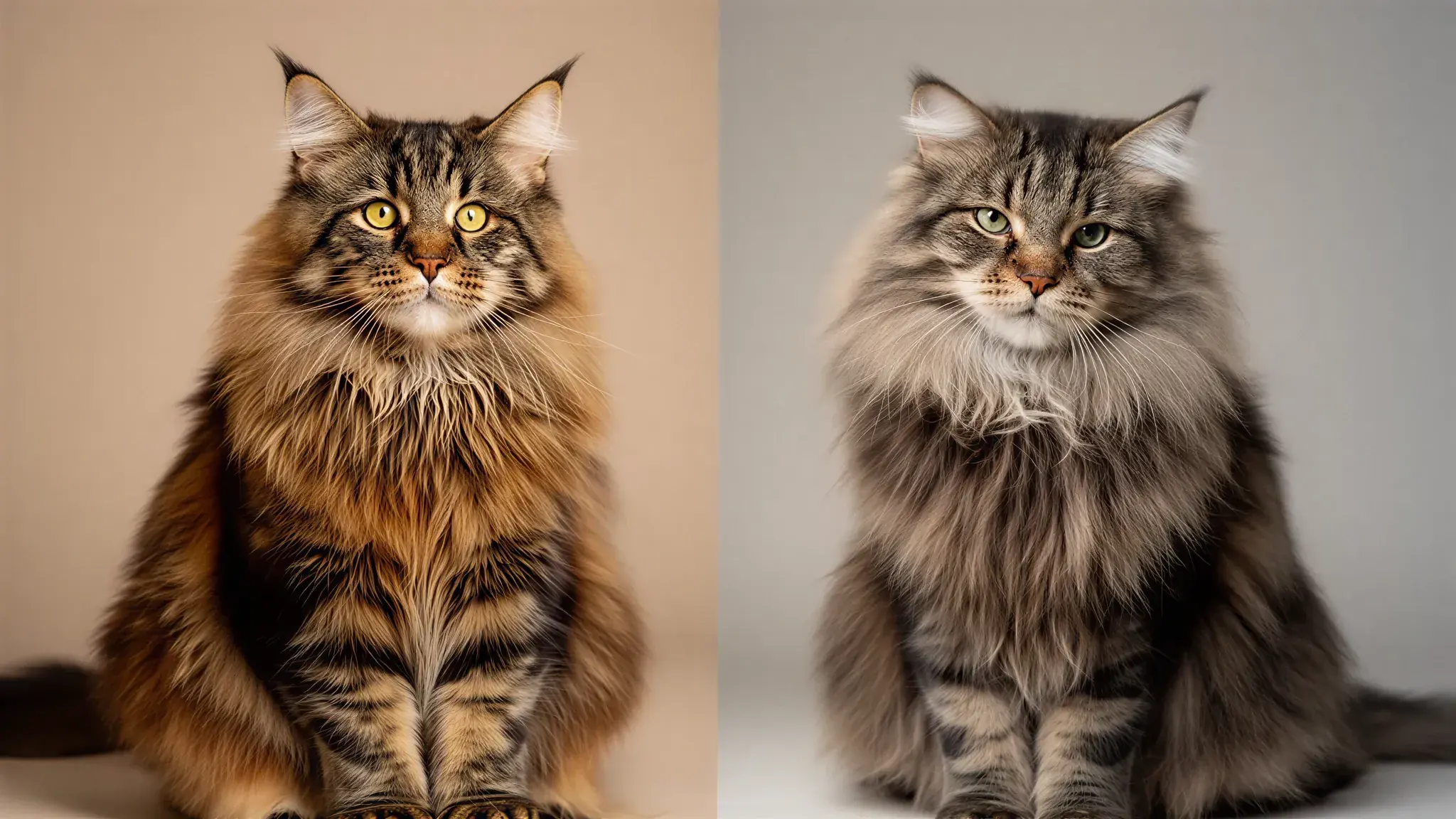
Both of these cats are large, longhaired, and slow to finish growing, and both came out of cold-weather working-cat populations. That is where the similarity starts to matter less than people expect. A Maine Coon is the one who follows you into the bathroom and treats a running tap as a hobby. A Norwegian Forest Cat is the one who supervises from the top of a cabinet and decides for itself when the lap happens. If you want a cat that goes limp in your arms, neither of these is that cat. If you want one that will sit on the windowsill and review the room, you are in the right place.
The decision is really social versus self-contained. Maine Coons tend to want in on whatever you are doing, and they are often the more vocal of the two. Forest Cats are calm, confident, and happier to work a room from a distance. Both have a coat that needs real comb time, and both bring a health-screening conversation you should have with a breeder or a rescue before you commit.
Quick Verdict
Choose Maine Coon if: you want a social, playful, dog-like cat who follows you around, often talks back, and often investigates water.
Choose Norwegian Forest Cat if: you want a quieter, more independent cat who entertains itself, comes to you on its own terms, and is content to watch the house from a high shelf.
Choose neither if: you wanted a floppy lap cat, a short coat with almost no maintenance, or a cat that will not test the top of your bookcase. A Ragdoll covers the first job and an American Shorthair covers the second. If you are not sure your cat is either breed, appearance alone will not settle it.
Side-by-Side Comparison
| Feature | Maine Coon | Norwegian Forest Cat |
|---|---|---|
| Size | Large; CFA calls the body medium to large and says quality is never sacrificed for size | Large; CFA lists males about 12–16 lb and females about 9–12 lb after slow growth |
| Coat | Long, heavy, uneven: shorter shoulders, longer britches and a frontal ruff | Long water-resistant double coat over a dense undercoat |
| Head and profile | Slightly longer than wide, square muzzle, slight profile concavity | Equilateral-triangle head, straight profile from brow to nose |
| Build | Rectangular, broad-chested, muscular | Solid and moderate, hind legs longer than the front |
| Personality | Friendly, playful, intelligent, sociable | Gentle, independent, affectionate on its own schedule |
| Care level | Medium | Medium |
| Lifespan (profile) | 12–15 years | 14–16 years |
| Health to ask about | HCM and hip dysplasia | Glycogen storage disease type IV, hip dysplasia, HCM |
| Best for | A home that wants an interactive, present cat | A home that wants a calm, self-reliant cat |
| Vocal level | Chirps and trills, not a talkative breed in the Siamese sense | Bird-like chirps when excited, otherwise quiet |
What You Can Actually See
Head shape is the fastest tell. The Maine Coon head is a little longer than it is wide, with a square muzzle and a strong chin. The Forest Cat head is an equilateral triangle, the same length from the outside of each ear base to the chin, with a straight line from brow to nose. A square muzzle is a disqualification on the Forest Cat standard, and the long rectangular Maine Coon body is another. Those two shapes separate the breeds in a photo better than coat length does.
The coat maps differently too. A Maine Coon has an uneven, shaggy coat that is shorter on the shoulders and longer on the stomach and britches, plus a front ruff. A Forest Cat wears a dense undercoat under long, glossy guard hairs that shed water, with full britches and a three-part bib. Both are big cats in winter wool, but the texture and the way the fur sits are not the same.
The rear end is another clue. Forest Cats have hind legs longer than the front, so the rump sits higher than the shoulders, and the paws toe out slightly in front. Maine Coons are built long and level. Maine Coons also often show tufted ears and tufted paws, but tufting is not proof of a breed. Any of these features can show up in a mixed longhair, which is why a look-alike is not a pedigree.
Temperament: Social versus Self-Contained
Maine Coon
CFA describes Maine Coons as sociable and loyal, and notes that at home they tend to move from lap to lap rather than attaching to one person and staying put. They solve problems, remember where a toy was hidden, and stay curious well past kittenhood. Voice is a set of chirps, trills, and purrs rather than a running commentary. Many of them like water, or at least like watching it: a dripping faucet, a bowl, the edge of a shower. That is a tendency, not a guarantee, and it is a reason not to leave a full tub open to a curious cat.
This is a cat who wants to be near the action. CFA’s own note is that people who work from home may occasionally need a closed door. If you wanted a cat that stays out of the way, a Maine Coon is the wrong direction. The upside is a cat that greets you, follows you, and often plays fetch on its own terms.
Norwegian Forest Cat
The Forest Cat is friendly but self-sufficient. CFA says they are not clingy, that they will seek company after being alone a while, and that they may be lap cats but decide when the lap begins and ends. They entertain themselves with runs, ambushes, and climbing. That independence is not coldness; it is a cat that arrives on its own schedule. A week in the house usually looks like a morning patrol, a long nap in a high spot, a burst of play, and an evening nearby without being on you.
They get along with children, dogs, and other cats in CFA’s description, and they are typically quiet, using bird-like chirps when excited. Both breeds can be good with respectful kids, but a large cat needs an adult who will teach a child to sit and let the cat choose the contact. A cat this size can knock a toddler over without meaning to, and a Forest Cat who has had enough will leave rather than endure.
Grooming and Care
Both coats are real work, but the work is different.
The Maine Coon coat is uneven on purpose, which means the longer areas mat first. Brush the britches behind the back legs and comb the ruff around the neck, not just the back. The coat is silky and falls smoothly when it is maintained; skip it long enough and you will feel a clump before you see one. A wide-tooth comb for the longer hair and a slicker or pin brush for the rest covers it. Shedding spikes in spring and fall. This is medium care, not Persian-level face washing, and not a British Shorthair wipe-down either.
The Forest Cat coat surprises people who bought it with their eyes. CFA’s grooming note says the impressive double coat does not need a lot of maintenance and that a steel comb handles most tangles. Spring is the season that matters, when the winter undercoat comes out and the britches and ruff can felt if you ignore them. Bathing is a project because the guard hairs resist water, and the coat takes a long time to wet and dry. Neither breed needs a weekly bath. Both need nails, ears, and teeth kept up like any cat.
Feeding and Weight
Both are large, slow-maturing cats, and both carry hip dysplasia on the health line. Extra weight loads a joint that may already be a weak point. The honest feeding answer is the same for both: measure the food, find the waist with your hands under the coat, and use a cat-specific calorie guide rather than a cup number copied from a breed page. Our How Much Should I Feed My Cat? walks through the math.
The trap with slow-maturing breeds is the long “he’s still filling in” stage. A Maine Coon may look unfinished at a year, and a Forest Cat can take roughly five years to finish, so it is easy to overfeed while waiting for the adult to appear. Weigh the cat monthly during that window. A large cat who suddenly stops jumping onto the tree they used last year is a veterinarian visit, not a personality change.
Health Screening
The health conversation is where the two breeds separate most.
For a Maine Coon, ask about echocardiograms for hypertrophic cardiomyopathy and hip x-rays. Cornell lists Maine Coons among the breeds where HCM is more prevalent, and among the breeds where hip dysplasia shows up more often. HCM is a thickening of the heart’s left-ventricle wall that can make the pump less efficient; many cats show no signs, while others develop labored breathing or lethargy when fluid builds up. Diagnosis is by ultrasound. Genetic tests exist, and Cornell’s guidance is to interpret them with a veterinarian because not every cat with a mutation develops the disease. Hip dysplasia is a loose ball-and-socket joint that grinds and can lead to arthritis; an x-ray is the diagnosis, and keeping the cat lean reduces the load.
For a Norwegian Forest Cat, the breed-specific test is for glycogen storage disease type IV. A 2007 paper described a rearrangement in the GBE1 gene in this breed. It is recessive, so two copies are needed, and carriers look normal. Most affected kittens die at or soon after birth, while some appear healthy until neuromuscular problems begin around five months. Ask a breeder for a DNA result, not a reassurance. CFA also lists HCM screening for the breed, and Cornell names Forest Cats among the higher-prevalence HCM breeds, so ask for an echo as well. Hip x-rays belong on the list too.
If a cat’s breathing changes, the hind legs fail, or a kitten collapses, that is a same-day veterinarian visit. This page does not diagnose anything.
Which One Fits Your House?
Choose a Maine Coon if you want a present, interactive cat who talks to you, follows you between rooms, and treats play as a daily event. Choose a Maine Coon if you will actually comb the britches and the ruff, put a sturdy tree under a ceiling, and fund a heart echo. Choose a Maine Coon if you like the idea of a cat who wants to help with whatever you are doing, including the shower.
Choose a Norwegian Forest Cat if you want a calm, independent cat who is happy in its own company, comes to you on its own terms, and spends a lot of the day in a high place watching the house. Choose a Forest Cat if you will still comb out the spring undercoat and ask for a GSD IV result. Choose a Forest Cat if a noisy house with an adult who manages the children is the setting and you want a cat that can remove itself from the chaos.
Choose neither if you wanted a cat that tolerates being carried around. CFA explicitly warns that Maine Coons and Forest Cats are not fond of being hauled, and Maine Coons in particular are described as moving from lap to lap rather than melting into one. Choose neither if you wanted low coat work, because both coats need attention, and the Forest Cat’s spring shed is a project. Choose neither if a big, climbing cat in a small, unenriched apartment is the plan.
If you already have a longhaired cat and are trying to name the breed from a photo, this is the wrong test. Appearance does not prove pedigree, and a domestic longhair can carry the tufts, the ruff, and the size without either breed’s paperwork. Our What Breed Is My Cat? guide covers what visual clues can and cannot tell you.
Frequently Asked Questions
Which is bigger, Maine Coon or Norwegian Forest Cat?
Maine Coons read as the longer, more rectangular cat. The Cat Fanciers’ Association calls the Maine Coon body medium to large and says quality is never sacrificed for size. For the Forest Cat it lists adult males around 12 to 16 pounds and females around 9 to 12 after up to five years of growth. Meet adults of both before you decide size from a photo.
Which breed sheds more?
Both shed, and the Forest Cat’s spring undercoat drop is the dramatic one. The Maine Coon coat is uneven, with longer britches and a ruff that mat if ignored. The Forest Cat coat takes longer to wet and dry because the guard hairs resist water. Budget comb time for either.
Which breed is more affectionate?
Maine Coons usually show it first. CFA describes them as sociable and loyal, often moving from lap to lap. Forest Cats are affectionate on their own schedule, and CFA says they decide when the lap starts and ends. Neither is a guaranteed lap cat, and individuals vary.
Can a Maine Coon and a Norwegian Forest Cat live together?
Often yes. Both tend to be social with other cats, and their similar size means neither is physically overwhelmed. Introductions still matter, and a slow, supervised introduction works better than dropping them in one room.
Which large breed is better for an apartment?
Both can adapt if they get height, play, and a window. A Maine Coon who wants constant company is a harder fit for a small, empty apartment than a Forest Cat who entertains itself. Whatever the breed, a large cat needs a sturdy tree that will not sway on landing.
Which breed lives longer?
The profiles put the Forest Cat slightly ahead, at 14 to 16 years against 12 to 15 for the Maine Coon. Those are typical ranges, not a guarantee for an individual cat. Screening and weight management matter more than the breed line on a rescue form.
Read the full Maine Coon breed guide and Norwegian Forest Cat breed guide for history, coat detail, and the breeder questions specific to each. If you want the floppy alternative, the Ragdoll breed guide explains why that breed is the lap-cat comparison for both of these. Names for either breed live on Maine Coon cat names and Norwegian Forest Cat names.