
British Shorthair vs Russian Blue: Plush vs Silver
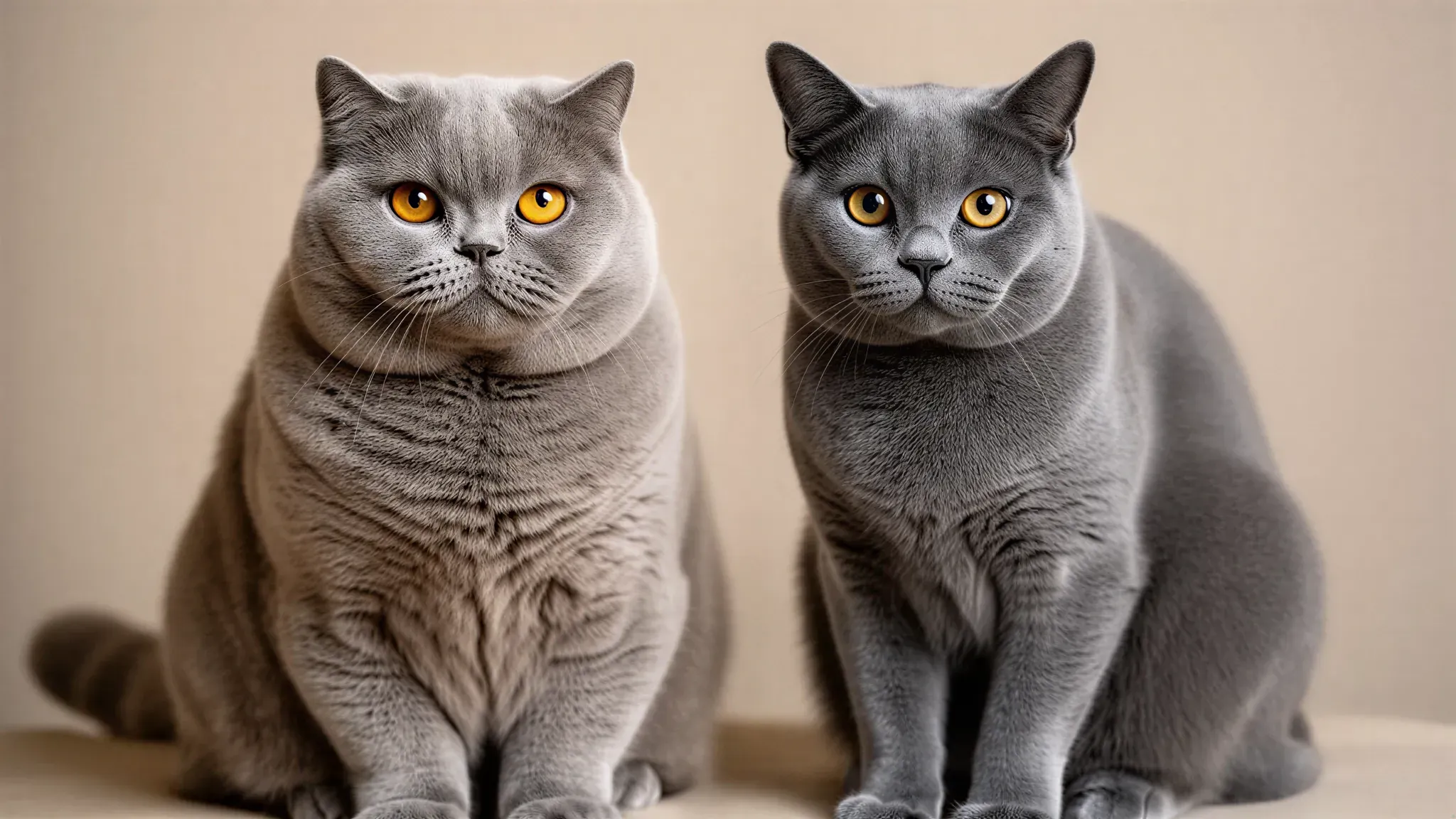
These two breeds get grouped together because both are calm, quiet, and often blue-grey. Up close they are built differently. A British Shorthair is round and heavy-boned with a dense coat that springs back when you push it, and it supervises the room from one cushion over. A Russian Blue is a fine-boned, silver-tipped wedge with vivid green eyes that tends to hide first and investigate second. Both are low-drama cats. Neither is a velcro cat.
The real choice is how much interaction you want and how you feel about being chosen. A British Shorthair is content to be near you and usually waits for an invitation to your lap. A Russian Blue is more likely to follow you once it decides you are safe, and it needs a job to keep its mind busy. Both carry the same two health items on the site profile, so the health conversation is nearly identical.
Quick Verdict
Choose British Shorthair if: you want a quiet, self-contained cat with a plush round look that sits beside you rather than on you, and you are fine waiting for it to come to you.
Choose Russian Blue if: you want a reserved but interactive cat that will bond closely once it trusts you, and you are ready to give it puzzles and attention.
Choose neither if: you wanted a cat that greets every guest at the door, or one that tolerates being picked up and carried around. A Siamese covers the greeter job and a Ragdoll is the more tolerant lap cat. Neither breed is hypoallergenic.
Side-by-Side Comparison
| Feature | British Shorthair | Russian Blue |
|---|---|---|
| Head | Round and massive, round cheeks, no stop | Smooth medium wedge, blunt muzzle, no break |
| Build | Compact, powerful, deep chest, broad | Fine-boned, long, firm, muscular, not tubular |
| Coat | Short, very dense, crisp; springs back against the grain | Short, fine, plush double coat with silver-tipped guard hairs |
| Eyes | Copper or gold on blue; other colors vary | Vivid green on the adult; kittens take time to turn green |
| Personality | Calm, independent, gentle, loyal | Gentle, intelligent, independent, quiet |
| Care level | Low for the coat | Low for the coat |
| Lifespan (profile) | 12–17 years | 10–16 years |
| Health to ask about | HCM and PKD | HCM and PKD |
| Best for | A quiet home that wants a calm presence | A quiet home willing to wait for the bond |
| Vocal level | Low; occasional comment | Low to moderate; soft chirps and check-ins |
What You Can Actually See
The heads tell you the most. A British Shorthair has a round, massive head with full cheeks and large round eyes, and the coat is so dense that it stands up and holds its shape. Push your hand against the grain and the coat returns to place. A Russian Blue has a smooth wedge head that is neither long and tapering nor short and round, with a flat skull profile and wide-set green eyes. The coat is fine and plush, and in daylight the guard hairs show a distinct silver tip over the blue.
Color is a trap. British Shorthairs come in many colors, and blue with copper or gold eyes is only the postcard version. Russian Blues are blue only in CFA, and any other color disqualifies, as do a locket or button, a long coat, or a kinked tail. A grey cat with gold eyes is not a Russian Blue. It might be a British Shorthair, a Chartreux, or a mixed cat, and appearance alone will not settle it.
The body shapes differ further once the cat moves. British Shorthairs are compact and powerful, with short, strong legs and a thick tail. Russian Blues are longer and fine-boned, with long legs and small paws, but the dense coat keeps them from looking thin. Both mature slowly: a British Shorthair can take three to five years to look finished, and a Russian Blue’s eyes may only turn fully green after kittenhood. Meet the adult, not just the kitten, if type matters to you.
Temperament: Present versus Reserved
British Shorthair
A British Shorthair is calm in a way that reads as dignity. CFA describes an interest in the household, affection spread across the family rather than fixed on one person, and a habit of supervising from a nearby distance. They wait for an invitation to the couch instead of climbing into your lap, and they are generally patient with children as long as nobody hauls them around. CFA specifically advises teaching children that these cats are not fond of being carried.
They are quiet and sedate, they learn the routine, and they will tap a paw when the routine changes. Loud play can make them withdraw, which is worth knowing before you bring one into a house with three kids and a dog. This is a cat that wants a calm presence in the room, not constant handling. The affection is real; it is just offered on the cat’s schedule.
Russian Blue
A Russian Blue is also quiet and calm, but more of an observer at first. CFA describes the typical reaction to a newcomer as hiding under the sofa, followed by curiosity. In the house, they are intelligent and mechanically minded: closed cabinets, drawers, and sealed jars are problems to solve. Give them puzzle feeders and regular interactive play, or they will find a job you did not assign. They are affectionate with their trusted people, can take a lap, and may ride a shoulder.
They dislike chaos and change, and they do best with consistent meal times and a predictable routine. Older children who let the cat take its time are a better fit than a loud playroom. Once a Russian Blue decides you are safe, the bond is strong, but it will not be rushed.
Grooming and Care
Grooming is low for both, with a seasonal bump.
The British Shorthair coat is dense and sheds, so a rubber brush a couple of times a week and daily during the shed keeps it under control. The coat should look crisp and open, never flat and greasy. Grooming does not replace the rest of the routine: nails, ears, and teeth still need attention. Low coat work is not a license to free-feed.
The Russian Blue has a plush double coat that also sheds, and it stands off the body because it is dense. A rubber brush or comb a couple of times a week, daily during the shed, is enough. Push the coat against the grain and the silver tipping should show. A flat, dull grey with no sheen is either an ungroomed cat or possibly not a pure Russian Blue, so it is worth looking closely before you buy.
Neither breed needs regular bathing. Both benefit from a sturdy tree or a window perch, though the British Shorthair is a power cat rather than an aerialist, and the Russian Blue appreciates a puzzle and a high spot. A wand they can catch beats a laser for both.
Feeding and Weight
Both breeds are on the easy side to overfeed. A British Shorthair likes dinner and carries a dense coat that can hide a middle, and a Russian Blue has a noted appetite in CFA’s breed notes. The fix is the same for both: measured portions, a monthly weigh-in, and play that gives the appetite somewhere to go. Use our How Much Should I Feed My Cat? for portions rather than a cup number copied from a breed page.
A cat who can no longer make the jump they used to is not being refined or lazy. That is a weight and joint conversation with your veterinarian. Keep both breeds lean, especially through the slow British Shorthair growth window, when “he’s still filling in” can quietly become overweight.
Health Screening
The two profiles list the same pair: hypertrophic cardiomyopathy and polycystic kidney disease. Ask for heart scans and kidney screening either way, and do not let a cheerful breed brochure replace paperwork.
For the British Shorthair, CFA’s health overview says there are no breed-specific issues of concern and flags blood type B for breeders, while Cornell names British Shorthairs on its PKD page. Those two statements can both be true and still leave you asking for a heart echo and a kidney check. Blood type is worth recording once for any cat, because it matters if a transfusion is ever needed.
For the Russian Blue, CFA says this natural breed is not known to have specific genetic problems and names obesity as the main risk. Cornell’s HCM and PKD pages are the general references, and the site profile lists both conditions for the breed. HCM is a thickening of the heart wall that can make the pump less efficient and is diagnosed by ultrasound; many cats show no signs, while others develop labored breathing or lethargy. PKD causes fluid-filled cysts in the kidneys and can be screened for. Genetic and ultrasound tests exist, and Cornell’s guidance is to interpret them with a veterinarian.
If a cat is drinking more, losing weight, hiding, or breathing differently, that is a veterinarian visit. This page does not diagnose or treat anything.
Which One Fits Your Home?
Choose a British Shorthair if you want a quiet, solid presence who is happy to be in the room without being on you, and if you will respect that it does not like being carried. Choose a British Shorthair if a calm house with a routine suits you and you can wait three to five years for the adult shape to arrive.
Choose a Russian Blue if you want a reserved cat that will become a close companion on its own terms, and if you will provide puzzles, play, and a predictable routine. Choose a Russian Blue if you are patient enough to let a new cat hide, watch, and then approach you. Choose a Russian Blue if you want a cat that notices when the household gets chaotic, because it will.
Choose neither if you want a cat that rushes the door for every guest. That is a different temperament. Choose neither if you expect to carry your cat around; the British Shorthair in particular is not fond of it. Choose neither if you need a hypoallergenic cat, because no cat is, and a dense coat can trap dander for some people and do nothing for others. Sit with an adult before you decide.
If you are looking at a grey cat and trying to work out which breed it is, a photo will not prove it. A mixed cat can have the round look or the silver tip without the registration. Our What Breed Is My Cat? guide explains what visual clues can and cannot tell you.
Frequently Asked Questions
Which breed is calmer, British Shorthair or Russian Blue?
Both are calm. The British Shorthair tends to be the more self-contained of the two and waits for an invitation to the couch. The Russian Blue is also quiet but more likely to seek you out once it trusts you. Individual cats vary, so meet an adult before you decide.
Which breed is quieter?
The British Shorthair is usually the quieter cat, with occasional comments rather than a running conversation. The Russian Blue is quiet too but tends to chirp and check in more. For a very noise-sensitive home, both are reasonable, and neither narrates like a Siamese.
Which breed is better with children?
Both do well with children who are taught to be gentle. The British Shorthair is patient but not fond of being carried around, so CFA advises telling children to leave it on the floor. The Russian Blue prefers older children who will let it approach on its own. An adult should always manage the contact.
Which breed sheds less?
Both shed. The Russian Blue’s fine coat can make the shed less obvious, but a plush double coat is still a coat. The British Shorthair’s dense, crisp coat blows seasonally and benefits from brushing a couple of times a week, daily during the shed.
Can a British Shorthair and a Russian Blue live together?
Usually yes. Both are calm, quiet cats with similar energy levels, and neither is aggressive by nature. A slow introduction still helps, especially for the Russian Blue, which tends to be reserved at first.
Which breed lives longer?
The profiles put the British Shorthair at 12 to 17 years and the Russian Blue at 10 to 16. Those are typical ranges, not promises. Screening, weight, and dental care move the odds more than the breed label.
Read the full British Shorthair breed guide and Russian Blue breed guide for history, coat detail, and the breeder questions specific to each. If the round face has you comparing other grey breeds, the Chartreux breed guide explains the third cat people mix into this group. Names for either breed live on British Shorthair cat names and Russian Blue cat names.