Norwegian Forest Cat Breed Guide: Personality & Care
A Norwegian Forest Cat is a large, independent farm cat from Norway with a water-resistant double coat and a head that reads as an equilateral triangle. The profile on this site lists them as gentle and independent, long-coated, medium care, 14–16 years. That is not a Maine Coon with a Scandinavian flag. The Coon is friendly and playful with a square muzzle. This one will sit near you until it remembers something more important to do on its own, which is also how the Cat Fanciers’ Association describes living with them.
Quick Facts
| Attribute | Detail |
|---|---|
| Origin | Norway |
| Size | Large (CFA: about five years to mature; males ~12–16 lb, females ~9–12 lb) |
| Coat | Long double coat; water-resistant guard hairs over a dense undercoat |
| Personality | Gentle, independent |
| Lifespan | 14–16 years |
| Care level | Medium |
| Health to ask about | Glycogen storage disease type IV, hip dysplasia; CFA also names HCM screening |
| Common names | Thor, Freya, Loki, Snow |
History & Origins
Call them Skogkatt in Norway and Wegie in a show hall if you want. The history that matters is shorter than the mythology. CFA’s breed page is honest that the exact origins are not clear. The “4,000 years in the forest” line is a thought, not a dig. What CFA will stand on: they were working farm and ship cats, King Olaf named them the official cat of Norway in the 1970s, the first breeding pair reached the United States in 1979, and CFA championship status arrived in 1993 — seventeen years after the Maine Coon.
The almost-lost part is real. CFA says the breed was nearly absorbed by shorthair strays until a club formed in Norway in the mid-1970s and started a program from carefully selected non-pedigreed cats, certified by a panel of judges. That is why a Forest Cat is not “any big fluffy cat from a cold place.” Someone had to pull a type back out of a farm population.
Norse stories attach them to Freya’s chariot. Fine for a name. Not evidence. Viking ships may have carried rodent-control cats to the North American coast around the late 900s, CFA says “it seems likely.” Treat it as a maybe. The cat in your living room still has to pass a GSD IV test.
If you are actually choosing between this breed and a Maine Coon, stop bouncing between two guides and use Maine Coon vs Norwegian Forest Cat. This page owns living with the Forest Cat.
Personality & Temperament
Gentle and independent is the whole personality line on our profile, and it is the part people skip when they buy a winter postcard. CFA fills in the daily version: they are not clingy; they will come looking for company if you leave them alone too long; they can be lap cats, but they decide when the lap starts and when it ends. They will help with whatever you are doing until they remember a better job. That sentence would be false for a Siamese who narrates the cupboard, and it would be a stretch for a Maine Coon that CFA describes as moving from lap to lap.
Moderately active, with random bursts. CFA says they entertain themselves — run, hide, ambush a toy like prey — and that they get along with other cats, dogs, and children. Bird-like chirps when they are excited, plus a soft purr. Not a talkative breed in the Siamese sense.
Height is not optional decoration. CFA is blunt: they like high places, so give them a tall tree or they will pick the kitchen cabinet. That is a Forest Cat sentence. A British Shorthair will take a sun patch on the floor and call it a day.
They showed up on Best Cat Breeds for Families with Kids because gentle plus independent is workable in a house that already has noise, as long as an adult owns the litter and the “leave the cat alone” call. They are a poor fit if you wanted a dog-like shadow. That is the Coon’s sales pitch, not this one.
Physical Characteristics
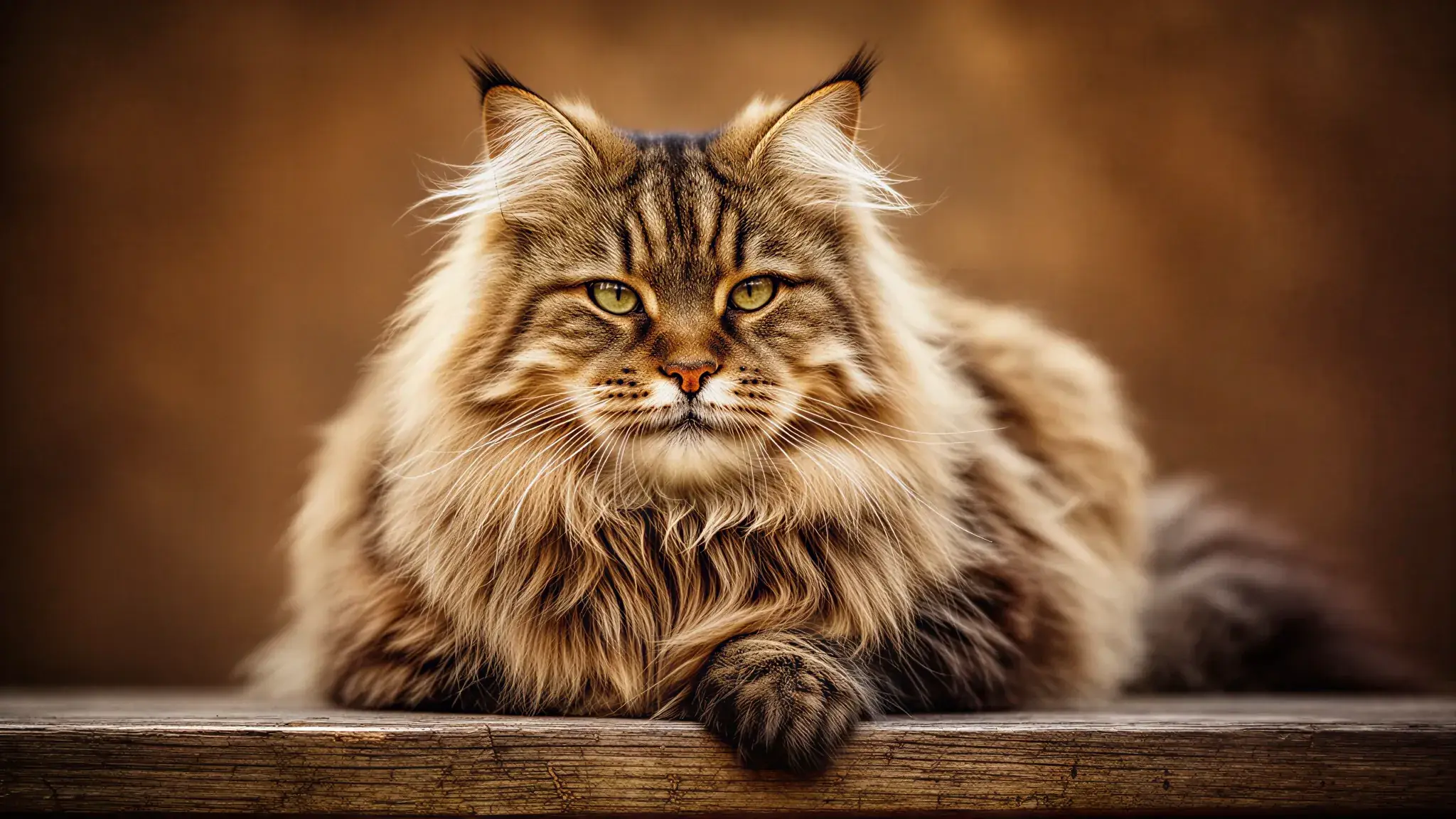
CFA’s standard is built to stop people from showing a Maine Coon in this class. The head is an equilateral triangle: same length from the outside of each ear base to the chin. The profile is straight from brow to nose, no break. A square muzzle is a disqualification. A long rectangular body is a disqualification. Those two DQs are Maine Coon virtues. If the cat in the photo has a boxy muzzle and a sofa-length rectangle, you are looking at the wrong breed.
Ears are medium to large, rounded at the tip, set as much on the side of the head as on top, heavily furnished. Lynx tips are desirable, not required. Eyes are large almonds, outer corner higher than the inner. The neck is short and heavily muscled.
The body is solid, moderate in length, broad-chested, with deep flanks. Males should look imposing; females may be smaller and more refined. Hind legs are longer than the front, so the rump sits higher than the shoulders. Paws toe out in front. Heavy tufting between the toes. Tail as long as the body from tail base to neck, bushy, broader at the base, guard hairs wanted.
The coat is the other tell: a distinguishing double coat, dense undercoat, long glossy water-resistant guard hairs hanging down the sides. The bib is three parts — short collar, mutton chops, frontal ruff — and the britches are full. Winter coat is fuller because the undercoat actually develops. Type of coat beats color. Every color and pattern is allowed except hybridization colors: chocolate, sable, lavender, lilac, cinnamon, fawn, and pointed Himalayan markings. Amber is on this standard as its own color class. Kittens can look brown or blue and mature into amber. That maturation is a Forest Cat fact. Do not expect it on a Maine Coon.
CFA’s breed page gives adult weights of about 12 to 16 pounds for males and 9 to 12 for females, after up to five years of growth. I am repeating their numbers, not a scale I own. A two-year-old who still looks lanky may be on schedule.
Care Requirements
Grooming
CFA’s grooming note surprises people who bought the coat with their eyes: the impressive double coat does not, in their words, require a lot of maintenance. Regular combing with a steel comb handles most tangles. The coat is generally less tangle-prone than some other longhairs, which is how a farm cat kept a coat that sheds water. Spring is the season that matters. The winter undercoat comes out. Some textures mat more than others. If you skip that shed, you will find felt in the britches and the ruff the same way you would on any longhair you ignored.
Bathing is a project because the guard hairs are water-resistant on purpose. CFA says the coat takes a long time to get wet and longer to dry. Ask a breeder before you invent a shampoo routine. Most pet Forest Cats need a comb, not a salon.
This is still medium care, not zero. A British Shorthair is zero-adjacent. A Persian is a second job. Land here.
Feeding
Large, slow-maturing, and on a profile that lists hip dysplasia. Extra weight is not a cosmetic problem. Cornell’s hip page says obesity increases pressure on the supporting structures of a bad hip. The right amount depends on the individual cat. Use How Much Should I Feed My Cat?, then find the waist under the ruff with your hands.
They take five years to look finished. Do not crash a rangy two-year-old because an internet photo looked heavier. Ask your veterinarian what “slow maturation” means for this cat’s meals.
Exercise & Enrichment
Independent is not sedentary. CFA’s bursts of energy and cabinet-climbing are the brief. A sturdy tree that can hold a large cat, a wand they can ambush, and a person who will play and then stop — that is the routine. Indoor Cat Enrichment is the longer setup.
They do not need a Norwegian forest. They do need height. A studio with one windowsill and a toddler already using it is a tighter fit than a Domestic Shorthair with a known calm temperament.
Health Concerns
The profile lists two: hip dysplasia and glycogen storage disease. CFA’s breed page adds hypertrophic cardiomyopathy as something breeders routinely test for. Cornell’s HCM article includes Norwegian Forest Cats on the list of breeds where that heart disease is more prevalent. Cover all three when you talk to a breeder. Do not let anyone skip the one that is actually unique to this breed.
Glycogen storage disease type IV is the Forest Cat question. A 2007 paper (Fyfe and colleagues, PMC2063609) describes a naturally occurring form of the human disease in this breed: a complex rearrangement in GBE1, the glycogen branching enzyme gene. Abnormal glycogen builds up in muscle, liver, and neurons. Most affected kittens die at or soon after birth, likely from low blood sugar. Survivors can look normal until progressive neuromuscular disease starts around five months. In that paper’s kindred, two cats had severe muscle disease by eight months; one was euthanized at nine months, another died of sudden cardiac failure at 13 months. The same paper screened 402 privately owned Forest Cats and found 58 carriers and 4 affected cats. That is one study, not a current worldwide rate. Inheritance is recessive: two copies. Carriers look fine. Ask for a DNA result. A “we don’t have that in our lines” sentence is not a result. I am not going to tell you how to treat an affected kitten. That conversation is your veterinarian’s.
Hip dysplasia is the joint malformation Cornell describes: a loose ball-and-socket that grinds, then shallows, then hurts. Cornell notes it is rare in cats compared with dogs and more often discussed in certain large breeds. Signs they list: limping, avoiding activity, pain when the hip is touched, licking at the hip. Diagnosis is an x-ray. Ask for films on breeding cats. Keep the adult lean. If a large cat stops jumping onto the tree they used last year, that is a vet visit, not a personality change.
Hypertrophic cardiomyopathy is thickening of the heart’s pumping walls. Cornell’s page is the one to read. Diagnosis is echocardiography. Genetic tests exist for some breeds and need a veterinarian’s interpretation. CFA says Forest Cat breeders now routinely test. Ask to see the echo, not a shrug.
If hind legs fail, breathing changes, or a kitten collapses, that is the same day, not this page.
Is a Norwegian Forest Cat Right for You?
This breed fits people who want a large, gentle, independent cat and will comb out a spring undercoat, fund a GSD IV test, and put a tree under a ceiling. Families who liked them on the families page wanted that independence — a cat that walks away instead of enduring until it explodes.
Who should pick a different cat: you, if you wanted a playful, people-shadowing giant. That is the Maine Coon. You, if you wanted a floppy lap fixture. That is the Ragdoll. You, if you wanted low coat work. American Shorthair. You, if a breeder will not show a GSD IV result and you were going to shrug. You, if five years of “they’re still filling out” will make you overfeed.
What Breed Is My Cat? is for the mixed longhair who only looks like a Skogkatt in winter light.
Finding a Norwegian Forest Cat
A serious breeder of this breed can produce a GSD IV genotype, talk about echos, and explain how they keep a slow-maturing kitten from turning into a mat. CFA’s own note is that breeders test for HCM and glycogen storage disease and work to keep carriers out of the pool. Ask what “out of the pool” means in their cattery. Ask to meet adults, because five-year coats are the product.
Rescue exists. Breed-specific groups and ordinary shelters both get Forest Cats and Forest-looking mixes whose people underestimated the spring shed. An adult with a known temperament beats a papered kitten you have not seen climb.
Red flags: no DNA paperwork, kittens in a shop window, “they’re just like Maine Coons,” extra toes sold as a breed requirement (incorrect toe count is a disqualification), or a square-muzzled rectangle labeled Norwegian because the coat is long.
Adopting vs. Buying from a Breeder is the general comparison. This page is the Forest Cat filter on top of it.
Popular Norwegian Forest Cat Names
The four names on the breed profile are Thor, Freya, Loki, and Snow. Snow is a color word people use; it is not in the name data, so the three that link are Thor, Freya, and Loki. Freya in that data means Lady, which is enough without turning the cat into a myth assignment. More of that winter register:
Thor — Norse, thunder; one of the four profile names
Freya — Norse, lady; the profile’s female name, independent on purpose
Loki — Norse, trickster god; for the cabinet-climbing personality, not a sleepy one
Odin — Norse, inspiration; heavier than Loki
Astrid — Norse, divinely beautiful; a girl name that is not Freya again
Bjorn — Norse, bear; rugged without copying Bear
Bear — English, large mammal; honest on a 12-to-16-pound male
Aurora — Latin, dawn; use it for a silver or pale coat, not because the internet said northern lights
Snowball — English, ball of snow; for an actual white cat
Forest — wooded area; only if you would shout it up the stairs
Luna — Latin, moon; silver tabbies
Oliver — English, olive tree; if you want friendly without the Norse kit
Explore more in Norwegian Forest Cat names, or filter gentle names in the Name Generator.
Frequently Asked Questions
What is the difference between a Norwegian Forest Cat and a Maine Coon?
A Norwegian Forest Cat has an equilateral-triangle head, a straight profile, hind legs longer than the front, and a water-resistant double coat. A Maine Coon has a square muzzle and a long rectangular body — both of those are disqualifications on the Forest Cat standard. Forest Cats take about five years to finish growing. Temperament on our profiles is gentle and independent versus the Maine Coon’s friendly, playful, and intelligent.
How big do Norwegian Forest Cats get?
They are a large breed that matures slowly. The Cat Fanciers’ Association says full growth takes about five years, and lists adult males around 12 to 16 pounds and females around 9 to 12. Those are CFA’s numbers, not a measurement I made. A year-old Forest Cat is still a teenager.
Do Norwegian Forest Cats need a lot of grooming?
Medium care, with a seasonal spike. CFA describes a distinguishing double coat — dense undercoat plus long water-resistant guard hairs — and says regular combing handles most tangles, with more work in spring when the winter undercoat comes out. The coat takes a long time to wet and a long time to dry. This is not Persian face-washing, and it is not a British Shorthair wipe-down.
What is glycogen storage disease in Norwegian Forest Cats?
Glycogen storage disease type IV is an inherited enzyme problem described in this breed. A 2007 paper in the veterinary literature found a rearrangement in the GBE1 gene. Most affected kittens die at or soon after birth; some look fine until neuromuscular disease starts around five months. It is recessive: two copies. Ask the breeder for a DNA result. I am not going to tell you how to treat it.
Are Norwegian Forest Cats good with children?
They can be. CFA says they get along with children, dogs, and other cats, and that they are not clingy. Our profile is gentler and more independent than a Maine Coon. Kids who want a cat that initiates every game will be happier with the Coon. Kids who will let a cat decide when the lap happens will do better here. An adult still owns the hard no.
Go look at an adult in winter coat, then look at the same line in July. The undercoat is the product. The Norwegian Forest Cat gallery is here if you want the look before you book the visit.