
Best Cat Litter Boxes: Top High-Sided & XL Pans
Updated
On this page (10 sections)
- Why Litter Box Design Dictates Feline Elimination Behavior
- Box Sizing Formula: The 1.5x Feline Length Standard
- Stainless Steel vs. Plastic: The Micro-Scratch Biofilm Breakdown
- The High-Peeing Sprayer Problem: One-Piece Walls vs. Two-Piece Hoods
- Top Picks: Best Cat Litter Boxes Compared
- Detailed Product Reviews
- Open vs. Enclosed vs. Top-Entry: Behavioral Tradeoffs
- Ideal Box Placement and Setup Guidelines
- Signs Something Is Wrong
- Frequently Asked Questions
This article contains affiliate links. If you purchase through our links, we may earn a small commission at no extra cost to you. We only recommend products we’ve researched or personally found valuable for cat owners.
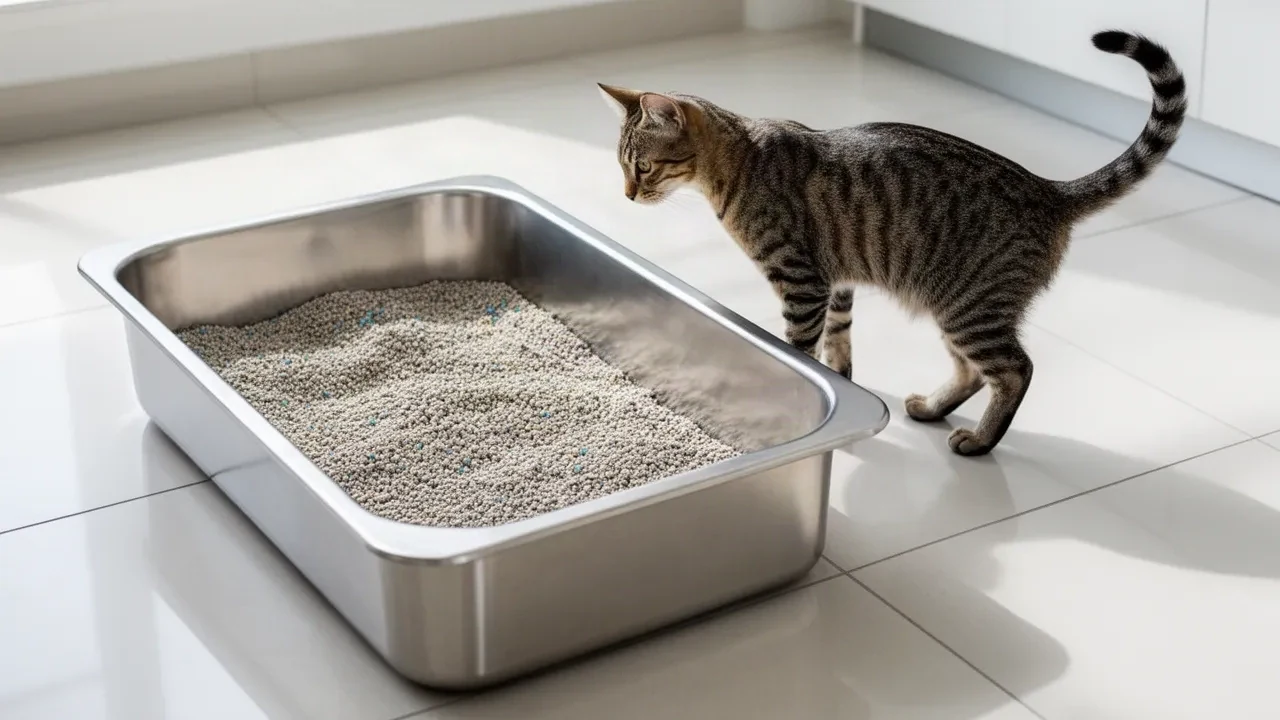
The best cat litter boxes provide unobstructed sightlines, smooth one-piece walls at least 10 to 12 inches high for high sprayers, and a floor footprint at least 1.5 times your cat’s nose-to-tail length. After testing different configurations with cats over thirty years, the top overall pick is the iPrimio High-Sided Stainless Steel Litter Box for its non-porous surface that never absorbs odors and 12-inch walls that stop urine leaks.
Choosing the right litter box is one of the most consequential gear decisions you will make as a cat owner. While human marketing prioritizes compact dimensions and hidden enclosures that blend into living room decor, feline biology demands space, ventilation, and clear escape routes. When a litter box fails to meet these instinctual requirements, cats do not lodge polite complaints; they simply choose your bath mat, carpet, or laundry pile instead.
This guide breaks down the engineering, feline ethology, and physical dimensions required to select the best litter box for your home, whether you manage a multi-cat household, a large breed, or a persistent high-peeing cat.
Why Litter Box Design Dictates Feline Elimination Behavior
Elimination is an intrinsically vulnerable moment for any feline. In natural outdoor environments, a cat seeks open terrain with loose substrate where they can survey their surroundings for predators and potential rivals before squatting. When we move that routine indoors, those fundamental instincts remain entirely unchanged.
According to the American Association of Feline Practitioners (AAFP) Environmental Needs Guidelines, litter box design directly impacts feline stress levels and house-soiling behavior. Enclosed, hooded boxes might seem appealing because they conceal waste from human eyes, but they present two severe challenges for felines.
First, hooded boxes concentrate ammonia and airborne dust inside an enclosed chamber. A cat’s sense of smell is roughly fourteen times more sensitive than a human’s. Odors that seem mildly unpleasant to us outside an enclosed box are completely overwhelming to an animal stepping into that confined space.
Second, enclosed designs create single-entry bottlenecks. In multi-cat homes, a dominant or playful cat can easily corner another cat as they exit a hooded box. This creates litter box ambush anxiety, which frequently leads to sudden box refusal. Providing an open-top box with wide visual angles removes this territorial friction and encourages consistent, stress-free use.
Box Sizing Formula: The 1.5x Feline Length Standard
The most common mistake cat owners make is purchasing a litter box scaled to their available floor space rather than their cat’s skeletal frame. Most commercial plastic litter pans sold in grocery stores measure roughly 18 inches long by 14 inches wide. For an average ten-pound domestic cat, this is uncomfortably tight; for a large breed, it is essentially unusable.
Veterinary behaviorists establish a clear sizing formula for optimal box dimensions:
$$\text{Minimum Box Length} = \text{Cat Length (Nose to Base of Tail)} \times 1.5$$
$$\text{Minimum Box Width} = \text{Cat Length (Nose to Base of Tail)} \times 1.0$$
To measure your cat accurately, run a soft measuring tape from the tip of their nose along their spine to the base of their tail (exclude the tail itself).
| Cat Size / Breed Category | Typical Nose-to-Tail Length | Minimum Recommended Box Floor (L × W) | Recommended Box Style |
|---|---|---|---|
| Kitten / Small Breed (e.g., Singapura) | 12–14 inches | 20 × 14 inches | Low-entry open pan (3” entry height) |
| Standard Domestic Adult (8–11 lbs) | 16–18 inches | 24–27 × 18 inches | High-sided open pan (10–12” walls) |
| Large Breed (Ragdoll, British Shorthair) | 19–22 inches | 30–33 × 20 inches | Extra-large stainless steel or open pan |
| Giant Breed (Maine Coon, Siberian) | 24–30 inches | 36–40 × 22 inches | Commercial storage tote or giant metal tub |
When a cat enters a litter box, they must have enough clearance to step inside, turn around a full 360 degrees without their whiskers or flank brushing against plastic walls, dig thoroughly, and squat without hanging their rear over the outer rim.
Stainless Steel vs. Plastic: The Micro-Scratch Biofilm Breakdown
Nearly 90% of litter boxes sold today are molded from polypropylene or polystyrene plastic. While plastic is cheap to manufacture and lightweight, it has a serious structural flaw: low surface hardness.
Every time your cat digs, their claws rake across the floor and interior walls of the box, creating microscopic grooves and scratches ranging from 5 to 50 microns deep. Over weeks of daily use, these micro-scratches become colonized by bacteria and saturated with feline urine compounds, specifically insoluble uric acid crystals.
Even aggressive scrubbing with bleach or dish soap cannot reach deep into these microscopic fissures. Over six to twelve months, the plastic box permanently absorbs a pungent ammonia odor. Humans notice a lingering background scent, but to your cat, the box smells permanently soiled, increasing the risk of behavioral rejection. To maintain hygiene with traditional plastic, owners must discard and replace the entire litter pan every twelve months.
Stainless steel litter boxes solve this problem permanently. High-grade stainless steel (such as 304 surgical grade) possesses a smooth, non-porous surface that cat claws cannot scratch. Urine slides off effortlessly without sticking, bacteria cannot establish protective biofilms, and uric acid crystals wash away completely with warm water and mild soap. A single stainless steel box lasts the entire lifetime of your cat, eliminating recurring replacement costs and plastic waste.
The High-Peeing Sprayer Problem: One-Piece Walls vs. Two-Piece Hoods
Many healthy cats do not squat deeply when they urinate. Some cats naturally stand horizontally, while others lift their tail and spray urine straight backward against the wall of the box. Senior cats with arthritis in their hips or spine often stand upright because squatting causes joint pain.
When high-peeing cats use standard two-piece litter boxes—such as a base pan with a snap-on hood or an attachable splash rim—urine inevitably strikes the seam where the two pieces join. Capillary action pulls the liquid through the crack, allowing urine to run down the outside of the box and puddle onto your subflooring or baseboards.
Solving the high-peeing issue requires a box with joint-free, one-piece construction featuring walls at least 10 to 14 inches high. When the vertical wall is continuous with no joints, clips, or overlapping plastic lips, urine simply flows down the smooth metal or plastic surface back into the litter substrate where it clumps instantly.
Top Picks: Best Cat Litter Boxes Compared
| Model | Primary Material | Dimensions (L × W × H) | Wall Height | Best For | Price Range |
|---|---|---|---|---|---|
| iPrimio High-Sided Stainless Steel | 304 Stainless Steel + Detachable Shield | 23.5 × 15.5 × 12 inches | 12 inches (with shield) | Best Overall / Odor Elimination | ~$45–65 |
| Modkat Flip Litter Box | BPA-Free Plastic + Tarpaulin Liner | 20 × 16.75 × 17 inches | 17 inches (enclosed) | Best Modern Enclosed Box | ~$85–105 |
| Nature’s Miracle High-Sided Corner Pan | Antimicrobial Plastic | 23 × 23 × 10 inches | 10 inches | Best Space-Saving Corner | ~$18–28 |
| Modkat XL Litter Box | Heavy-Duty Plastic | 21 × 16.3 × 17 inches | 17 inches | Best Top & Front Entry Hybrid | ~$110–140 |
| Petmate Giant High-Sided Pan | Recycled Plastic | 25.6 × 18.3 × 10 inches | 10 inches | Best Budget Extra-Large | ~$18–25 |
Detailed Product Reviews
1. iPrimio High-Sided Stainless Steel Litter Box — Best Overall Pick
🥇 Best Overall & Best Odor Elimination
iPrimio High-Sided Stainless Steel Litter Box
The gold standard for feline hygiene. Combines an indestructible 6-inch deep stainless steel basin with a firm 6-inch tall overlapping splash guard, creating 12 inches of leak-proof protection that never absorbs foul odors.
- 304 Stainless Steel Basin
- 12-Inch Combined Wall Height
- Zero Odor Absorption
- Non-Stick Surface
Amazon: 4.6/5 from over 5,200 reviews. The last litter pan you will ever need to buy.
The iPrimio High-Sided Stainless Steel box solves the two biggest frustrations cat owners face: persistent plastic odors and urine escaping over the sides. The base pan is pressed from a solid sheet of industrial-grade 304 stainless steel with rounded ergonomic corners. Wet clay litter slides off the smooth metallic floor during scooping, leaving zero residue behind.
To contain high-peeing cats and aggressive litter kickers, iPrimio engineered a clear, semi-flexible splash guard that sits securely inside the steel rim. Because the shield fits inside the perimeter, any urine sprayed against the wall runs directly back down into the basin without leaking through the junction. Measuring 23.5 inches long by 15.5 inches wide, it offers generous room for cats up to 14 pounds.
The stainless basin won’t scratch, degrade, or absorb ammonia, and 12 inches of total wall height stops high-spraying cats while non-skid pads keep the pan from sliding on hardwood. Scooping is easy because litter doesn’t cement to the metal floor. It costs more than a basic plastic pan up front, and the splash shield needs an occasional wipe around its retention clips.
2. Modkat Flip Litter Box — Best Modern Enclosed Box
🥈 Best Modern Enclosed Box
Modkat Flip Litter Box
A thoughtfully designed covered litter box with a 3-position magnetic lid that accommodates cats needing privacy while maintaining essential ventilation and effortless scooping access.
- 3-Position Magnetic Roof
- Reusable Tarpaulin Liner
- One-Piece Base Pan
- Sleek Architectural Profile
Amazon: 4.5/5 from over 4,100 reviews. Solves the hassle of removing heavy hoods during daily maintenance.
If your living space requires an enclosed aesthetic, the Modkat Flip is the premier option on the market. Traditional hooded litter boxes force you to unlatch clumsy plastic clips and lift an entire cumbersome dome every time you scoop. The Modkat Flip uses a three-position magnetic lid that folds back smoothly, allowing you to clean the entire interior in seconds without removing the cover.
You can configure the lid fully closed for nervous cats, half-open for increased airflow and visibility, or fully open for wide access. The interior features a heavy-duty, scratch-resistant tarpaulin liner that clips firmly into the frame, creating liquid-tight protection for high sprayers.
The magnetic folding lid makes daily scooping fast, and the clean profile looks at home in a visible spot, with high joint-free walls that prevent leaks. The 20 × 16.75-inch floor runs tight for cats over 14 pounds, and you’ll keep buying the proprietary replacement liners.
3. Nature’s Miracle High-Sided Corner Litter Box — Best Space-Saving Pick
🥉 Best Space-Saving Corner Pan
Nature's Miracle High-Sided Corner Litter Box
A triangular high-walled litter box designed to tuck neatly into unused 90-degree room corners, maximizing usable floor space in smaller apartments while retaining 10-inch splash walls.
- Triangular Corner Footprint
- 10-Inch High Rear Walls
- Low-Profile Entry Lip
- Non-Stick Antimicrobial Coating
Amazon: 4.4/5 from over 9,300 reviews. Ideal budget solution for bathrooms and tight corners.
Finding a practical place for a large litter pan in an apartment or compact bathroom is challenging. Nature’s Miracle solved this layout puzzle by engineering a triangular box with 23-inch diagonal sides that nests into standard 90-degree corners.
Despite its space-conscious footprint, the corner design offers significant usable interior volume. The two rear walls rise to a full 10 inches, containing kicked litter and standing urine spray. The front edge dips to an accessible entry height, making it easy for kittens and older cats to step inside comfortably.
It reclaims dead corner space, and the high rear walls keep stray litter off walls and baseboards at a price that suits multi-box setups. The diagonal depth gives standard cats room to turn. The plastic will scratch over time and need replacing after about a year, and the triangular shape makes scooping the corners a little slower.
4. Modkat XL Litter Box — Best Top-Entry and Front-Entry Convertible
🐾 Best Convertible Top-Entry
Modkat XL Litter Box
An oversized, heavy-duty litter box that converts effortlessly between top-entry and front-entry configurations, offering unbeatable dog-proofing and litter tracking containment.
- Top-Entry or Front-Entry Setup
- Walk-Off Grated Roof
- Extra-Large 21-Inch Frame
- Dog-Proof Enclosure
Amazon: 4.5/5 from over 3,800 reviews. Unrivaled tracking prevention for multi-pet households.
For households dealing with inquisitive dogs who raid litter pans, top-entry boxes provide important security. The Modkat XL is the largest and most versatile top-entry system available. The grated swivel lid functions as a walk-off mat: as your cat leaps up out of the box, trapped litter granules fall directly through the perforations back into the pan below.
If you have an older cat who develops stiffness and struggles with vertical jumping, you do not need to discard the unit. The Modkat XL includes an optional front entry door panel, allowing you to convert the box from top-entry to front-entry in minutes.
In top-entry mode it nearly eliminates tracking and keeps dogs and toddlers out, with 21 × 16.3 × 17-inch dimensions that handle cats up to 16 pounds and a swivel lid that dumps collected litter back into the pan. It’s a real investment compared to standard pans, and kittens under four months plus arthritic seniors can’t safely jump onto the top lid.
5. Petmate Giant High-Sided Litter Pan — Best Budget XL Pick
💰 Best Budget Extra-Large
Petmate Giant High-Sided Litter Pan
A massive, no-frills open litter pan molded with continuous 10-inch walls, providing generous room for big cats at an economical price point.
- 25.6 × 18.3-Inch Footprint
- Molded One-Piece Plastic
- Built-In Storage Pockets
- Reinforced Rim Handles
Amazon: 4.6/5 from over 11,000 reviews. The most reliable budget workhorse for multi-cat homes.
If you manage multiple cats on a practical budget, the Petmate Giant High-Sided Pan delivers the floor space large felines need without unnecessary gadgets. Spanning over 25 inches in length and 18 inches in width, this open tray gives even a full-grown Maine Coon ample space to posture naturally.
The one-piece molded polypropylene body has no seams, hinges, or latches. The sidewalls rise to 10 inches while the front entry drops to 6 inches. Integrated accessory compartments molded into the back rim hold extra scoops or waste bags conveniently within arm’s reach.
The generous floor clearance suits large and heavy breeds, and the low price makes it easy to follow the one-box-per-cat-plus-one rule. The one-piece body keeps liquid from leaking down outside walls, and the open top gives full visibility and ventilation. The plastic resin will scratch and need annual replacement, and the bulky footprint eats space in small bathrooms.
Open vs. Enclosed vs. Top-Entry: Behavioral Tradeoffs
Choosing a litter box style requires balancing feline behavioral health against your household setup. Each box architecture presents distinct advantages and compromises.
| Box architecture | Primary feline advantages | Potential behavioral risks |
|---|---|---|
| Open-top pan | 360-degree sightlines, no ammonia vapor trapping, universal access for all ages | More litter scatter, exposed waste |
| Enclosed hooded | Visual containment, less horizontal scatter, modest dog deterrent | Traps ammonia and dust, creates an ambush bottleneck in multi-cat homes, hides odors that delay scooping |
| Top-entry box | Maximum tracking containment, complete dog barrier, leak-proof perimeter | Inaccessible for seniors and young kittens, blind jump on exit, stressful for timid cats |
Open-top boxes remain the default recommendation of veterinary behaviorists. Research published in the Journal of Veterinary Behavior revealed that when cats are given an open choice between covered and uncovered boxes of identical size, the vast majority demonstrate a clear preference for uncovered pans or show no aversion to open layouts.
Enclosed boxes should only be used when equipped with wide entryways, excellent top ventilation, and daily scooping discipline. Top-entry models excel specifically at eliminating dog interference and litter scatter, but you must ensure your cat has the athletic agility and confidence to use them comfortably.
Ideal Box Placement and Setup Guidelines
Where and how you position your litter boxes is just as critical as the hardware itself. Follow these core setup principles:
- The $N+1$ Rule: Always provide one more litter box than the total number of cats in your home (e.g., three boxes for two cats). Distribute them across different rooms rather than lining them up side-by-side, which cats view as a single large box.
- Substrate Depth: Maintain a consistent 2 to 3-inch depth of fine-grain, unscented clumping clay litter. Too little litter prevents natural burying; too much creates an unstable, shifting surface that cats dislike standing on.
- Avoid Appliance Noise: Never place litter boxes directly beside loud, unpredictable household appliances like washing machines, dryers, or furnace blowers. A sudden spin cycle while a cat is inside can trigger lifelong box avoidance.
- Maintain Dual Escape Paths: Position open pans so a cat cannot be trapped in a narrow alcove by a playful dog or companion cat.
If your cat exhibits sudden house-soiling or avoids their box, always consult your veterinarian first to rule out feline lower urinary tract disease (FLUTD), bladder stones, or urinary tract infections before assuming it is a behavioral preference. To log scooping frequency and spot box-habit changes over time, our free Cat Care Planner keeps a simple daily record.
Signs Something Is Wrong
Straining, crying in the box, blood in the urine, or repeated trips that produce only a few drops can signal a urinary blockage or infection, and a blocked male cat is a medical emergency. A cat who stops using the box altogether, starts urinating outside it, or pairs those habits with a sudden drop in appetite or energy should see a veterinarian. If you notice any of these signs, consult your veterinarian. This article is for informational purposes and does not replace professional veterinary advice.
Frequently Asked Questions
How big should a cat’s litter box actually be?
A litter box should measure at least 1.5 times the length of your cat from the tip of their nose to the base of their tail, and at least as wide as their full body length. For a typical 10-pound adult cat, this translates to a minimum floor footprint of 24 by 18 inches. Large breeds like Maine Coons need boxes measuring 30 to 36 inches long.
Are stainless steel litter boxes worth the extra cost?
Yes. Stainless steel litter boxes are made from non-porous metal that cannot be scratched by cat claws. Unlike plastic boxes, which develop microscopic claw grooves that trap bacteria and absorb ammonia permanently, stainless steel never absorbs odors, cleans effortlessly, and lasts the lifetime of your cat.
Why does my cat pee over the edge of the litter box?
Cats pee over the edge for three primary reasons: the box is too small for them to position their body fully inside, they naturally urinate standing horizontally rather than squatting, or arthritis in their hips makes squatting painful. Switching to a high-sided litter box with smooth 10 to 12-inch walls resolves this immediately.
How often should you replace a plastic litter box?
Traditional plastic litter boxes should be replaced every 12 months. Over a year of daily use, digging claws create deep micro-abrasions in the plastic floor that permanently harbor bacteria and foul urine odors, even after thorough washing. Stainless steel boxes never require replacement.
Do cats prefer covered or open litter boxes?
Clinical behavioral studies demonstrate that most cats prefer open-top litter boxes. Open boxes provide 360-degree sightlines, multiple escape routes, and zero ammonia gas concentration. Covered boxes are preferred mainly by human owners for aesthetic reasons and require diligent twice-daily scooping to remain acceptable to cats.
Looking for related litter care solutions? Check out our guides on Why Is My Cat Not Using the Litter Box and Best Cat Litter for Odor Control, or explore the Best Cat Litter Mats to eliminate floor tracking.
Written by Max
Max is a lifelong cat owner and runs CuteCatsHQ. Health and care guides are checked against the veterinary sources listed with each article.
Keep reading
Best Cat Litter Mats for Tracking: Buying Guide
Stop litter scatter on hardwood and carpet with the best cat litter mats. Compare honeycomb, looped mesh, and silicone designs, sizing, and placement.

Best Cat Litter for Multiple Cats (Buying Guide)
Tackle heavy traffic, broken clumps, and ammonia with our top heavy-duty multi-cat litters. Learn the N+1 box formula, monthly bulk costs, and FIC stress.

Best Cat Litter for Odor Control: Buying Guide
Stop litter box smell with the best cat litters for odor control. Compare clay, silica, corn, and grass seed on ammonia absorption, tracking, and value.