
Siberian Cat Breed Guide: Personality & Care
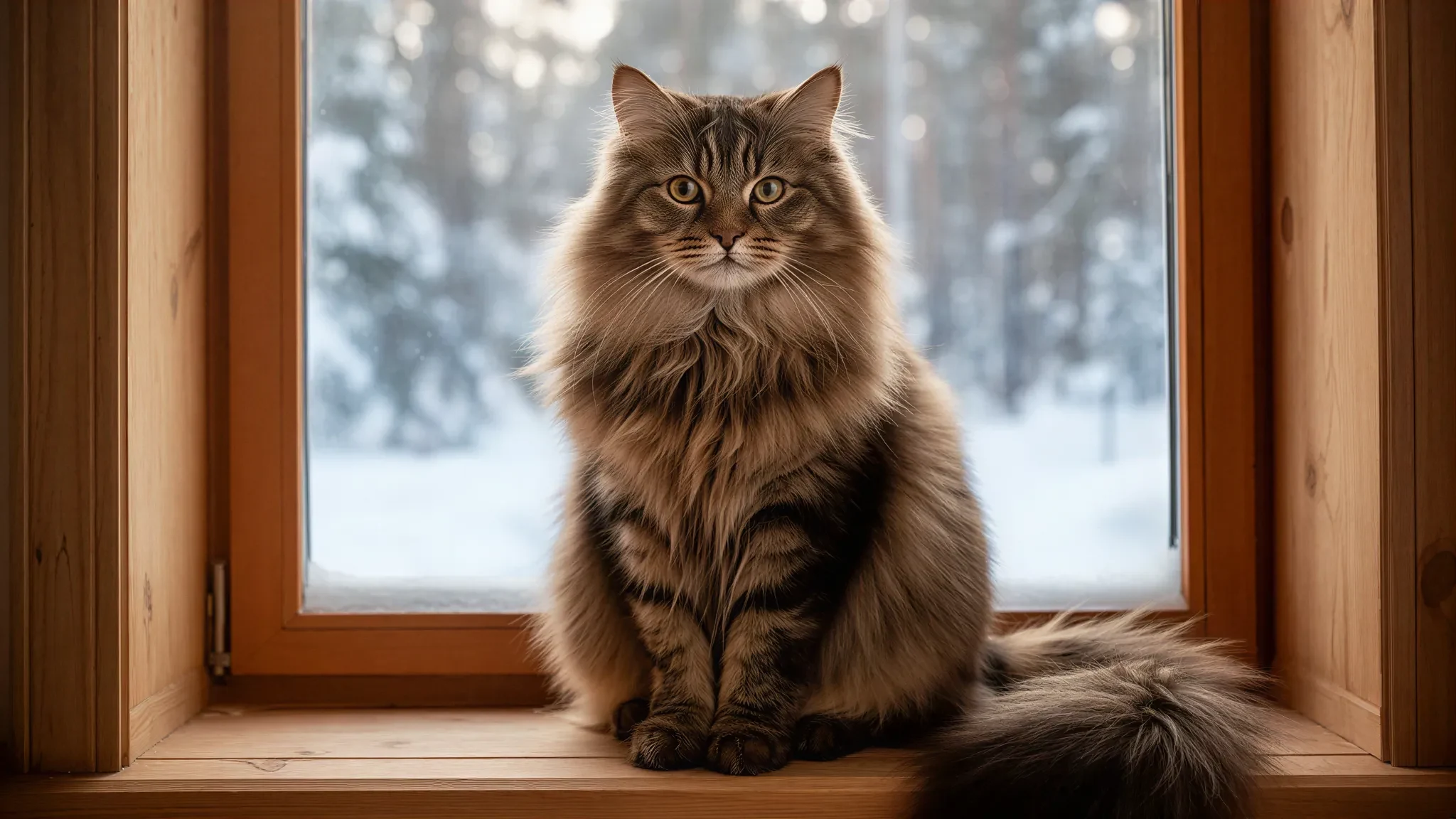
A Siberian is a medium-to-large, barrel-bodied Russian forest cat with a water-resistant triple coat and a face made of circles, who may take five years to finish becoming the cat you bought. The profile on this site lists them as affectionate, intelligent, and playful, medium care, 12–15 years, with hypertrophic cardiomyopathy and periodontal disease on the health line. The Cat Fanciers’ Association’s version is recorded history around the year 1000, U.S. imports in 1990, championship language in a 2008 yearbook, HCM and PKD on the future page, and a hypoallergenic reputation the same article says has not been proven medically. If you wanted rectangles, that is the Maine Coon. If you wanted a straight profile and a waterproof Norwegian coat, that is the Norwegian Forest Cat.
Quick Facts
| Attribute | Detail |
|---|---|
| Origin | Russia |
| Size | Large (medium to medium-large; slow to mature; females smaller) |
| Coat | Medium-long to long triple coat, water-resistant |
| Personality | Affectionate, intelligent, playful |
| Lifespan | 12–15 years |
| Care level | Medium |
| Health to ask about | HCM, periodontal (profile); CFA also names PKD |
| Common names | Max, Luna, Bear, Snowball |
History & Origins
CFA’s standard: Russia’s native forest cat, first appeared in recorded history around the year 1000, unforgiving climate of Siberia, no extremes in type. The 2008 yearbook article by Pamela A. Martin fills in the modern paper trail. Leningrad’s first cat show in 1987, clubs Kotofei and Kis, Soviet Felinological Association registering traditional colors and the colorpoint (Neva Masquerade in Europe). June 28, 1990: three kittens arrived at the Port of New York for Elizabeth Terrell’s Starpoint Cattery in Louisiana — Kaliostro Vasenjkovich, Naina Romanova, Ofelia Romanova — with metrikas. First U.S.-born litter July 13, 1991.
The 2008 article: in 2005 Siberians were fully accepted for championship in all registries, after a great deal of work. That is the date I can print from CFA’s own yearbook. I am not going to invent a different year.
Colorpoints exist. Blue eyes on those. Traditional coats, gold to green eyes, no required match except the pointed cats. Brown mackerel tabby with or without white is the common postcard. Bimetallic — gold and silver in the same coat — is a newer show color CFA’s future page mentions.
They are not a Maine Coon. They are not a Norwegian Forest Cat. Circles versus rectangles versus a straight profile. Learn the head before you pay forest-cat money.
Personality & Temperament
Affectionate, intelligent, playful. CFA: extremely intelligent, keen interest, cabinets and suitcases, not overactive or intrusive, sociable, curious, easygoing, wants to be near you and know what is going on. They learn “no” and may translate it as okay when no one is looking. Owners’ joke on the CFA page: 90% placid and 10% mischief. Quiet cats who prefer loud purrs to other feline speech.
The 2008 article adds fetch, chirps, the computer cursor, the bathroom escort, the stolen shiny thing. Dog-like loyalty is other people’s word. CFA’s version is attuned to mood, sought as potential emotional support animals, good with dogs, other animals, children. I am not going to certify an ESA. I am going to say they want to be in the room.
A week in the house: morning at the door, a cabinet you actually latched, a window, an evening of play that includes a somersault if you have a wand, a lap for the placid 90%. If you wanted a Persian who stays on the floor, this is the wrong longhair. If you wanted a Bengal all day, this is the wrong 10%.
Kids: CFA and the yearbook both put them with children. An adult still owns the house. A large slow-maturing cat and a toddler who wants a pony are a mix you supervise. Best Cat Breeds for Families with Kids is the family-fit owner.
Indoor Cat Enrichment still applies. Bringing Home a New Cat still applies. A Siberian in a bathroom will help you with the towel bar.
Physical Characteristics
CFA: medium to medium large, strong triple-coated cat with surprising heft, strength, presence, alertness, sweet expression. Roundness and circles, not rectangles and triangles. Extremely slow to mature — as long as five years. Females generally smaller. Size secondary to type. I am not printing a fake pound range. The 2008 article mentions altered males at weights I will not turn into a shopping number. Meet the five-year-old.
Head a modified wedge, medium/large, rounded contours, broader at the top, full-rounded muzzle, slight doming between the ears, almost flat forehead. Males develop jowls. Ears medium-large, rounded, wide at the base, tilt slightly forward, set as much on the sides as on top, furnishings, tipping allowed. Eyes medium to large, almost round, outer corner angled slightly toward the ear, more than one eye’s width apart.
Coat: dense, water-resistant, medium to long. Full dense winter coat, shorter less dense summer coat. Shorter on the shoulders, ruff, fluffy britches, bushy tail carried up. Ear tipping desired, full ear furnishings required. Some take as long as three years to get the correct coat. That is on top of the five-year body.
Care Requirements
Grooming
Medium care is molt and water. CFA’s article: relatively tangle-free, males knot in spring if not combed daily, pet Siberians do not require Persian-level work, they molt twice a year for about ten days, daily brushing then to prevent mats. Occasional grooming otherwise unless the cat insists. Water-resistant means the bath is a fight with physics. Persian breeders who show both, in that article, say the Siberian can be harder to wet and harder to dry.
Comb the ruff, armpits, britches, and the tail. Nails, ears, teeth. Periodontal disease is on our profile. A triple coat does not clean a mouth.
Feeding
Heft is the standard. Fat is still fat, and the coat will hide it. Use How Much Should I Feed My Cat?. Weigh them. No invented cups. Five years of “he’s still filling in” is how you get a round cat who was never a kitten. The 2008 article is romantic about teddy-bear size. Your veterinarian is not.
Exercise & Enrichment
Placid 90%, mischief 10%. Wand, fetch, a cabinet they are allowed to investigate. They stay playful. They are not a couch potato in the yearbook’s telling. They also do not need a Bengal’s daily marathon. Watch the five-year fill-in. A cat who cannot jump may be heavy, sore, or both.
The 10% mischief is cabinets, suitcases, the cursor, the stolen chain. Child-proof what you cannot replace. The 90% placid is the cat on the bed after. You do not get to keep only one half. A Siberian who never investigates is not “easy.” That may be a sick cat, a scared cat, or a different forest breed. Meet the adult in a room with a closed suitcase and see which percent shows up.
Pointed Siberians are still this URL in CFA. They are not Siamese. The wedge and the opera live on the Siamese page. The barrel and the triple coat live here. If the seller blurs Neva, colorpoint, and “just a pointed longhair,” you are shopping a look. Pay pointed-Siberian money only if the papers say Siberian.
Health Concerns
Hypertrophic cardiomyopathy is on the profile and on CFA’s future page. Cornell’s cardiomyopathy page is the general library. Ask for echos on breeding cats. Breathing, hiding, a cat who will not play — veterinarian.
Polycystic kidney disease is on CFA’s future page with “several other recessive conditions.” It is not on our profile. I am printing both sentences. Ask the breeder what they ran. Thirst, weight loss — veterinarian.
Periodontal disease is on our profile. Cornell’s dental page is the general library. Look in the mouth. CFA’s future page talks the cost of preventive testing as one reason Siberians may be more expensive. I will not print a price. I will say testing is the honest sentence.
Hypoallergenic: the 2008 CFA article is the most honest paragraph on the internet about this breed’s marketing. Many allergy people believe. It has not been proven medically or scientifically. Cat-by-cat, person-by-person. Sit with one. If you react, you react. I will not print a success rate from a cattery anecdote.
Is a Siberian Right for You?
This breed fits people who want a large, round-faced, people-in-the-room forest cat and will comb through molt, wait five years for the adult, and ask about hearts, kidneys, and teeth. Households that like a helper in the bathroom. People who will test allergies in person.
Who should pick a different cat: you, if you wanted a proven allergy workaround. You, if you wanted a Maine Coon rectangle. You, if you wanted a Persian comb every day and thought any longhair was that. You, if free-feeding through year five was the plan. You, if you needed a silent apartment cat who never opens a suitcase.
Apartments work if you comb and play. First cat: a reasonable one if you will wait; worse than a Domestic Longhair if you needed easy coat and no health list. Allergies: visit for hours. Triple coat is not a medical device.
Finding a Siberian
A serious breeder talks HCM, PKD, mouths, the five-year clock, and lets you sit with an adult if allergies are the reason you came. Ask which registry. Ask about colorpoint versus traditional if papers matter. Ask what molt looks like in that house.
Rescue gets Siberian mixes and the occasional registered adult. An adult whose heft and hello you can watch is better information than a kitten in winter fluff.
Red flags: sold as hypoallergenic with a guarantee, no heart talk, kittens at six weeks, a Norwegian sold as a cheap Siberian, a price pitch instead of a test.
Adopting vs. Buying from a Breeder still applies.
Meet the adult on a chair they chose, after you have been in the room long enough to itch if you are going to. If they never come closer, believe them. If they fetch the thing they stole, that is the 10%. Then decide.
Circles, not rectangles. That is the head test against a Maine Coon and a Norwegian. Rounder ears, almost-round eyes, a muzzle that fills out, a barrel you feel when you pick them up. A straight Norwegian profile on a “Siberian” is a different forest. A rectangular Coon body with lynx tips is a different forest. Triple coat is the shared weather gear, not the breed.
Five years is a long kittenhood. CFA wrote it. The coat may take three. A two-year-old who looks lanky is the standard talking. A two-year-old who looks like a sofa is the bowl talking. Molt is about ten days, twice a year, in the 2008 article — daily comb then, or the ruff becomes felt. Water-resistant is why the bath takes forever. It is also why a damp Siberian in a cold hallway is a husbandry problem, not a tough forest myth.
Colorpoint Siberians exist and have blue eyes. Traditional cats do not owe you a pointed face. Brown mackerel tabby with white is common and not a requirement. Neva Masquerade is a European name for the pointed ones. If papers matter, ask which word the registry is using.
Allergy visits are the whole marketing argument boiled down to one afternoon. CFA’s yearbook said unproven. Sit there. Pet the adult. Wait. If you itch, you itch. A kitten in a freshly wiped room is not the test. The adult in molt is closer. I will not sell you hope with a number.
Popular Siberian Names
The four names on the profile are ordinary on purpose. Bear is English, large fierce animal. Snowball is English, ball of snow. Nikolai exists if you like it — Russian, victory of the people. Natasha exists — Russian, birthday of the Lord.
Max — Latin, greatest
Luna — Latin, moon
Bear — English, large fierce animal
Snowball — English, ball of snow
Nikolai — Russian, victory of the people
Natasha — Russian, birthday of the Lord
Oliver — English, olive tree
Bella — Italian, beautiful
Milo — German, merciful
Sasha — Russian, defender of mankind
Felix — Latin, happy, lucky
Charlie — English, free man
More on Siberian cat names and the Name Generator.
Frequently Asked Questions
Are Siberian cats hypoallergenic?
No cat is proven hypoallergenic. CFA’s 2008 yearbook article says many people believe Siberians are, and that this has not been proven medically or scientifically. Sit with an adult for hours before you put money down. A reaction is data. I will not print a percentage of lucky buyers.
Is a Siberian the same as a Maine Coon or a Norwegian Forest Cat?
No. CFA’s article: Maine Coons are rectangular with longer legs and higher pointed ears. Norwegian Forest Cats have a more angular face and a very straight profile. Siberians are circles — rounder ears, eyes, faces, a barrel body with heft. Triple coats look related. Type is not. Different pages.
How long do Siberians take to grow up?
CFA says the breed is extremely slow to mature, taking as long as five years. Females are generally smaller. A lanky two-year-old is not a failed Siberian. Do not free-feed him while you wait. The triple coat will hide a middle.
What health tests should a Siberian breeder show me?
Ask about hypertrophic cardiomyopathy. CFA names HCM and PKD and other recessives on the future page. Our profile lists HCM and periodontal disease. Cornell has general pages for hearts, PKD, and dental disease. Ask who scanned the heart, who talked kidneys, and who looks at the mouth. I will not invent a treatment.
Do Siberians need a lot of grooming?
Medium care. CFA: dense water-resistant triple coat, shorter on the shoulders, ruff, britches, bushy tail. They molt; the 2008 article says a molting period of about ten days twice a year wants daily brushing then. Males can knot in spring. Water-resistant means baths are a project. Comb anyway.
Meet the adult walking, eating, and shedding. The Siberian gallery is here if you want the ruff before you book the visit. A second visit, during molt if you can, is the coat-care version of a temperament test.