
Best Wall-Mounted Cat Shelves: Studs and Routes
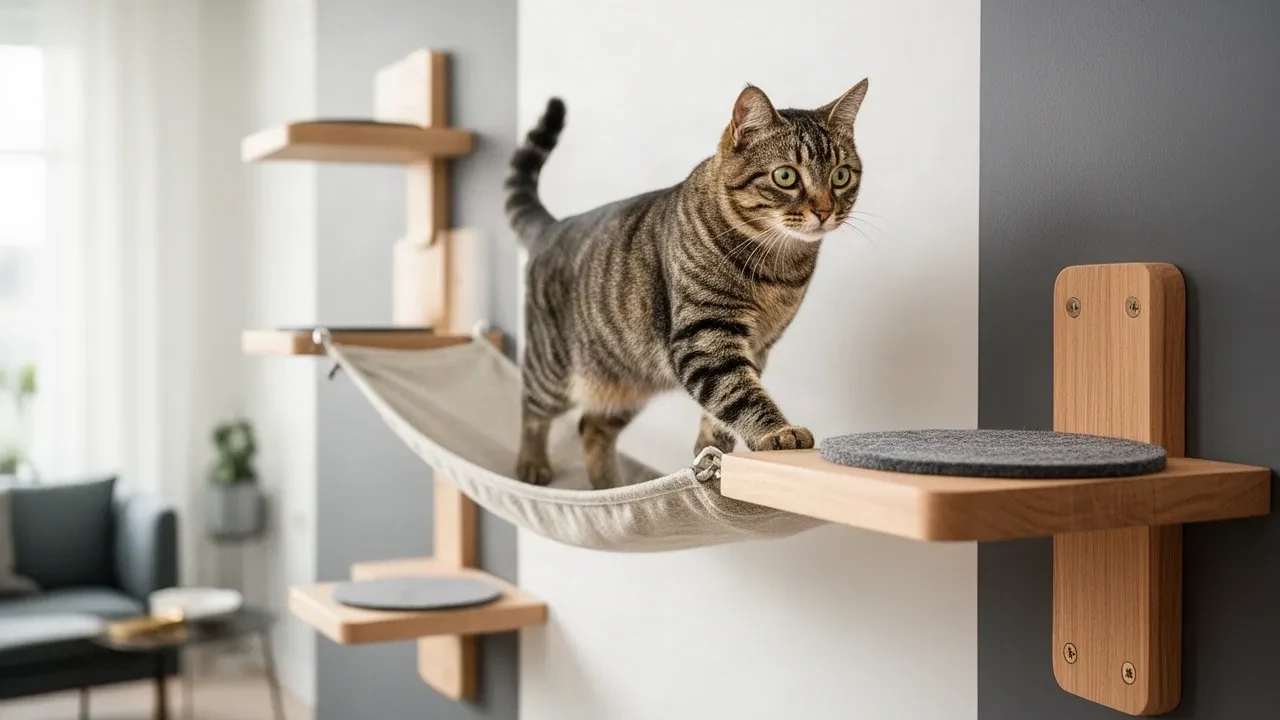
On this page (13 sections)
- Why a wall run is not a picture frame
- Who should skip wall shelves
- Match the mount to your wall
- Two ways down, not a scenic dead end
- Starting heights
- Kits compared by job
- CatastrophiCreations modular track
- Fukumaru wood set
- Trixie wall lounger
- 7Penn starter steps
- How to put them on the wall
- When to see a vet
- Frequently Asked Questions
This article contains affiliate links. If you purchase through our links, we may earn a commission at no extra cost to you.
Wall-mounted cat shelves earn their keep when the floor is already full and the cat still wants height. A 2013 AAFP and ISFM environmental-needs guideline treats a raised, private spot as a safe place, and lists elevated perches among the resources a household should not force cats to share in one pile. This page is the buying and mounting decision that guideline does not make: which kit job to start with, and how to mount it using the shelf maker’s rated instructions for your wall.
Why a wall run is not a picture frame
Cats do not step onto a shelf like a folded sweater. They hit it. A sleeping cat is one steady load. A cat that launches from the bookcase adds a repeated, dynamic load, and that changes what the mount has to handle over time.
The answer is not a number this page invents. It is to use the mounting hardware and anchors the shelf manufacturer rates for your wall, and to follow their installation instructions exactly. If the kit’s hardware does not match your wall type, use hardware rated for that substrate — or choose a different mount. That is the conservative rule: mount to the substrate the maker specifies, with the fasteners they rate for it.
Height matters for the cat, not just for your square footage. The same AAFP/ISFM text says a safe place is often raised, that an elevated perch lets a cat watch the room, and that in a multi-cat home that safe place should have more than one entry so another cat cannot stand in the only doorway. A dead-end summit is how a confident cat parks a timid one on the ceiling.
A freestanding tree is still the right answer if you cannot drill, you move next year, or you wanted scratching and cubbies in one footprint. A suction cup in a window is a different job again. For more on the rest of indoor life, see indoor cat enrichment.
Who should skip wall shelves
Skip the whole wall if the lease or the landlord forbids holes. A tree you can pick up is cheaper than a deposit argument.
Skip any mount whose included hardware is not rated for your wall. If the kit ships anchors for drywall and your wall is masonry, buy fasteners made for masonry or choose another product. Do not hang a perch a cat lands on with hardware the maker did not rate for the job.
Skip a single high corner shelf in a two-cat home. The AAFP guideline is explicit: a multi-cat safe place needs more than one way in, and you want at least as many single-cat hide-and-rest spots as you have cats. One glamorous hammock over the door is a trap, not enrichment. If the trouble is already showing up around boxes and bowls, read litter box problems before you add a dead-end throne.
Skip a tall first jump for a kitten, a senior, or any cat that already hesitates at the sofa. The same guidelines put limited-mobility cats on low shelves or ramps. Use the age calculator if you are guessing the life stage, then start the route where the cat already lands.
Skip wall kits if you wanted a scratching post with a bed on top. Buy the tree. Skip them if the only wall you have is a window you hoped to use. Skip a full modular track as a first experiment; a two-step starter kit tells you whether this cat even wants the wall.
Match the mount to your wall
North American wood-frame walls commonly have studs at regular intervals, but the spacing, and even the presence of wood framing, varies by building. A stud finder tells you what your wall actually has; a magnet or a small exploratory hole works too. The point is not a rule of thumb. It is to know your substrate before you drill.
Once you know the wall, the decision is simple. Use the shelf manufacturer’s rated mounting instructions and the fasteners they specify for that substrate. If you are mounting into wood framing, use the structural screws the maker rates for the kit. If the kit’s hardware is meant for a different wall, replace it with anchors rated for yours. If you cannot identify what the included hardware is rated for, do not guess — buy hardware that carries a rating, or use a freestanding tree.
| Wall or substrate | What conservative guidance looks like |
|---|---|
| Wood frame with accessible studs | Mount with the structural screws the shelf maker specifies for wood framing, following their pilot-hole and depth instructions |
| Drywall or plaster with no reachable framing | Use anchors rated for the load and substrate the maker names, or choose a different mount; follow the anchor maker’s instructions |
| Metal studs | Use fasteners and toggles rated for metal studs, and follow their manufacturer’s instructions |
| Masonry, brick, or concrete | Use masonry anchors rated for the substrate, and follow the anchor maker’s instructions |
When in doubt, hire someone who mounts heavy items for a living. A shelf a cat will land on is not the place to improvise with hardware you cannot identify.
Two ways down, not a scenic dead end
The layout mistake is the same in every small apartment: one ladder, one hammock, one proud photo, and a second cat who cannot get past the first.
AAFP/ISFM is not a “continuous loop” building code. What it actually says is plainer. Give the safe place more than one entry so it cannot be blocked. Separate rest spots so cats are not staring at each other to lie down. Put seniors and kittens on a height they can reach without a leap of faith.
The high piece is a rest, not a cul-de-sac. From that rest, the cat should step down one side onto furniture they already use, and down the other through smaller steps to the floor. If you only have budget for three pieces, spend them on a low on-ramp, a middle step, and a perch with an exit — not one wide shelf six feet up. A canvas bridge helps when the mounting points you can use are far apart. A crescent lounger is a nap at the end of a route, not the route.
Multi-cat tension is not cured by plywood. Extra height helps when each cat can choose a perch the other is not standing on. If they already guard the litter, adding a dead-end shelf will not make them generous. Budget for the whole household, not just the hardware, in what it costs to own a cat.
Starting heights
There is no reliable breed-by-inch chart, so use the cat in front of you. A safe starting point is a first step smaller than the jump they already make onto the sofa, then let the gaps grow only after they use the route without a scramble.
| Cat | First step | Later gaps | Surface |
|---|---|---|---|
| Kitten or senior, stiff landings | Very low, or a ramp from furniture they already use | Short rises; add a piece rather than widening | Carpet, felt, or a hammock dip they can sink into |
| Average adult who already jumps to counters | About sofa-back height | Moderate; watch for a pause or a miss | Wood with some grip, or canvas pulled taut |
| High-energy adult who already uses bookcases | They will self-select bigger gaps | Still give a second way down | Whatever they will not skate off of |
AAFP/ISFM notes that a hammock-style dip in a perch can help a cat feel hidden. That is a rest shape, not a reason to skip grip on the steps. Bare glossy paint on a round dowel is how a cat bounces off the wall. Jute, sisal, felt, or taut canvas all beat a polished plank.
If the cat used the route last month and now walks around it, stop shopping and call the veterinarian. Pain, vision, and balance problems show up as “they got lazy.” This page will not diagnose that.
Kits compared by job
Pick the job, then the object.
| Kit | Job | Mount | Skip if |
|---|---|---|---|
| CatastrophiCreations Modular Wall Track | A growing wall run: steps, hammocks, bridges on hidden brackets | Designed around stud spacing; bamboo and canvas | You cannot mount to the maker’s rated substrate, or you wanted one cheap experiment |
| Fukumaru wood shelf set | A small hardwood climb with a curved rest and jute-wrapped steps | Uses the maker’s rated hardware and instructions | You need one wide nap and no extra steps |
| Trixie wall lounger | One crescent bed as a summit or a window-adjacent nap | Dual brackets, mounted to the maker’s rated substrate | This is your only piece in a two-cat home |
| 7Penn steps and hammock | A short test route from sofa to wall | Uses the maker’s rated hardware and instructions | You already know you want a full room of track |
Those four kits are different jobs, not interchangeable pieces. Match the kit to the route you want and the wall you actually have.
CatastrophiCreations modular track
Best overall modular run
CatastrophiCreations Modular Wall Track
A stud-spaced wall system in bamboo and canvas you can grow with extra steps and bridges instead of buying a second tree footprint.
- Bamboo brackets, canvas spans
- Hidden steel hardware
- Built around stud layout
- Fabric comes off to wash
Buy this when you already know the cat uses height and your wall matches the maker's rated mounting. It is a furniture project, not a first toy.
CatastrophiCreations designs the wall as the tree. Their site describes solid bamboo, heavyweight canvas, and steel brackets that sit inset once installed, with modular pieces and fabric you can wash. That is the job: a run you can extend when you learn where the cat actually walks.
Follow CatastrophiCreations’ rated mounting instructions for your wall, and use their specified hardware or an equivalent rated for your substrate. If a bracket cannot reach a suitable mounting point, move the piece or choose a different span rather than forcing an anchor into a wall it was not rated for.
| Detail | What to expect |
|---|---|
| Materials | Bamboo structure, canvas rest and walk surface, steel hardware |
| Best room | A long blank wall where the brackets line up with your mounting points |
| Maintenance | Wash the fabric, wipe the wood, and re-check the fasteners after the first week of use |
| Not for | Renters who cannot drill, or a household that only wanted a single napping bowl |
Add a bridge when the cat is jumping a gap they miss. Add a low step before you add another hammock at picture-rail height. The expensive mistake is buying the summit first.
Fukumaru wood set
Best small hardwood set
Fukumaru Solid Wood Cat Shelf Set
A curved rest plus jute-wrapped climbing steps for a short wall that still needs grip, not a full modular catalog.
- Rubberwood shelves
- Jute on the steps
- Curved lounging piece
- Rearrange around art
Use the maker's rated mounting hardware for your wall. The jute is the grip. The curve is the nap.
This is the mid-size wood answer when you want the wall to look like furniture and you do not need a catalog of add-ons. The set is sold as rubberwood with a curved platform and round steps wrapped in jute. Jute is the point: a cat accelerating up a wall benefits from something to catch a claw.
Use the mounting hardware Fukumaru rates for your wall, and follow their instructions. If the included hardware is not rated for your substrate, replace it with anchors rated for that substrate. Arrange the curve as the rest with two ways off it — onto a step, and onto a sofa back or a tree. Narrow steps are a poor sole perch for a heavy cat. Give that cat the curve, or give them a tree.
| Detail | What to expect |
|---|---|
| Materials | Wood shelves, jute-wrapped steps, included hardware |
| Best room | A short wall between a sofa and a window |
| Maintenance | Vacuum the jute, wipe the wood, and watch for a spinning step |
| Not for | A cat who only sleeps, and will never use a round step |
You can stain or paint wood to match the trim. That does not make the mount optional.
Trixie wall lounger
Best single napping perch
Trixie Lounger Wall Perch
One crescent bed for a cat who already has a way up. Sisal on the underside gives an approaching cat something to scratch.
- Curved nap shape
- Removable cushion
- Sisal underneath
- One perch, not a highway
This is a destination. Pair it with furniture or steps. Do not hang it as the only high object in a two-cat room.
The Trixie lounger is the piece people hang over a doorway because the photo is cute. Used that way with no second exit, it is the dead-end to skip. Used as the nap at the top of a route the cat already climbs — sofa, bookcase, two steps — it is a reasonable single bed. The crescent holds a curled cat. The sisal underside is a scratch they can hit on the way up. The cover comes off to wash.
Mount the brackets using Trixie’s rated hardware and instructions for your wall. A doorway header may be wood and the drywall beside it may not be, so verify the substrate before you drill rather than assuming. This is not the shelf to force onto hardware the maker did not rate for a landing.
| Detail | What to expect |
|---|---|
| Materials | Shaped frame, plush cover, sisal wrap |
| Best room | Above a sofa back the cat already uses, or beside a window with a real mount |
| Maintenance | Wash the cover; check the sisal for loose strands a chewer might swallow |
| Not for | The only elevated object in a tense two-cat home |
7Penn starter steps
Best cheap test kit
7Penn Cat Wall Step & Hammock
Two climbing steps and a small canvas hammock to see whether this cat wants the wall before you commit a whole elevation to it.
- Pine steps
- Small canvas hammock
- Short sofa-to-wall test
- Replace later if they love it
Pine dents. The hammock is small. That is acceptable for a trial, not for a Maine Coon pileup.
Buy this when you do not know if the cat cares. Two steps off the arm of a couch plus a hammock is enough to learn. If they ignore it for two weeks, you learned cheaply. If they live on it, add better wood or a modular track without having guessed a whole wall.
Pine is softer than bamboo, so claws will show. Use the hardware 7Penn rates for your wall; soft wood in the kit is not an excuse to mount on hardware the maker did not rate for the job. A large cat will look ridiculous in a small hammock. The question is use, not dignity.
| Detail | What to expect |
|---|---|
| Materials | Pine, cotton canvas, included hardware |
| Best room | A bedroom or office where a miss is a sofa, not a staircase |
| Maintenance | Spot-clean the canvas and retighten after the first week |
| Not for | A finished “architectural” wall you wanted on day one |
How to put them on the wall
You need the shelf maker’s installation instructions, a way to find your wall’s framing or substrate, a level, a drill, the fasteners they rate for your wall, painter’s tape, and a pencil.
- Read the manufacturer’s mounting instructions and confirm the rated substrate and hardware.
- Map the framing or substrate at the height you actually want. Mark the mounting points on tape.
- Tape a paper stand-in for each piece. Confirm two ways down, and a first step the cat already makes.
- Hold the real bracket on the mounting point, level it, mark the holes, and follow the maker’s pilot-hole instructions.
- Drive the rated fasteners until the bracket is flush and does not rock. If it rocks, stop and re-check the substrate and hardware.
- Re-check the fasteners after the first week of use, then periodically after that.
Keep wand toys and dangling strings off the shelves when you leave the room. Cats find the loose fastener the night you stop thinking about it.
When to see a vet
If a cat falls more than once, stops jumping onto perches they used last month, lands short, or limps after a jump, that can be pain, vision, or a balance problem. Do not answer it with a taller shelf. Call your veterinarian. If you notice any of these signs, consult your veterinarian. This article is for informational purposes and does not replace professional veterinary advice.
Frequently Asked Questions
Can I install cat wall shelves if I cannot hit a stud?
It depends on the shelf and the wall. Many kits are rated only for wood framing, in which case a perch a cat lands on needs a mounting point the maker approves. Other kits rate specific anchors for specific wall types. Follow the manufacturer’s rated mounting instructions, and if you cannot reach a mounting point they approve, choose a different shelf or a floor tree. If you are unsure, ask someone experienced with heavy wall mounts.
How far apart should cat wall shelves be?
Start closer than you think, then add a step if the cat hesitates. Seniors and kittens need a low first step or a ramp. Athletic adults will take a bigger gap once they trust the route. If a timid cat in a two-cat home has only one way down, add a second descent before you widen the jumps.
How do I get a cat to use wall shelves?
Put a treat or a familiar bed on the lowest step, not the summit. Let the cat choose the next height over a few days. Do not lift them onto a high shelf and walk away. Pair the route with a window or a tree they already use so the wall is a path, not a cliff. If they used height last month and now refuse, call your veterinarian before you buy another kit.
Do wall cat shelves ruin drywall?
Any wall mount leaves holes. Screws into wood framing typically leave small holes you can patch when you move; anchors in drywall leave larger ones. Follow the maker’s instructions, map the mounting points before you drill, and ask your landlord first if you rent. A floor tree avoids the wall entirely if the lease forbids holes.
Are wall shelves better than a cat tree?
They are a different job. Shelves free floor space and need a drill. A tree sits on the floor, moves with you, and still gives height if the base is stable. Many apartments want both: a tree as the on-ramp and a short wall run to a window. If you cannot mount safely on your wall, buy the tree.
Written by Max
Max is a lifelong cat owner and runs CuteCatsHQ. Health and care guides are checked against the veterinary sources listed with each article.
Keep reading
Best Modern Cat Trees for Your Home
Upgrade your living space with stylish, modern cat trees. Compare real wood towers, Scandinavian designs, washable cushions, and non-toxic wood finishes.
Best Cat Trees for Large Cats: Heavy-Duty Picks
A wobbly tower is useless to a big cat. Compare thick-post, wide-base cat trees built for Maine Coons and other heavy breeds, plus how to anchor them.

Cat Whisker Fatigue: Signs, Science & Best Bowls
Understand cat whisker fatigue: signs, vibrissae anatomy, clinical research, and how wide, shallow food bowls improve mealtime comfort for sensitive felines.