
Best Cat Trees for Large Cats: Heavy-Duty Picks
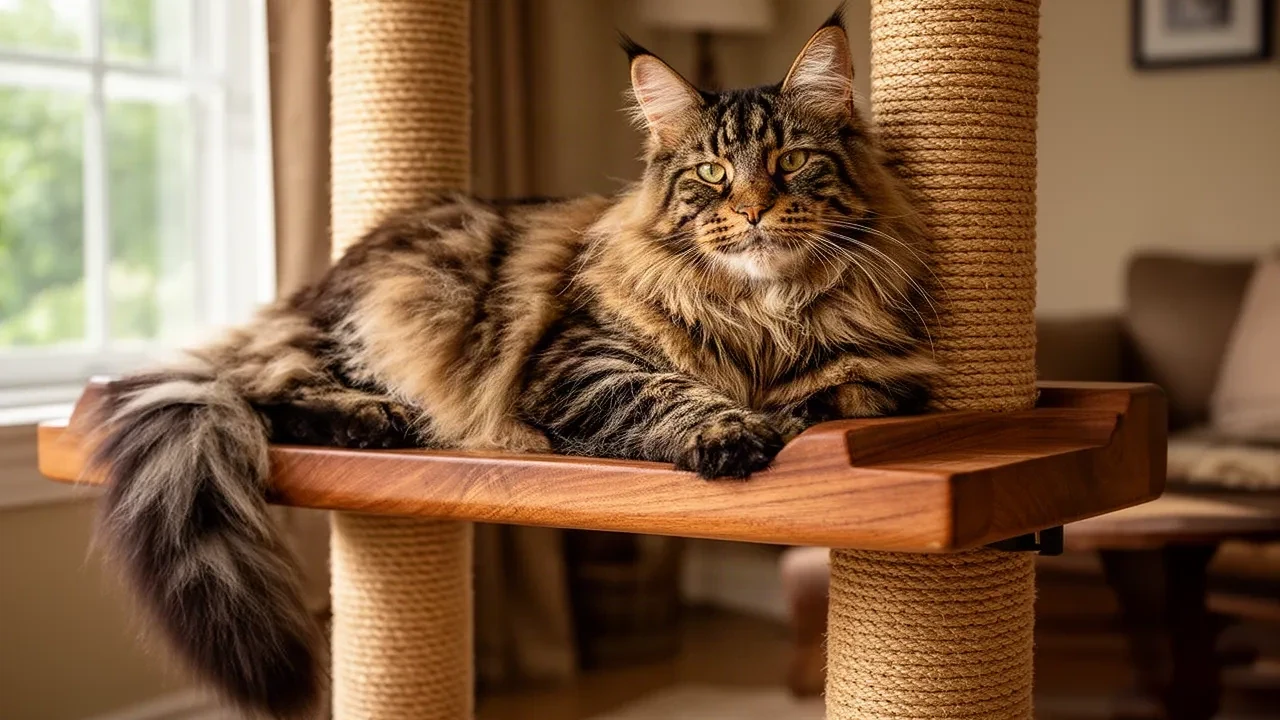
This article contains affiliate links. If you purchase through our links, we may earn a small commission at no extra cost to you. We only recommend products we’ve researched or personally found valuable for cat owners.
The best cat trees for large cats share three traits: posts at least six inches thick, a base heavy enough to stay planted when a cat hits the top perch, and sleeping platforms wide enough for a cat to lie flat. If you share your home with a Maine Coon, Ragdoll, Siberian, Norwegian Forest Cat, or a solid 18-pound domestic shorthair, most pet-store towers are not sized for your cat.
The failure is predictable. A big cat launches at the top platform, the tower sways, the cat feels the movement, and it never trusts the tree again. From then on your sofa, curtains, and doorframes take the abuse. The fix is not a taller tower. It is a heavier base, thicker posts, and larger perches. The CatTreeKing Queensplace XXL Cat Tower is the pick that solves all three at once; the rest of this guide explains how to judge any tower on your own.
What a Large Cat Actually Needs
A 20-pound cat standing still is a 20-pound load. A 20-pound cat landing on an upper perch adds momentum on top of that weight, and the force concentrates at the weakest joint in the tower: the base plate or the screw connection beneath the platform. That is why cheap trees usually fail at the fasteners rather than mid-post.
You do not need a physics degree to shop for this. You need a short list of thresholds. A tower that meets all of them is worth considering for a big cat:
| Spec | Target for a large cat | Why it matters |
|---|---|---|
| Post diameter | 6 inches or more | Thick posts resist lateral flex under a landing cat |
| Base weight | 40 to 80 pounds | Keeps the center of gravity low and the tree planted |
| Base footprint | 20 × 20 inches or larger | A wide stance resists tipping better than a heavy narrow one |
| Perch width | 18 to 22 inches | Lets a big cat stretch out instead of draping over the edge |
| Condo opening | 9 to 10 inches | Big cats need room to turn around inside without squeezing |
The rest is construction quality. Two towers can list the same height and weight and still differ enormously once a cat climbs them, which is why it helps to look at the post core, the base, and the sisal before you buy.
Post Cores, Bases, and Sisal: What Holds Up
The post core
Budget towers use a spiral-wound cardboard tube capped at each end, with small threaded rods holding the sections together. Under repeated lateral impacts from a heavy cat, the tube tears around the end cap and the post gives way at that joint. A better tower uses a solid or thick reinforced core, most often kiln-dried timber or a dense resin, bolted with heavier hardware. You can spot the difference by squeezing the post: a cardboard core flexes, a solid one does not.
The base plate
A tall structure needs a low center of gravity. The bases that work for large cats are thick, wide, and heavy, often double-layered and weighing 40 pounds or more. That mass is what stops the tree from lifting when a cat lands up high. If the base feels light relative to the tower height, plan on anchoring it or skip it.
Sisal wrapping
The best towers wrap the posts in thick natural sisal bonded to the core, not stapled at the top and bottom only. When rope is spot-stapled, one cut strand starts a chain that unravels the whole post. When it is bonded along its length, a broken strand stays put. Look for natural, unoiled sisal; slick white polypropylene rope is cheaper and cats tend to ignore it.
Perch and Hammock Sizes by Breed
Big cats sleep stretched out, not curled into a ball. A perch that is too small leaves legs and heads dangling, which most cats will not tolerate. Use this as a starting point when you compare platforms:
| Cat | Typical adult weight | Minimum perch | Minimum hammock |
|---|---|---|---|
| Maine Coon | 15 to 25 pounds | 20 × 24 inches | 18 to 20 inches, reinforced |
| Ragdoll | 12 to 20 pounds | 18 × 20 inches | 16 to 18 inches |
| Siberian | 14 to 20 pounds | 18 × 20 inches | 16 to 18 inches |
| British Shorthair | 12 to 18 pounds | 16 × 18 inches | 16 inches |
| Domestic shorthair | 8 to 11 pounds | 14 × 14 inches | 14 inches |
Condo entrances should be at least 9 inches wide so a large cat can walk in, turn, and settle without wedging its shoulders through the opening.
Top Picks Compared
| Model | Post / base | Rated for | Best for |
|---|---|---|---|
| CatTreeKing Queensplace XXL | 8-inch solid posts, 88-pound base | Multiple giant cats | The largest cats and multi-cat homes |
| Mau Pets Cento Real Wood | Solid wood trunks, 24 × 18 base | Around 23 pounds per basket | Homes where looks matter as much as strength |
| Feandrea 75.6” Multi-Level | 4.4-inch reinforced posts, batten base | Around 20 pounds per tier | Height and features on a mid-range budget |
| Yaheetech 63” Heavy-Duty | Four 3.5-inch posts, wide footprint | Around 18 pounds per tier | A first big-cat tree on a tight budget |
Detailed Picks
1. CatTreeKing Queensplace XXL Cat Tower — Best for the Biggest Cats
🥇 Best for the biggest cats
CatTreeKing Queensplace XXL Cat Tower
An 88-pound tower with 8-inch solid sisal columns and a 24-inch crown perch, built for the heaviest domestic cats.
- 8-inch solid sisal columns
- 88 lbs total weight
- 24 × 18-inch crown perch
- Removable, washable cushion
Built for Maine Coons, Ragdolls, and homes with more than one big cat.
The Queensplace XXL is engineered around one idea: remove every bit of flex. The scratching columns are 8 inches across and wrapped in thick sisal bonded to the core, so a cat cannot unzip the rope. The base is nearly 2 inches thick and weighted, which brings the assembled tower to 88 pounds and keeps it planted even when two large cats climb at once.
The top sleeping perch is a 24 by 18-inch platform with a removable quilted cushion, wide enough for a Maine Coon to stretch out. With a base this heavy, wall anchoring is optional rather than required. The tradeoffs are real: it costs more than the rest of this list, and the box is heavy enough that you want two people to move it and assemble it.
2. Mau Pets Cento Real Wood Cat Tree — Best Looking Heavy-Duty Option
🌿 Best looking heavy-duty option
Mau Pets Cento Real Wood Cat Tree
Handcrafted from real branches and woven baskets, with solid wood cores that resist the flex of particleboard.
- Solid natural wood trunks
- Hand-woven wicker baskets
- Washable plush cushions
- Furniture-grade finish
A piece of furniture first, a cat tree second, and it holds up like both.
The Cento uses real, sustainably harvested branches instead of veneered board. That matters at the joints: solid wood resists the snap and warp you get from a thin panel under a landing cat. The two upper baskets are hand-woven and lined with removable plush cushions, and sisal is wrapped around the main trunk sections for scratching.
The look is the reason many people buy it: it reads as furniture rather than carpeted cat gear, and no two units are identical. The tradeoffs are that the roughly 17-inch baskets suit cats up to about 20 pounds and get snug for a very large male, and because every branch is different, the perch angles vary from unit to unit.
3. Feandrea 75.6” Multi-Level Cat Tower — Best Mid-Range Height and Features
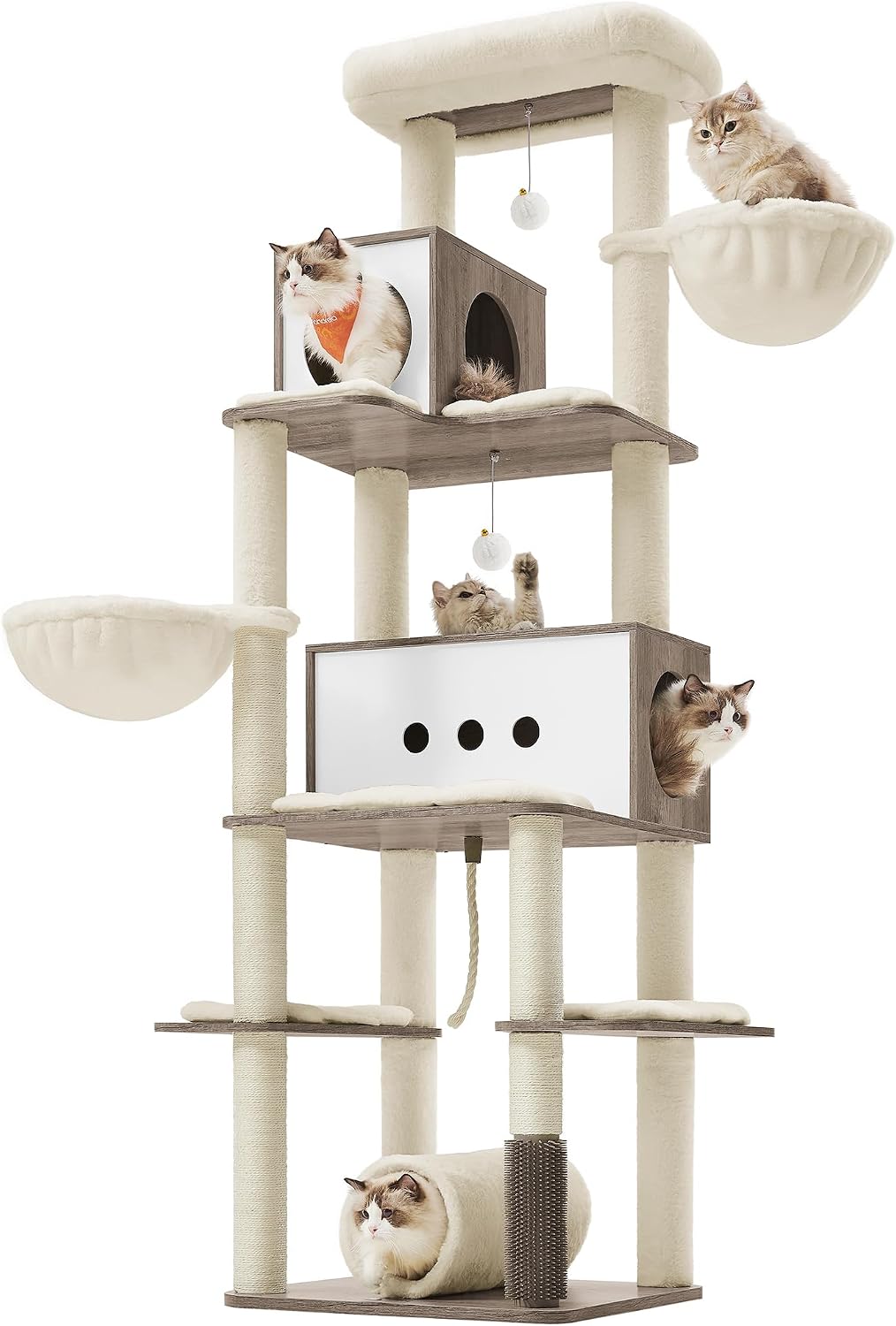
⭐ Best mid-range height and features
Feandrea 75.6" Multi-Level Cat Tower
A 75.6-inch tower with reinforced 4.4-inch posts, two condos, hammocks, and a base braced with wooden battens.
- 75.6-inch height
- Reinforced base battens
- Two condo caves
- Anti-tip wall strap included
A good balance of height, climbing features, and stiffness for cats up to about 20 pounds.
This tower gets its height without feeling flimsy. Feandrea strengthened the 4.4-inch posts and braced the base plate with wooden battens, which cuts sway compared with a flat panel base. The layout gives a big cat low, staggered steps rather than a single hard jump to the top, and there are two condos plus basket hammocks for sleeping.
The 75.6-inch height satisfies a cat’s urge to survey the room, and the widest condo openings accommodate most large cats. If your cat is over 18 pounds, use the included wall strap and drive it into a stud. Assembly takes most people 45 to 60 minutes.
4. Yaheetech 63” Heavy-Duty Multi-Level Tree — Best Budget Big-Cat Tree
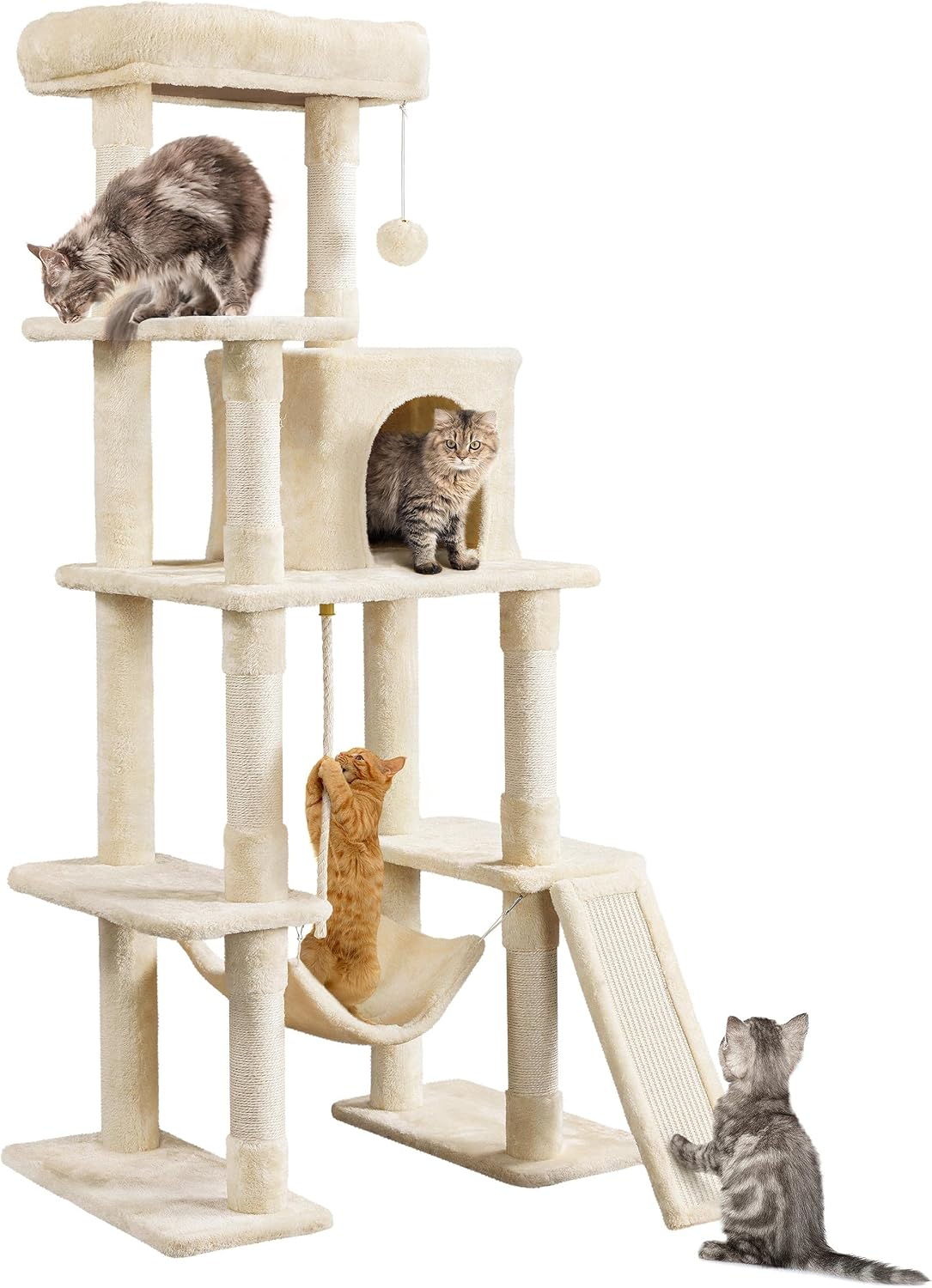
💰 Best budget big-cat tree
Yaheetech 63" Heavy-Duty Cat Tree
A 63-inch tower that spreads its weight across four corner posts instead of one central column.
- 63-inch height
- Oversized 18-inch top perch
- Four-pillar weight distribution
- Wall anchor included
The most dependable entry-level pick for cats up to about 18 pounds.
The value here is in the layout. Rather than relying on a single central post, Yaheetech distributes the load across four corner pillars, which gives the tower a broad, stable footprint for the money. The crown platform is 18 inches across with a raised cushioned rim, and the middle tier adds a condo and a soft hammock.
It does not have the solid timber columns of the top picks, so the post cores will wear faster under hard daily scratching, and the hammock is tight for cats over about 16 pounds. Used with the included wall strap, though, it gives a medium-large cat reliable height on a budget.
Wall Anchoring That Actually Holds
Any tall tree is safer anchored, even a heavy one, and a light tower must be anchored. The included nylon straps are a starting point, but a rigid metal bracket does more.
- Find a stud. Skip plastic drywall plugs; a landing cat can pull them straight out. Use a stud finder to locate a solid 2x4.
- Use a metal L-bracket. A 2-inch stainless L-bracket bolted under the highest solid platform is far stronger than a fabric strap.
- Drive into the framing. Run a 2.5-inch structural screw through the bracket and into the center of the stud. That creates a rigid mechanical tie that resists lateral pull.
If no stud lines up where the tree has to sit, heavy-duty toggle bolts rated for the load are the next best option, or wedge the tree into a corner so it cannot rotate.
Sisal Wear and Longevity
Scratching sheds old claw layers, stretches the shoulders, and leaves scent from the paw glands. A big cat works a post hard, and cheap rope gives out within months.
When you compare posts, favor natural unoiled sisal around 8mm and up, and check that the rope is bonded along the post rather than stapled at the ends. Bonded sisal keeps its tension even after a claw cuts a strand. If you already own a good tree with worn rope, replacing the sisal is cheaper than replacing the tower.
Low-Impact Steps for Older Big Cats
Large cats carry more weight on the same joints, and arthritis is common as they age. A straight drop from a 60-inch perch onto hard flooring is a lot to ask of sore elbows and wrists.
Look for towers where the platforms overlap like a staircase, so your cat can descend in 10 to 14-inch steps instead of one long drop. An angled scratcher ramp up to the first level helps a stiff cat walk up rather than jump. If your cat is already showing signs of arthritis, the senior cat care guide covers the wider setup, and our cat age calculator helps you match furniture to life stage.
When to See a Vet
A fall or a collapse from a cat tree deserves attention. If your cat limps, refuses to bear weight on a leg, cries when touched, or hides after a fall, book a vet visit even if nothing looks broken, because joint and spinal injuries do not always show. If you notice any of these signs, consult your veterinarian. This article is for informational purposes and does not replace professional veterinary advice.
Frequently Asked Questions
How heavy should a cat tree base be for large cats?
For a cat in the 15 to 25 pound range, aim for a base plate of at least 35 to 50 pounds, or anchor the tree to a wall stud. A heavy, wide base keeps the center of gravity low so the tower does not lift or rock when your cat lands on an upper perch.
What size scratching posts do Maine Coons need?
Maine Coons do best with posts at least 6 to 8 inches in diameter wrapped in thick natural sisal, and tall enough for a full standing stretch. A post under 30 inches forces a big cat to scratch in a half-crouch, which is why they turn to the sofa instead.
Why do cheap cat trees wobble?
Cheap towers use narrow hollow posts, small screws, and a light particleboard base. When a heavy cat lands up high, the post flexes and the base lifts because there is not enough mass holding it down. A wobble is usually a base problem, not a post problem.
Can a cat tree tip over and hurt a cat?
Yes. An unanchored lightweight tower can tip when a large cat lands on the top perch at speed, and a fall can cause fractures, torn claws, or a lasting fear of climbing. A heavy base plus a wall anchor removes most of that risk.
How do I anchor a cat tree if I do not have wall studs available?
If no stud lines up with the tree, use heavy-duty toggle bolts rated for the load in drywall, or wedge the tree into a 90-degree corner so it cannot rotate. Avoid plastic drywall plugs, which pull out under a landing cat.
If you are weighing a large breed, the Maine Coon vs Norwegian Forest Cat comparison lays out size and temperament side by side. For a big indoor cat that needs more to do, see our indoor cat enrichment guide, and for an older giant who still wants height, the senior cat care guide is the next step.