
Cat Whisker Fatigue: Signs, Science & Best Bowls
Updated
On this page (10 sections)
- What Is Whisker Fatigue in Cats?
- The Anatomy of Feline Vibrissae: Why Whiskers Are So Sensitive
- Veterinary Science vs. Marketing Hype: What Research Shows
- Common Signs Your Cat Is Experiencing Whisker Stress
- Is It Whisker Fatigue or Dental Pain? The Diagnostic Checklist
- The Flat Dessert Plate Test: A DIY Kitchen Diagnostic
- Choosing the Right Bowl: Shape, Depth, and Materials
- Special Considerations for Flat-Faced (Brachycephalic) Breeds
- When to See a Veterinarian
- Frequently Asked Questions
Cat whisker fatigue, often called whisker stress, describes sensory irritation caused when a cat’s highly sensitive facial vibrissae repeatedly press against the sides of deep, narrow food or water dishes. Common signs include pawing kibble onto the floor, leaving food around bowl edges, pacing nervously at mealtimes, or walking away before finishing. Switching to a wide, shallow ceramic or stainless steel plate eliminates this friction and restores mealtime comfort. Calculate your pet’s life stage milestones with our Cat Age Calculator, or explore the science and bowl solutions below.
What Is Whisker Fatigue in Cats?
Whisker fatigue is not a disease, infection, or permanent physical injury. It is a state of neurological and sensory overstimulation that occurs when the delicate mechanoreceptors located at the root of a cat’s whiskers are continuously activated by physical contact with a feeding container.
Every time a cat dips their face into a deep, steep-sided bowl, dozens of stiff facial hairs are forced backward and compressed against the rim. For a predatory animal whose sensory apparatus is calibrated to detect microscopic air currents and minute spatial changes, this constant physical contact generates an unbroken barrage of nerve signals to the brain. Over time, that relentless sensory input turns what should be an enjoyable, nourishing meal into a frustrating, uncomfortable chore.
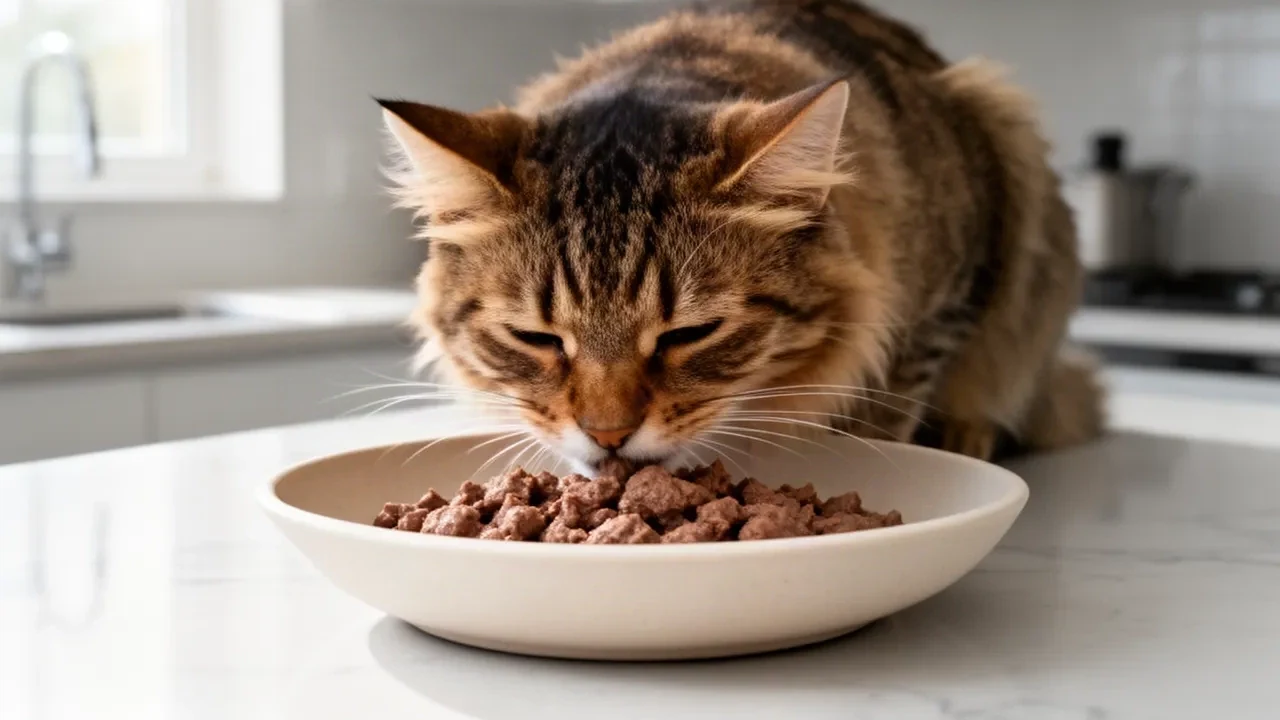
Many cat owners misinterpret these behaviors as picky eating or stubborn quirks. In reality, a cat who nudges food out of the bowl with their nose, scoops mouthfuls onto the kitchen tile with a paw, or stands beside a half-full dish crying for food is trying to satisfy their hunger while avoiding sensory discomfort.
The Anatomy of Feline Vibrissae: Why Whiskers Are So Sensitive
To understand why a simple bowl can cause sensory friction, you need to examine the neuro-anatomy of feline whiskers, scientifically known as vibrissae. Whiskers are not ordinary hairs made purely of keratin; they are sophisticated tactile sensor arrays hardwired directly into the feline central nervous system.
Unlike regular body fur, which sits in shallow superficial follicles, each facial vibrissa is rooted deep within the hypodermis. The follicle is encased in a specialized blood-sinus capsule densely packed with thousands of nerve endings, including Merkel cells, Ruffini endings, and lamellar corpuscles. When the tip of a whisker brushes against an object or experiences the slightest deflection, the hair shaft acts as a mechanical lever. This movement displaces the fluid within the blood sinus, magnifying the physical pressure and instantly triggering mechanoreceptor nerve impulses.
These sensory impulses travel along the trigeminal nerve (cranial nerve V) straight to the sensory cortex of the brain. A remarkably large portion of the feline brain’s somatosensory mapping is dedicated exclusively to processing tactile data from the facial whiskers. Whiskers provide continuous information about spatial orientation, navigation in complete darkness, prey movement, and object proximity. When forced against hard ceramic or plastic bowl walls dozens of times per minute during eating, these finely tuned sensors experience continuous, unnecessary neural firing.
| Anatomical Structure | Biological Function | Impact of Deep Food Bowls |
|---|---|---|
| Vibrissa Hair Shaft | Thick, rigid keratin antenna acting as a mechanical lever | Repeatedly bent and deflected against steep bowl walls |
| Follicular Blood Sinus | Fluid-filled capsule amplifying minute tactile vibrations | Continuous hydrodynamic pressure displacement |
| Mechanoreceptors (Merkel Cells) | High-precision tactile nerve endings detecting static touch | Constant sensory firing that triggers neurological fatigue |
| Trigeminal Nerve Pathway | Direct neural highway transmitting signals to the brain cortex | Sensory overload that causes mealtime hesitation and pacing |
Veterinary Science vs. Marketing Hype: What Research Shows
In recent years, the pet products industry has embraced whisker fatigue as a major marketing talking point, occasionally exaggerating the condition into a catastrophic trauma to sell expensive specialty accessories. It is important to separate genuine veterinary behavioral science from commercial hype.
A landmark clinical study published in the Journal of Feline Medicine and Surgery evaluated whether food bowl geometry objectively altered feline feeding behavior. Researchers measured time spent eating, food dropped outside the bowl, and owner-reported mealtime satisfaction when cats ate from standard commercial deep bowls versus wide, whisker-friendly dishes. While the study found that not every individual cat exhibited measurable clinical distress from standard bowls, a notable subset demonstrated a clear preference for shallow dishes, showing reduced mealtime hesitation and less dropped food.
Veterinary behaviorists agree that whisker sensitivity exists on a spectrum. Some cats possess high tolerance and eat comfortably from almost any container, while more sensitive individuals, older cats, or flat-faced breeds experience marked behavioral disruption. Treating whisker fatigue is not about buying into panic-driven marketing; it is about observing your cat’s specific mealtime behavior and making simple, compassionate adjustments to improve their daily quality of life.
Common Signs Your Cat Is Experiencing Whisker Stress
Cats communicate physical discomfort through distinct, subtle behavioral adjustments around their feeding stations. Recognizing these patterns helps you distinguish between true behavioral fussiness and physical bowl aversion.
Pawing Food Out onto the Floor
One of the clearest indicators of whisker stress is a cat using their paw like a spoon to scoop wet or dry food out of the bowl and onto the floor. By placing the food directly on the floor or mat, the cat can eat freely from a flat surface without forcing their face and whiskers into a narrow opening.
Leaving Food Around the Perimeter
If your cat consistently eats a clean circle right out of the center of their dish but refuses to touch the substantial ring of food resting against the outer rim, whisker fatigue is the primary suspect. Reaching those edge morsels requires pressing their whiskers firmly against the bowl wall, so the cat walks away leaving perfectly edible food behind.
Pacing, Vocalizing, and Mealtime Hesitation
A cat experiencing whisker irritation will often greet you enthusiastically when you prepare their meal, only to hesitate once the bowl touches the floor. They may circle the bowl, meow loudly as if asking for food they already have, take a single bite, retreat several paces, and repeat the cycle. This approach-avoidance conflict reflects a hungry cat who wants to eat but anticipates sensory discomfort.
Aggressive Bowl Flipping or Sideways Approaches
Some cats attempt to solve the problem mechanically by tilting their heads at awkward, unnatural sideways angles to keep their whiskers above the rim. Highly frustrated cats may use their nose or paws to deliberately flip the bowl over, preferring to eat the scattered contents off the kitchen floor rather than reaching into the container.
Is It Whisker Fatigue or Dental Pain? The Diagnostic Checklist
Because whisker fatigue and oral disease produce overlapping mealtime symptoms, cat owners must carefully rule out medical conditions before assuming a behavioral issue. Feline dental disorders such as Tooth Resorption (FORL), severe gingivitis, fractured teeth, and feline chronic gingivostomatitis are common, painful, and require professional veterinary intervention.
Use this diagnostic comparison to evaluate your cat’s symptoms:
| Observable Sign | Likely Whisker Fatigue | Likely Dental Disease / Medical Pain |
|---|---|---|
| Pawing at the Mouth | Rare; cat paws at the food dish, not their face | Common; cat paws frantically at jaws after biting |
| Chewing Mechanics | Normal chewing once food is extracted onto floor | Dropping food from mouth, chewing on one side only |
| Oral Odor & Salivation | Normal breath, clean dry chin | Foul breath (halitosis), excessive drooling, blood-tinged saliva |
| Response to Flat Plate | Immediate, dramatic improvement in meal pace | Continued pain, hesitation, and dropping of food |
| Physical Oral Exam | Pink gums, clean teeth, intact crowns | Bright red inflamed gums, tartar buildup, missing/broken teeth |
If your cat exhibits any signs of oral pain, foul breath, or drooling, schedule a veterinary oral exam immediately. Review our guide to cat dental care to understand how professional cleanings and home hygiene prevent chronic periodontal issues.
The Flat Dessert Plate Test: A DIY Kitchen Diagnostic
Before purchasing specialized commercial dishes, you can confirm whether your cat suffers from whisker fatigue using a simple, cost-free test from your own kitchen cabinets.
Take a standard, flat porcelain human dessert plate or saucer with no raised rim. Place your cat’s normal portion of wet or dry food directly in the center of the plate, and set it down in their regular feeding area. Observe their behavior over the next three to four days:
If your cat immediately finishes their portion without pacing, stops pawing food onto the floor, and eats the entire meal in one comfortable sitting, you have confirmed that bowl geometry was the root cause of their mealtime stress. If the hesitation, food dropping, or crying persists unchanged on a completely flat surface, the issue likely stems from food palatability, dental discomfort, or gastrointestinal nausea.
Choosing the Right Bowl: Shape, Depth, and Materials
Once you establish that your cat prefers an ergonomic feeding setup, selecting the proper replacement dish involves evaluating three key factors: diameter, lip profile, and material composition.
Optimal Dimensions and Geometry
Look for dishes with an open diameter of at least 5.5 to 6.5 inches and a maximum depth of less than one inch. The ideal whisker-friendly dish resembles an oval or saucer with gently sloped sides rather than vertical walls. This allows your cat to access every morsel of food from any angle without their lateral vibrissae making contact with the dish edges.
Material Selection: Stainless Steel and Ceramic vs. Plastic
Avoid inexpensive plastic bowls entirely. Plastic is a soft, porous material that easily develops microscopic surface scratches from cleaning and eating. These micro-grooves trap food oils, saliva, and bacterial colonies that cannot be fully sanitized by hand washing or dishwashers.
When a cat’s chin repeatedly contacts a bacteria-laden plastic rim, the hair follicles become clogged and infected, leading to feline chin acne—a painful condition characterized by black crusty comedones, pustules, and swelling. Always choose non-porous, medical-grade stainless steel, glazed ceramic, or heavy porcelain dishes that can be thoroughly sanitized at high temperatures.
Elevated and Tilted Stands
For senior felines, cats with arthritis, or breeds prone to cervical spine stiffness, pair a wide shallow dish with a slightly elevated, tilted feeding stand. Raising the dish 2 to 4 inches off the floor allows your cat to maintain a natural, ergonomic posture without bending their neck and spine downward. This alignment aids smooth digestion, reduces esophageal strain, and minimizes post-meal regurgitation. If you are refining your cat’s daily portions and nutrition, consult our complete breakdown on how much to feed a cat.
Special Considerations for Flat-Faced (Brachycephalic) Breeds
Certain pedigree breeds face distinct physical challenges during meals due to their unique skull morphology. Brachycephalic breeds, such as the Persian, Exotic Shorthair, and British Shorthair, possess shortened facial bones, flat muzzles, and compressed nasal passages.
For these cats, eating from a standard bowl is not merely a sensory nuisance—it is a physical obstacle. Because their jaws and noses sit flush against their facial planes, attempting to reach into a standard bowl forces their nostrils directly against food and container walls, making breathing difficult while chewing.
Flat-faced breeds benefit enormously from wide, scalloped ceramic platters with subtle internal ridges that keep wet food elevated, allowing them to grasp portions easily with their tongue and teeth without smashing their faces into deep corners.
When to See a Veterinarian
While mealtime hesitation is often resolved with a change in dish shape, any sudden loss of appetite or prolonged food refusal is a serious veterinary concern. Cats have a unique liver metabolism; an overweight or adult cat who stops eating entirely for 24 to 48 hours is at severe risk of developing hepatic lipidosis (fatty liver disease), a potentially fatal condition that requires intensive medical care.
Schedule a prompt veterinary visit if you observe any of the following warning signs. A total refusal to eat or drink for more than twenty-four hours is the most urgent, but noticeable unintended weight loss or muscle wasting also deserves a checkup. Drooling, pawing at the mouth, and bright red or bleeding gum tissue point toward dental disease rather than whisker sensitivity.
Frequent vomiting, regurgitation, or severe lethargy are more reasons to call, as is tilting the head dramatically to one side while attempting to chew. A veterinarian can sort out whether the problem is sensory, dental, or gastrointestinal.
If you notice any of these signs, consult your veterinarian. This article is for informational purposes and does not replace professional veterinary advice.
Frequently Asked Questions
Can whisker fatigue cause permanent damage to a cat?
Whisker fatigue does not cause permanent nerve damage, physical deformation, or structural harm to your cat’s facial vibrissae. It is an acute sensory and behavioral irritation. Once you replace narrow containers with wide, shallow dishes, the overstimulation ceases immediately, and normal, comfortable feeding behaviors return.
Do cats get whisker fatigue from water bowls too?
Cats can experience whisker fatigue from water bowls, especially narrow mugs, small gravity dispensers, or tight fountains. Cats experiencing water bowl stress often dip their paws into the water to lick moisture off their fur, tip water dishes over, or refuse to drink from their bowls while eagerly drinking from running sink faucets.
Should I ever trim my cat’s whiskers to prevent whisker stress?
You must never trim, cut, or pluck a cat’s whiskers. Whiskers are essential sensory organs filled with sensitive nerve endings. Trimming them disorients your cat, impairs their spatial navigation, causes significant psychological distress, and increases the risk of falls and collisions. Always change the bowl, never the cat.
Why does my cat still leave food in the center of a flat plate?
If your cat leaves food in the center of a wide, flat dish, the issue is likely food palatability, overfeeding, or meal consistency rather than whisker fatigue. Wet food that has dried out after sitting in the open air loses its aroma and flavor, prompting cats to reject the remainder once their initial hunger is satisfied.
Written by Max
Max is a lifelong cat owner and runs CuteCatsHQ. Health and care guides are checked against the veterinary sources listed with each article.
Keep reading
Best Microchip Cat Feeders: Multi-Cat Guide
Protect prescription diets and stop food thieves with the best microchip cat feeders. Compare RFID compatibility, training, battery life, and long-term ROI.
Best Cat Litter Mats for Tracking: Buying Guide
Stop litter scatter on hardwood and carpet with the best cat litter mats. Compare honeycomb, looped mesh, and silicone designs, sizing, and placement.
Best Cat Litter Boxes: Top High-Sided & XL Pans
Find the best cat litter boxes for messy cats, high sprayers, and large breeds. Compare stainless steel, top-entry, and open pans, plus sizing and placement.