
Kitten Teething Timeline: Months 3 to 7 Guide
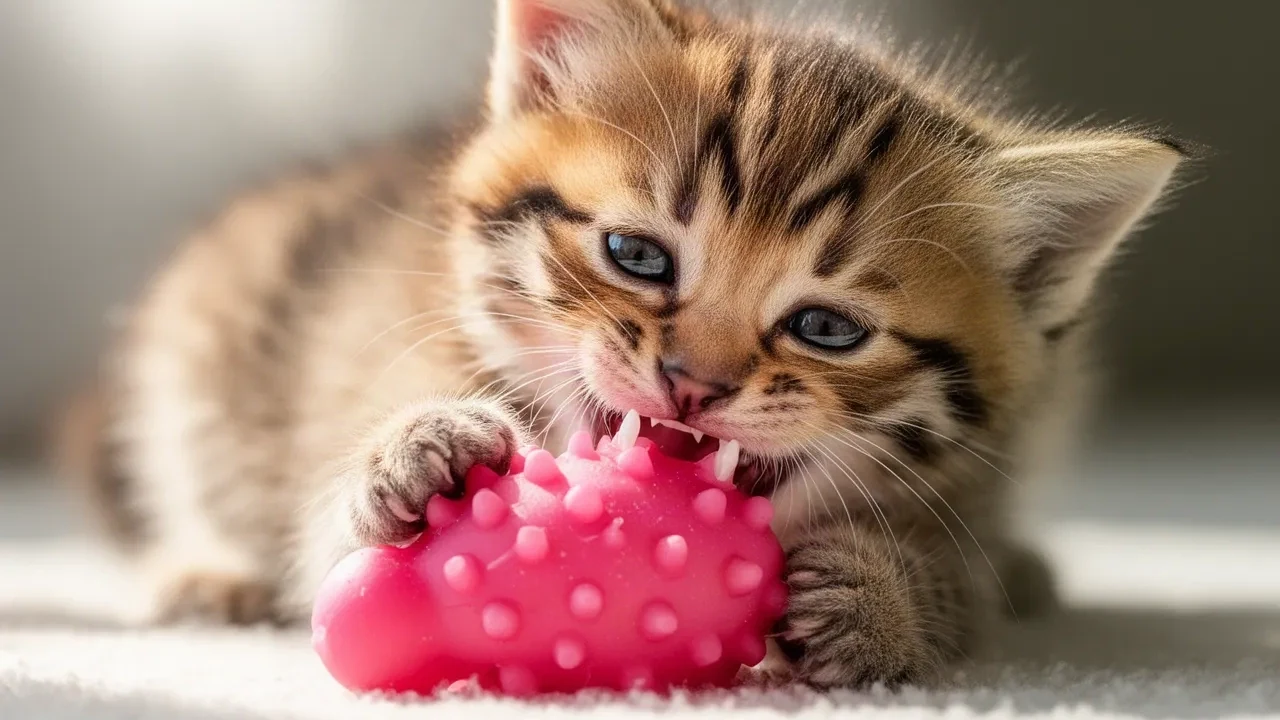
Kittens undergo two distinct teething stages: developing 26 deciduous (baby) teeth between 2 and 6 weeks of age, followed by replacing them with 30 permanent adult teeth between 3 and 7 months. Peak adult teething occurs between 4 and 6 months, often accompanied by intense chewing on household objects, mild gum inflammation, drooling, and shedding tiny teeth. You can estimate your kitten’s dental milestone dates with our Cat Age Calculator or explore our complete timeline and soothing hacks below.
Complete Deciduous vs. Permanent Dental Chronology
Cats are diphyodont carnivores, meaning they develop two successive sets of teeth during their lifetime. The table below outlines the anatomical breakdown and exact eruption chronology according to American Veterinary Dental College (AVDC) clinical standards.
| Tooth Type | Deciduous Count (Baby) | Baby Eruption Age | Permanent Count (Adult) | Adult Eruption Age | Anatomical Function |
|---|---|---|---|---|---|
| Incisors | 12 (6 upper / 6 lower) | Weeks 2 to 4 | 12 (6 upper / 6 lower) | Months 3 to 4 | Grooming fur and delicate nibbling |
| Canines (Fangs) | 4 (2 upper / 2 lower) | Weeks 3 to 4 | 4 (2 upper / 2 lower) | Months 4 to 6 | Grasping prey, puncturing, defense |
| Premolars | 10 (6 upper / 4 lower) | Weeks 4 to 6 | 10 (6 upper / 4 lower) | Months 4 to 6 | Shearing meat and crushing kibble |
| Molars | 0 (None in kittens) | Absent in baby set | 4 (2 upper / 2 lower) | Months 4 to 7 | Grinding and mechanical chewing |
| Total Dentition | 26 Deciduous Teeth | Fully in by Week 6 | 30 Permanent Teeth | Fully in by Month 7 | Complete adult carnivorous bite |
Deciduous Teeth (Weeks 2–6): The Needle-Sharp Baby Set
A newborn kitten is born completely edentulous (without visible teeth). The first pearly white crowns begin cutting through the gums around two to three weeks of age, starting with the tiny central incisors.
By four weeks, the four dagger-like canines erupt. These temporary baby fangs are hollow, slender, and extremely sharp. They serve an important purpose in nursing litters: when kittens begin biting their mother’s teats during nursing, the discomfort prompts the mother to stand up and walk away, initiating the natural behavioral weaning process.
By six weeks of age, all ten deciduous premolars are in place, bringing the complete baby set to 26 teeth. Noticeably, kittens have zero molars; molars only appear during the adult dental eruption.
Permanent Adult Teeth (Months 3–7): The Adult Transition
The replacement of baby teeth by permanent adult teeth begins around 12 to 14 weeks of age. Deep inside the jawbone, adult tooth buds develop directly beneath the roots of the baby teeth. As the adult tooth grows, it applies pressure against the deciduous root, triggering specialized cells called odontoclasts to resorb the baby root.
Without a root to anchor it, the crown of the baby tooth loosens, detaches from the gumline, and falls out. Most owners never find these shed baby teeth because kittens swallow them harmlessly during meals or grooming.
Adult teeth erupt in a strict sequence:
- Adult Incisors (Months 3–4): The tiny center front teeth fall out first, replaced by slightly wider, serrated adult incisors.
- Adult Canines (Months 4–6): The prominent fangs shed. The new adult canines are thicker, sturdier, and have a deeper groove on their outer surface.
- Adult Premolars & Molars (Months 4–7): The chewing teeth along the sides emerge. The four true adult molars (two on the upper jaw, two on the lower) erupt at the very back of the mouth where no baby teeth existed before.
In flat-faced brachycephalic breeds such as the Persian and Exotic Shorthair, the shortened maxillary jawbone often leads to dental crowding, rotated premolars, and delayed eruption schedules that require careful veterinary monitoring.
Common Signs Your Kitten Is Teething
As adult teeth push through sensitive gingival tissue, kittens experience mild discomfort and localized inflammation. Look for a handful of hallmark signs. The most obvious is an intense urge to chew: kittens gnaw compulsively on electrical cords, cardboard boxes, chair legs, shoe leather, and human knuckles to relieve pressure in their gums. A thin, pinkish-red line of inflammation often appears along the gumline where new crowns are breaking through, and increased saliva lubricates those sore gums, leaving a wet chin and the occasional face-rub against furniture. Mild halitosis is common for a few weeks as microscopic blood droplets and natural bacterial turnover collect around shedding roots. Some kittens also hesitate at the bowl, eating more slowly or preferring soft food over crunchy kibble on the days their gums hurt most.
What’s Normal and What’s Not During Teething
Most teething is quiet and self-limiting, but it helps to know where the line sits between ordinary and alarming. Normal teething means a kitten chews more than usual, has a faint pink line at the gumline, drools a little, and maybe eats more slowly for a day or two. Their energy, appetite, and playfulness stay essentially intact, and the symptoms come and go in waves as each tooth erupts rather than worsening day after day.
Concern rises when the picture changes. Gums that bleed on their own, breath that turns sharply foul rather than mildly kitten-smelling, a kitten who stops eating entirely, or swelling that is noticeably worse on one side of the face are all reasons to call your veterinarian rather than wait out the phase. Teething should never cause a true fever, vomiting, or diarrhea; if those appear, something else is going on and it needs a diagnosis. A quick check of appetite and energy usually tells you which side of the line you are on.
5 Safe At-Home Gum Soothing Hacks
You can help your kitten manage teething discomfort safely using simple home enrichment and soothing techniques.
1. Chilled & Frozen Wet Food Lick Mats
Spread two tablespoons of high-protein kitten pate or pureed bone broth across a textured silicone lick mat and place it in the freezer for 30 minutes. Licking the cold surface numbs sore gums, provides soothing relief, and keeps the kitten occupied for twenty minutes.
2. Damp Chilled Washcloth Braids
Take a clean 100% cotton washcloth, roll it into a tight braid, soak it in plain water or low-sodium cat-safe chicken broth, and freeze it. The cold, wet cotton fibers give kittens a satisfying texture to gnaw on without damaging delicate oral tissues. Always supervise washcloth play and remove the cloth if strings begin to fray.
3. Pliable Soft-Rubber Chews & Dental Mesh Toys
Provide pet-safe soft rubber chew toys designed specifically for cats, such as pliable KONG kitten toys or dental mesh pillows. The textured ridges clean plaque along the gumline while offering safe mechanical resistance for chewing instincts.
4. Softening Kibble with Warm Water
If your kitten hesitates to crunch dry food during canine eruption, soften their meals by adding two tablespoons of warm water or Kitten Milk Replacer to their bowl five minutes before serving. Warm moisture softens hard edges and releases savory aromas.
5. Introducing Finger-Brush Gum Massages
Teething is the ideal developmental stage to habituate your kitten to lifelong tooth brushing. Dip your clean finger or a soft silicone finger brush into poultry-flavored enzymatic cat toothpaste and gently massage their outer gums for 30 seconds daily. This soothes inflamed tissue and establishes cooperative dental care habits before adulthood.
Just as important as what to offer is what to avoid. Never give a kitten human pain relievers—acetaminophen and ibuprofen are toxic to cats even in tiny doses—and steer clear of frozen-solid treats that can crack teeth or raw hides that can splinter. Cold, not frozen, is the goal: a lightly chilled washcloth or a refrigerated rather than rock-hard lick mat soothes without risking thin enamel. If your kitten seems genuinely uncomfortable rather than just mouthy, ask your veterinarian about safe options instead of reaching for over-the-counter remedies on your own.
For a full lifelong dental hygiene routine, review our detailed guide on cat dental care.
Retained Deciduous Teeth: The Danger of “Double Fangs”
The most significant clinical complication during feline teething is a retained deciduous tooth. This occurs when an adult tooth erupts alongside a baby tooth whose root failed to resorb properly.
Retained teeth most commonly affect the upper canine fangs, resulting in a condition popularly called “double fangs.” When two teeth attempt to occupy the exact same small socket, severe problems follow:
| Eruption Pattern | Step 1 | Step 2 | Step 3 |
|---|---|---|---|
| Normal Eruption | Deciduous root resorbs | Baby tooth sheds | Adult tooth emerges in correct alignment |
| Retained Eruption | Baby root persists | Adult tooth pushed outward or inward | Plaque trap forms |
Two adjacent canine teeth create an extremely narrow gap that traps food debris, fur, and oral bacteria. Within months, this tight space develops severe periodontal disease, deep gum pockets, and premature bone loss around the permanent root. An improperly positioned canine can also strike the roof of the mouth or lower lip, causing painful soft-tissue trauma and malocclusion.
Inspect your kitten’s mouth weekly between 4 and 6 months. If a baby canine tooth remains firmly rooted next to a fully emerged adult tooth for more than two weeks, your veterinarian should surgically extract the baby tooth. This extraction is frequently performed during the kitten’s routine spay or neuter surgery under the same anesthesia.
Teething vs. Juvenile Gingivitis: When to See a Vet
While mild gum redness and extra chewing are completely normal, severe oral inflammation warrants professional veterinary care.
Contact your veterinarian if the gums become severely ulcerated, bleed spontaneously, turn purple, or grow thick overgrown tissue around the teeth, which can signal juvenile onset gingivitis or feline calicivirus. A fractured baby fang with an exposed pink pulp canal can let bacteria travel down the root and damage the developing adult tooth underneath. A kitten who refuses all food for more than 12 hours risks dehydration and hepatic lipidosis, and severe, one-sided facial swelling points to a tooth root abscess or deep infection that needs antibiotics and dental drainage.
If you notice any of these signs, consult your veterinarian. This article is for informational purposes and does not replace professional veterinary advice.
For broader developmental milestones from birth onward, check our week-by-week kitten development guide.
Frequently Asked Questions
Do kittens swallow their baby teeth?
Yes. It is entirely normal for kittens to swallow their shed baby teeth while eating or grooming. The tiny calcified crowns pass harmlessly through the digestive tract without causing blockages or internal trauma. Finding shed baby teeth on carpets or bedding is relatively rare.
Is it normal for a kitten’s breath to smell bad while teething?
Yes. Mild halitosis (“teething breath”) is very common between 4 and 6 months of age. It is caused by minor gum inflammation, microscopic blood droplets, and temporary bacterial shifts as baby teeth loosen and permanent teeth emerge. The odor should resolve once adult teeth are fully in place.
Can teething cause fever or diarrhea in kittens?
Teething itself does not cause true fever, vomiting, or watery diarrhea. While mild drooling and slight irritability are common, systemic illness like high fever or gastrointestinal upset usually indicates an underlying viral infection, parasites, or dietary indiscretion that requires veterinary evaluation.
At what age are all permanent adult cat teeth fully in?
All 30 permanent adult teeth are typically fully erupted and firmly seated by 6 to 7 months of age. If your 7-month-old cat still has baby teeth visible or missing adult teeth, have your veterinarian examine their mouth during their adolescent wellness exam.
Do kittens lose their appetite completely while teething?
Most kittens eat slightly less or more slowly during peak gum sensitivity, but a complete refusal to eat is not a normal part of teething. If your kitten skips more than a couple of meals or avoids food for over 12 hours, call your veterinarian, because that pattern points to illness or a painful mouth problem rather than ordinary teething.
What should I do if I find a baby tooth on the floor?
Nothing—finding one is a small bonus, not a problem. Baby teeth usually get swallowed harmlessly during meals, so discovering one on the carpet is rare and completely normal. You don’t need to save it or worry that one is “missing,” since the adult tooth should be erupting right behind it.
Can I give my kitten a dental chew while they’re teething?
Yes, but choose soft, pliable rubber chews made for cats and skip anything hard enough to crack a tooth or small enough to swallow. Textured dental mesh toys and soft rubber teethers let a kitten gnaw safely while the adult teeth finish coming in. Watch the toy for fraying, and put it away if pieces start to come loose.
Is it normal for my kitten to have swollen gums at five months?
Some gum swelling is expected when the adult canines and premolars erupt around four to six months, and a faint pink line at the gumline is normal. Swelling that looks red and angry, bleeds when touched, or makes one side of the face puff out is not, and it warrants a veterinary look.