
Singapura Cat Breed Guide: Personality & Care
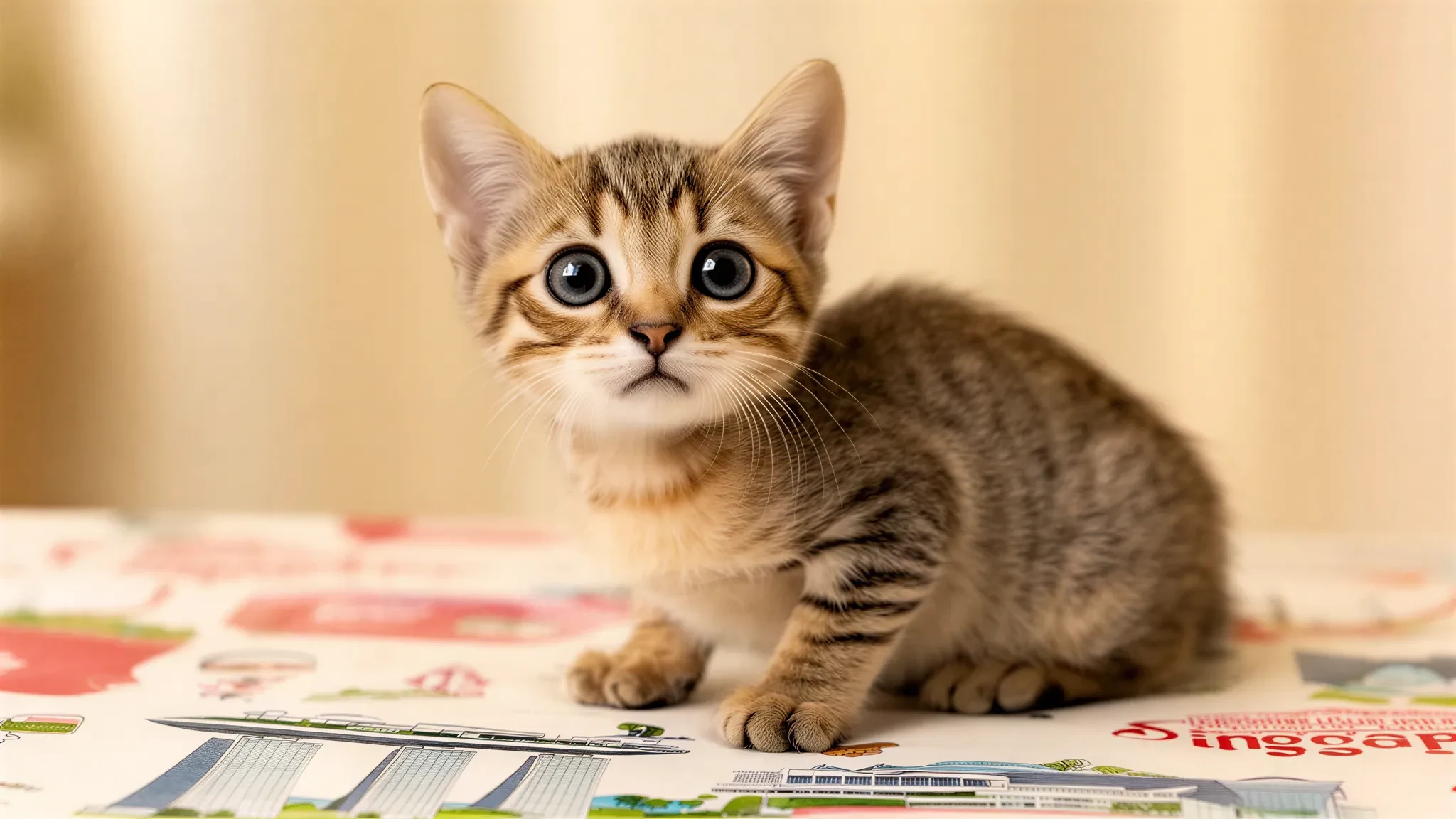
A Singapura is a small, muscular, ticked cat from Singapore, and it is the breed with exactly one accepted coat color: sepia agouti, dark brown ticking over warm old ivory. Singapuras tend to be curious, playful, and alert, with a short coat, low care needs, and an 11–15 year lifespan. The Cat Fanciers’ Association describes an extroverted cat that treats whatever has your attention as a job it was hired to help with. This is not a decorative cat. If you wanted the same ticking in a leggier, medium frame, that is the Abyssinian. If you wanted a quiet floor cat, this is the wrong page.
Quick Facts
| Attribute | Detail |
|---|---|
| Origin | Singapore |
| Size | Small (CFA standard: small to medium, muscular) |
| Coat | Short, fine, silky; one color, sepia agouti |
| Personality | Curious, playful, alert |
| Lifespan | 11–15 years |
| Care level | Low |
| Health to ask about | Progressive retinal atrophy, pyruvate kinase deficiency, uterine inertia |
| Common names | Sing, Little, Pip, Tiny |
History & Origins
CFA classifies the Singapura as a natural breed and permits no outcrosses, which is the part of the record that is not in dispute. The official account, repeated in CFA’s 1996 breed article, is that Hal and Tommy Meadow kept three local “drain cats” while living in Singapore in the early 1970s. When the Meadows returned to the United States in 1975, they brought the three cats — Puss’e, a young female, Ticle, a male kitten, and Tes, his female littermate — and those cats became the foundation of the breed. CFA accepted the Singapura for registration in 1982 and granted championship status in 1988. The name is Malay for Singapore, and the breed is also called Kucinta, a blend of the Malay words for cat and love. The Singapore government later declared it a “living national monument” and put statues of the breed along the Singapore River, and CFA’s 2006 article records the Guinness listing as the smallest pedigreed cat.
The origin is where the record gets complicated, and no honest guide should smooth that out. CFA’s own 2006 breed article opens its history section with the plain sentence: “There has been much controversy concerning the origin of the Singapura. It has been insinuated that the breed was a hybrid, created using Burmese and Abyssinians.” The 1996 article goes further. In 1990, one of the CFA Singapura breed clubs asked the CFA Board to examine the breed’s origins, because import documents showed that in 1974 the Meadows had brought cats into Singapore carrying the same names — Puss’e, Tes, and Ticle — as the cats said to have been found on the street there. At the October 1990 board meeting, breeder and judge Joan Wastlhuber Miller argued that the gene pool had always been in Southeast Asia, that the Burmese and Abyssinian lines were present regardless, and that whether the cats mated on Singapore streets or in Michigan did not change the legitimacy of the breed. The Meadows then told a February 1991 board meeting that the original four cats had been imported in 1971 aboard a work boat without export or import documents, and that Puss’e, Ticle, and Tes were their grandchildren. The board found no probable cause for wrongdoing and took no action. The 2006 article adds that CFA judges have themselves described the Singapura to exhibitors as a Texas creation from Burmese and Abyssinian stock, which tells you the disagreement never fully closed.
One cat in the pedigree is not subject to the argument. Chiko was imported from Singapore’s SPCA in 1980 as a whole cat and entered the breeding program, and CFA’s 1996 article treats her as documentation that cats matching the Singapura description existed on Singapore’s streets. So the breed does have at least one verified Singapore street cat in its background, whatever is true of the founding three.
What nobody disputes is the bottleneck. CFA’s 1996 article notes that the CFA Singapuras trace to three cats from 1975, two of them littermates, plus one additional cat from 1980. In 1985, breeders discovered that some Singapuras carried a simple recessive gene for solid color, and most began test-mating to solid cats and removing carriers. A breed built this narrowly has to be managed carefully, and that management is the real story behind its health screening.
Personality & Temperament
The CFA description is the one to trust over any caption: extroverted, curious, and very playful, an intelligent cat compelled to investigate every aspect of its environment, especially whatever is currently occupying you. It will help you cook dinner, type on the computer, and make the bed, then sleep under the covers with you. Breeders in CFA’s 1996 article describe the same animal. One describes the Singapura attitude as “the world is my oyster — get out of my way, I’m going for the pearl and you can’t stop me,” delivered with the low-key persistence of a small child saying please until you give in.
That is a genuinely interactive cat, and the interaction does not taper off with age. CFA notes that the love of play continues well into adulthood and that the breed’s energy and activity level rarely flag as it gets older. A Singapura that has been bored all day will find its own entertainment, and the candidates are usually on your counters or in your cabinets. This is a cat that wants vertical space and a person willing to run a wand toy until everyone is out of breath.
Voice is quieter than the personality. CFA calls them relatively quiet cats with surprisingly loud voices when they do decide to speak up. That is a real distinction for anyone who has lived with a Siamese that narrates every hour of the day. A Singapura is not silent, but it does not run a commentary.
Two behavioral details are worth planning around. First, confidence is tied to familiarity. CFA says the Singapura is outgoing in territory it knows but may become wary when something substantial changes, and owners should give it time to adjust rather than forcing the introduction. A move, a new baby, or a new roommate is a real event for this cat. Second, it is not a confrontational breed. The 1996 article notes that Singapuras rarely squabble, and that when another cat in the house starts a fight, the Singapura tends to leave the room rather than escalate. In a multi-cat home, that makes it a peaceable resident, but it also means it needs somewhere to retreat to.
The breed matures slowly. CFA’s articles report that females may not come into season until past a year old and males may not breed until around fifteen months, and CFA’s 2006 article notes a typical litter of two to three kittens. A young Singapura is a small cat for longer than the calendar suggests. Individual cats vary, so treat the profile as a tendency rather than a promise.
Physical Characteristics
The CFA standard is the best antidote to the internet version of this breed. The body is small to medium overall, moderately stocky and muscular, with the legs and floor forming a square and a firm, untucked midsection. This is not a fragile toy. It is a compact, athletic cat built to climb.
The head is rounded front to back and side to side, widening at the outer eye and narrowing to a definite whisker break, with a medium-short, broad muzzle and a blunt nose. In profile there is a rounded skull, a slight curve well below eye level, and a straight line from nose to chin. The ears are the signature: large, slightly pointed, wide open at the base, deep-cupped, and set so their outer lines rise at an angle slightly wider than parallel. Small ears are a serious fault. The eyes are large almonds, held wide open with a slant, and the standard permits only hazel, green, or yellow. Blue eyes are a disqualification.
The coat is fine, very short, and silky, lying close to the body, and the standard treats a springy coat as a fault. Color is sepia agouti and nothing else: dark brown ticking on a warm old ivory ground, with every hair carrying at least two bands of dark ticking. The underside, muzzle, chin, and chest shade toward the color of unbleached muslin. Dark cheetah lines run from the inner corners of the eyes alongside the nose bridge, with darker lines outside the eyes and cheekbone shading, all desirable. The tail is short of the shoulder when laid along the torso, slender with a blunt tip. White spotting, an unticked crown, blue eyes, or any color other than sepia agouti all disqualify a show cat, which is why a “white Singapura” or a “blue-eyed Singapura” is not a variety of this breed.
The size question deserves a straight answer. The breed is routinely called the smallest pedigreed cat, and CFA’s 2006 article repeats the Guinness listing, but the CFA standard itself says small to medium. The 1996 article records that the foundation female Tes weighed around four pounds as an adult and that a year-old female can be the size of a six-month-old American Shorthair kitten. So the honest expectation is a small cat, often a very small one, without treating any single number as the breed’s specification. Slow maturation means a young cat may still be filling out.
Care Requirements
Grooming
The short, close, silky coat is the reason the care level is low. There is no long undercoat to felt and no ruff to comb out, so a weekly session with a soft brush or a rubber grooming mitt removes loose hair and keeps the coat sleek. The standard’s dislike of a springy coat is a useful hint about the texture you are maintaining: fine and flat, not fluffy. Nails and ears are ordinary cat work, and because this is an active climber, nails grow fast and appreciate regular trims. Bathing is rarely necessary unless the cat gets into something.
Feeding
A small frame and a high activity level make portion control more important than it sounds. A four-to-eight pound cat that treats the kitchen counter as a climbing wall burns energy, but it also cannot carry much extra weight on a compact frame before it shows. Free-feeding dry food to a busy, food-motivated Singapura is the quickest way to blur the waistline that makes the breed look athletic. Use How Much Should I Feed My Cat? for the actual math, then look at the cat: you should be able to feel ribs without pressing and find a waist behind the ribs. Wet food helps with water intake for any cat, and a slow-maturing breed deserves a veterinarian’s growth plan rather than a number read off a bag.
Exercise & Enrichment
This is not a cat that will amuse itself on a windowsill. CFA’s description of a Singapura climbing kitchen cabinets for a better view is the enrichment brief: it wants height, and it wants to be involved. A tall cat tree near the action, a window perch, and a daily interactive play session that actually ends in a catch will do more than a basket of untouched toys. Puzzle feeders help with the intelligent, busy side. The breed’s tendency to get into everything means cabinet locks and a check for small swallowable objects are part of setting up the house, not optional extras. A ceiling-high route to a sunny perch is the difference between a bored cat and a content one. The longer version of this setup is in Indoor Cat Enrichment.
Health Concerns
The starting point is reassuring and also limited. CFA’s 2006 article describes a survey mailed to forty-nine Singapura breeders worldwide, with results presented at the 2002 breed council meeting, and the general conclusion was that there were no significant health issues. That is a survey of breeders, not a long-term veterinary study, so treat it as a signal rather than a guarantee.
CFA’s breed page names one condition directly: progressive retinal atrophy, which it describes as a cause of blindness, and it advises buyers to ask breeders about any history of it in their lines. PRA is a group of degenerative eye diseases that damage the retina and lead to vision loss over time. Cornell’s feline vision article covers the many causes of vision problems in cats, and the condition is worth an early conversation with a veterinarian rather than a wait-and-see approach.
Pyruvate kinase deficiency is the other gene worth knowing. It is an inherited hemolytic anemia, meaning the red blood cells are destroyed faster than the body replaces them. A 2012 study in BMC Veterinary Research identified the mutation behind it across multiple breeds and lists the Singapura among the breeds for which testing is recommended, and the UC Davis Veterinary Genetics Laboratory offers the DNA test. Affected cats can have a normal lifespan with intermittent anemia, and carriers look completely normal, which is exactly why testing breeding cats matters. Signs associated with the anemia include lethargy, weakness, weight loss, and yellowing of the gums. Any of those in your cat is a veterinarian visit, not a wait-and-see.
Uterine inertia is the third item, and it is specific to this breed’s history. CFA’s 2006 article records that the foundation female Pusse had difficulty delivering her kittens, later attributed to uterine inertia, and states that it “still appears in a few of our females today.” That is a queening complication, not a condition that affects a spayed pet cat, but it is a real question for anyone buying a breeding queen or talking to a breeder about their lines.
If your cat’s breathing changes, it tires faster than usual, or its vision changes, get a veterinarian involved. This page is not a diagnosis; ask your veterinarian what screening makes sense, and ask a breeder for the test results behind any health claim.
Is a Singapura Right for You?
This breed fits people who want a small, busy, people-oriented cat and are willing to be part of its day. It suits an apartment with vertical space, a single person who works from home, a couple who will share the wand toy, and a household where a cat on the counter is a feature rather than a crisis. It also suits someone who likes the idea of a cat that stays playful into old age and does not need a huge house to be happy. The low grooming load is a genuine advantage for anyone who wants a cat without a coat project.
Who should choose a different cat: you, if you wanted a cat that settles into a sunny spot and stays out of the way. That job belongs to a placid breed like the British Shorthair, not this one. You, if you are away long hours and want a cat that shrugs it off; the Singapura’s people-orientation means long empty days are a poor match. You, if a cat on the keyboard or in the cabinet would frustrate you more than amuse you. You, if you wanted a large, sturdy cat you can scoop up without thinking. And you, if a big change in the household is on the horizon and no one has time to help a change-sensitive cat settle in.
A Singapura is a strong fit for a first-time owner who is home, engaged, and treats the cat as a small roommate with opinions. It is a poor fit for a household that wants the cat to be furniture.
Finding a Singapura
The breed is rare, and the gene pool is small, so the finding process matters more than it does for a common breed. CFA maintains a breed directory of Singapura breeders, and that is a reasonable starting point. The questions to ask are specific: what genetic testing do they run for pyruvate kinase deficiency, whether they have a history of progressive retinal atrophy in their lines, what their queens’ litters have been like given the breed’s history of uterine inertia, and whether the cats behind the pedigree are the cats you are actually meeting. Ask to see adults, not just kittens, because the adult is the size and coat you are buying, and the breed’s slow maturation means a kitten is a rough forecast.
Rescue is real for this breed, though rare. Breed-specific rescues and ordinary shelters occasionally take in Singapuras and Singapura mixes, often from owners who underestimated how involved the cat would be. An adult with a known temperament is worth more than a papered kitten you have not seen climb. If you are still deciding between adoption and a breeder, Adopting vs. Buying from a Breeder covers that ground; this page is the Singapura filter on top of it.
Red flags are the same as elsewhere, with a breed-specific twist. A seller who will not produce genetic test results, who keeps cats in a window or a cage with no health records, or who markets a “teacup” or “micro” version of an already-small breed is selling a story, not a cat. So is anyone who insists the breed’s origin is entirely settled, in either direction. The honest answer is that the registered breed exists, has a documented Singapore street cat in its background, and grew from a very small foundation. That is enough to buy a pet. It is not enough to justify an invented size claim or a health guarantee.
Popular Singapura Names
The names on the breed profile are Sing, Little, Pip, and Tiny. None of them has a detail page here, which is fine; they are short, easy to call, and they suit a small cat without turning the size into a joke. More names that fit the breed, with the meanings used across the site’s name pages:
Peanut — English, small nut; the plainest affectionate read on a compact cat
Pixel — Modern, digital image unit; for a cat that moves in quick bursts
Mochi — Japanese, rice cake; soft and two beats, good for a calm individual
Kiki — Japanese, double happiness; bright and easy to shout
Mika — Japanese, beautiful fragrance; gentle without being fussy
Poppy — Latin, red flower; a warm color name for the ticked coat
Cleo — Greek, glory; short and confident, good on a busy cat
Ivy — English, climbing plant; honest for a cat that goes up everything
Pepper — English, spicy seasoning; fits the alert, quick-moving side
Ziggy — German, victorious protector; quirky and quick to say
Explore more in Singapura cat names, or filter by curious and playful in the Name Generator. The Singapura gallery is the place to see the ticking and the large eyes before you commit.
Frequently Asked Questions
How big do Singapura cats get?
Small. The Cat Fanciers’ Association standard describes the body as small to medium, moderately stocky and muscular, and the breed is often called the smallest pedigreed cat. CFA does not set a pound range. The 1996 CFA breed article notes a foundation female who weighed about four pounds as an adult. Meet the cat.
Why is the Singapura origin story disputed?
CFA classifies the Singapura as a natural breed found in Singapore, and CFA’s own 2006 article says it has been insinuated the breed was created from Burmese and Abyssinians. Import papers from 1974 showed cats with the same names as the supposed street cats entering Singapore. A 1990 CFA Board review found no probable cause for wrongdoing and took no action.
Do Singapura cats need a lot of grooming?
No. The CFA standard calls for a fine, very short, silky coat that lies close to the body, and a springy coat is a fault in the ring. A weekly pass with a soft brush or grooming mitt and the usual nail and ear checks cover most of it. This is not a longhair brushing schedule.
What health problems do Singapura cats have?
CFA names progressive retinal atrophy as something to ask breeders about, and a 2012 study lists the Singapura among breeds for which pyruvate kinase deficiency testing is recommended. Uterine inertia has appeared in some queens. A 2002 CFA breeder survey found no significant health issues overall. Ask your veterinarian.
Are Singapura cats good with children?
They are active, people-oriented cats that want to be in the middle of the household, which can work well with children who respect a small, fast cat. The breed can be wary of big changes, so a loud, chaotic home needs calm spots. Supervise young children, and let the cat set the pace.
Go look at an adult, watch how quickly it investigates the room, then check the ticking in the light. The Singapura gallery will show you the coat before you make the trip.