
Best Microchip Cat Doors: Smart Flap Guide
On this page (9 sections)
- Top Microchip Cat Doors at a Glance
- How Microchip Cat Doors Work: RFID Frequency Physics
- Detailed Reviews of the Best Microchip Cat Doors
- Installation Blueprints: Doors vs. Walls vs. Glass
- Raccoon and Predator Defenses: Stopping Intruders
- Why Dusk-to-Dawn Curfews Protect Outdoor Cats
- Training Your Cat to Use a Microchip Door
- When to See a Vet
- Frequently Asked Questions
This article contains affiliate links. If you purchase through our links, we may earn a small commission at no extra cost to you. We only recommend products we’ve researched or personally found valuable for cat owners.
The best microchip cat doors use selective radio-frequency identification (RFID) scanning to unlock only when your cat approaches, keeping neighborhood strays, aggressive tomcats, and raccoons out of your home. After evaluating selective pet doors across thirty years of living with adventurous cats and outdoor catios, the top overall pick is the SureFlap Microchip Cat Door by Sure Petcare for its universal 15-digit microchip recognition, dual anti-tamper locking claws, and weather-sealed magnetic draft insulation.
Allowing a cat access to an outdoor catio, an enclosed porch, or a secure yard enriches their daily life, but standard flap doors create a glaring home security hole. Uncontrolled pet doors invite neighborhood strays who spray territory inside your kitchen, steal food, and transmit infectious diseases like feline leukemia virus (FeLV). Worse, native wildlife like raccoons, possums, and skunks quickly learn to push through unlatched flaps to raid food bowls.
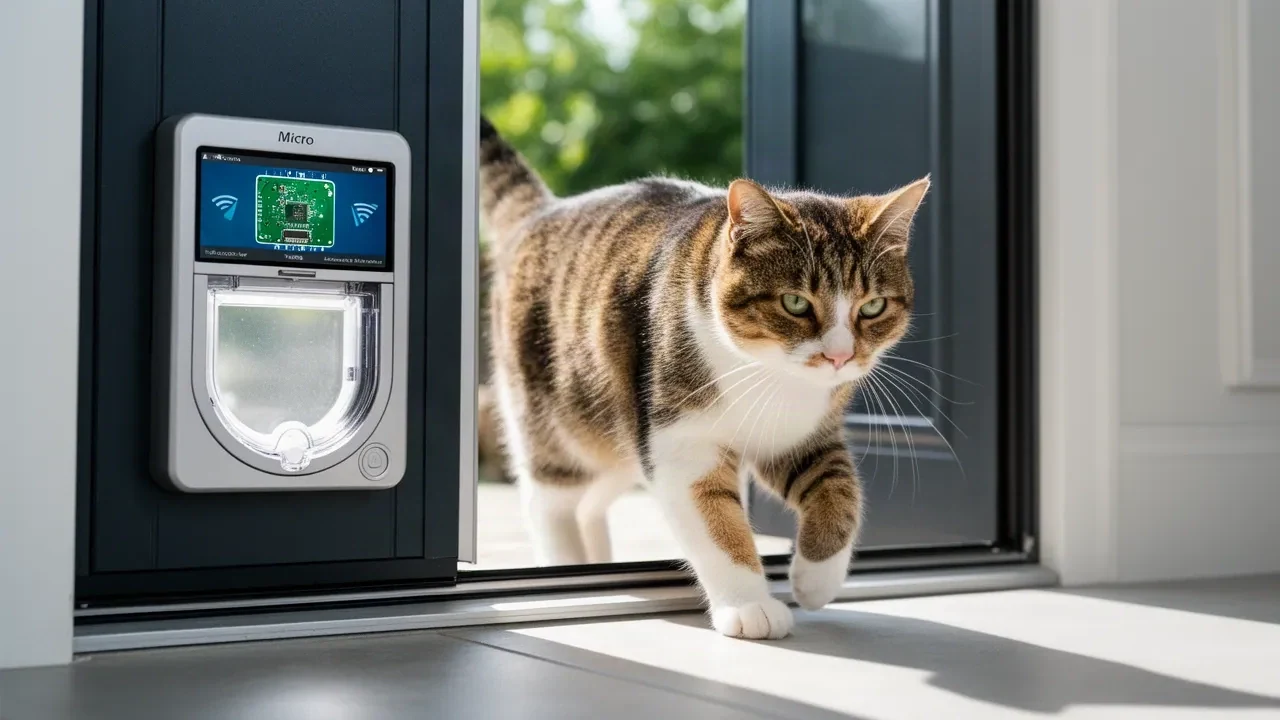
Microchip cat doors solve this by turning your cat’s existing subcutaneous microchip into an automated biological key. When your cat approaches the external tunnel, the scanner reads their unique 15-digit implant and drops heavy-duty motorized latch pins in a fraction of a second. This guide breaks down tunnel installation across solid doors, brick walls, and double-pane glass, details raccoon-proof locking engineering, and explains why automated dusk-to-dawn curfew timers are essential for feline safety.
Top Microchip Cat Doors at a Glance
| Model | Scanner Compatibility | Flap Opening Size | Installation Options | App & Curfew Control | Best For | Price Range |
|---|---|---|---|---|---|---|
| SureFlap Microchip Cat Door | 15-Digit ISO / 10-Digit / RFID Tag | 5.59″ × 4.72″ | Wood, PVC, Glass, Wall | 4-Way Manual Dial | Best Overall Standard | ~$140–170 |
| SureFlap Pet Door Connect | 15-Digit ISO / 10-Digit / RFID Tag | 7.00″ × 6.69″ | Wood, Glass, Brick Wall | App Notifications & Curfew | Best Smart / Large Breed | ~$230–280 |
| PetSafe Microchip Cat Door | 15-Digit ISO / 9-Digit / 10-Digit | 5.90″ × 5.50″ | Wood, PVC, Metal Door | 4-Way Manual Rotary Lock | Best Mid-Tier Value | ~$110–135 |
| SureFlap Wall Extension Set | Hardware Accessory (Polymer) | 2.00″ Depth per Tunnel | Solid Brick, Stud Walls | N/A (Tunnel Extender) | Mandatory for Wall Mounts | ~$18–28 |
How Microchip Cat Doors Work: RFID Frequency Physics
To understand why a smart cat flap is so reliable, it helps to examine the underlying radio-frequency identification (RFID) technology. Microchip doors operate on passive RFID circuits, meaning your cat’s implanted microchip contains no battery or internal power source.
When your cat steps into the door’s entry tunnel, their body enters a low-frequency electromagnetic scanning field generated by an antenna coil embedded in the frame. This magnetic field energizes the copper coil inside the subcutaneous microchip, prompting the chip to broadcast its unique ID number back to the door’s receiver.
| Step | What happens |
|---|---|
| Approach | The cat enters the scanning tunnel 3–5 inches from the flap |
| Energize | A 134.2 kHz coil emits a passive RF pulse to the chip |
| Verify | The microchip sends its 15-digit ISO 11784 code to memory |
| Release | A motorized solenoid drops the dual anti-tamper latch pins |
| Pass & lock | The cat pushes through; the pins re-engage to block trailing animals |
Microchip Standards & Scanner Compatibility
Before cutting into an exterior door, verify that your door matches your cat’s microchip standard:
- 15-Digit ISO 11784/11785 (FDX-B): Operating at 134.2 kHz, this is the universal veterinary global standard implanted in almost all cats today. Every modern microchip flap reads this format instantly.
- 10-Digit FDX-A (FECAVA): Operating at 128 kHz or 125 kHz, this older format is fully supported by Sure Petcare and PetSafe units.
- 9-Digit Avid Encrypted: Operating at 125 kHz, this legacy chip is supported by modern multi-frequency scanners.
- Collar RFID Tags: If your cat has a migrated microchip that sits too far down the shoulder for the overhead scanner to detect, lightweight RFID collar medallions (included with most doors) provide identical selective access.
Detailed Reviews of the Best Microchip Cat Doors
1. SureFlap Microchip Cat Door (Sure Petcare) — Best Overall Standard Pick
🥇 Best Overall Standard Microchip Door
SureFlap Microchip Cat Door
The definitive selective entry pet door. Scans all standard 15-digit microchips, stores up to 32 pet profiles in memory, and prevents intruder entry with patented anti-tamper locking claws.
- Universal 15-digit ISO microchip reader
- 32 pet memory profiles
- 4-way manual rotary lock
- 12+ months battery life (4 AA cells)
The gold standard for draft exclusion and intruder defense.
The SureFlap Microchip Cat Door is the benchmark for selective exterior access. Engineered in the UK, where outdoor cat access is standard practice, this unit combines fast microchip recognition with heavy-duty weatherproofing. The frame features an overhead antenna arch that reads your cat’s chip the moment their head enters the tunnel, dropping the motorized latch pins in roughly 0.3 seconds so your cat can push through without breaking stride.
The external frame uses a dual-point anti-tamper locking mechanism. Unlike cheap magnetic flaps that clever raccoons can pull outward by catching their claws under the bottom edge, the SureFlap locks from the bottom with rigid polymer claws that resist outward force. A perimeter brush seal and magnetic bottom catch keep wind, rain, and winter drafts from whistling into your living room.
A manual four-way rotary dial on the interior frame lets you select between In-Only, Out-Only, In/Out (Fully Open), and Completely Locked. Programming takes two seconds: press the memory button, guide your cat through the tunnel once with a treat, and their 15-digit ID is stored permanently in non-volatile memory, even during battery changes.
It reads every standard 15-digit ISO, 10-digit, and 9-digit microchip, and the dual anti-tamper claws stop raccoons and stray cats from prying the door outward. Four AA batteries run it for over a year, and the compact frame fits standard doors cleanly. The 5.59-by-4.72-inch opening is too small for giant breeds over fifteen pounds, and wall or glass installs need separate adapter plates.
2. SureFlap Microchip Pet Door Connect with Hub — Best Smart App Pick for Large Cats
📱 Best Smart Door with Curfew Timers
SureFlap Microchip Pet Door Connect
A larger, connected smart door that lets you set automatic dusk-to-dawn curfew locks from your phone, monitor daily outdoor activity, and comfortably accommodate large cat breeds like Maine Coons.
- Spacious 7.00″ × 6.69″ opening
- App curfew scheduling
- DualScan entry & exit tracking
- Runs on 4 C-cell batteries
Ideal for setting automated nighttime predator curfews.
For owners who want app control or live with large cat breeds like the Maine Coon or Ragdoll, the SureFlap Pet Door Connect is the ultimate upgrade. Offering a generous seven-inch by 6.69-inch flap opening, it gives big, broad-chested cats plenty of shoulder clearance without scraping their backs.
The standout feature is the integration with the Sure Petcare mobile app via the included wireless Hub. The app allows you to lock and unlock the door remotely from anywhere in the world and set precise, automated curfew schedules. You can program the door to lock automatically at 7:30 PM (allowing cats to enter from the outside, but blocking all departures) and unlock at 7:00 AM once daylight returns.
The unit also features DualScan technology, meaning it possesses RFID scanning antennas on both the inside and outside of the tunnel. In a multi-cat home where one cat is allowed outdoors while another indoor-only cat must stay inside, the door recognizes which specific cat is approaching and enforces individual access permissions.
Automated curfew scheduling keeps cats indoors during peak predator hours, and the DualScan antennas let you set custom exit permissions for each cat. The generous opening fits large breeds, and it sends smartphone notifications whenever a cat leaves or returns. It costs substantially more than a manual flap, and the Hub needs a dedicated Ethernet port on your router.
3. PetSafe Microchip Cat Door — Best Mid-Tier Value
💰 Best Value Selective Cat Door
PetSafe Microchip Cat Door
A dependable, cost-effective selective entry cat flap featuring a dual magnetic weather seal, 40-pet memory capacity, and reinforced mechanical locking pins.
- Reads 15-digit, 10-digit, and 9-digit chips
- 40 pet memory capacity
- Reinforced dual-point lock
- Low battery indicator light
Reliable selective access at an approachable price point.
If you want dependable selective entry without the premium cost of app connectivity, the PetSafe Microchip Cat Door delivers solid mechanical performance. The unit accommodates up to forty separate pet profiles, making it well-suited for rescue shelters, foster homes, and large multi-cat families.
PetSafe designed this unit with a slightly wider 5.9-inch opening than basic entry-level models, providing comfortable clearance for average domestic cats up to twelve pounds. The frame incorporates dual magnetic seals along the bottom and sides of the flap, preventing annoying flap flutter during high winds.
The front rotary dial provides four standard lock states (Locked, In-Only, Out-Only, and Open). A bright LED warning light flashes red when the four AA batteries drop below 20% power, giving you several weeks of advance warning to replace cells before the motorized lock loses voltage.
It costs less than the app-enabled models, and it stores up to forty cat IDs in memory. The dual magnetic seals cut drafts and wind noise, and programming is a simple one-button process. The tunnel depth is fixed, so wall installs need DIY framing, and the plastic frame lacks SureFlap’s anti-pry claw reinforcement.
4. SureFlap Wall Mounting Adaptor & Tunnel Extender — Mandatory Wall Install Add-On
🧱 Essential Wall Mount Hardware
SureFlap Wall Mounting Adaptor & Tunnel Set
A precision-molded polymer adapter plate and interlocking two-inch tunnel extenders designed to create a clean, insulated passageway through exterior brick, drywall, and stud walls.
- Interlocking 2-inch tunnel sections
- Weatherproof ABS polymer
- Covers rough wall cutouts
- Clean circular framing
Mandatory accessory for exterior wall and glass installations.
When installing a microchip cat door through an exterior wall or brick foundation rather than a thin wooden door panel, the built-in 2.75-inch tunnel on the main chassis is not long enough to bridge the gap. Attempting to leave exposed insulation or raw drywall inside the cutout creates a moisture trap that cats can scratch and damage.
The SureFlap Tunnel Extenders solve this by interlocking together in two-inch increments. You simply stack as many tunnel sections as needed to span the exact thickness of your wall (typically three to four sections for a standard 2×6 stud wall with exterior siding).
Paired with the circular Wall Mounting Adaptor plate, this kit creates a smooth, fully enclosed, waterproof plastic sleeve from interior drywall to exterior siding. The smooth interior tunnel prevents cat claws from snagging and ensures the RFID scanning field remains focused through the center of the passage.
The interlocking design matches any wall thickness, and the smooth non-porous plastic keeps moisture out and cleans easily. The adapter plates hide jagged cuts in drywall, brick, or stucco while preserving the wall’s strength. You have to buy it separately from the door, and walls over six inches need multiple sections.
Installation Blueprints: Doors vs. Walls vs. Glass
Installing an automated pet door requires careful preparation based on your home’s construction materials. Below are the key structural protocols for three common installation scenarios:
| Install type | Cutout dimensions | Special accessories | Key hazard |
|---|---|---|---|
| Solid wood | 6.5″ × 6.75″ rectangle | None (standard screws) | Core alignment |
| Metal/steel | 8.35″ diameter circle | Mounting adapter plate | RF signal loss |
| Stud wall | 6.75″ × 7.00″ rectangle | Tunnel extenders (2–4×) | Hidden wiring |
| Glass pane | 8.35″ diameter circle | Glazier circular cutout | Toughened glass |
1. Solid Wood and Composite Door Installation
This is the simplest setup. Use the manufacturer’s paper template to trace the rectangular cutout on your door panel. Ensure the bottom of the cutout sits between 4.0 and 5.5 inches off the floor, which matches the average cat’s chest height. Drill four corner pilot holes, cut out the interior rectangle using a jigsaw, insert the front and back frames, and tighten the four through-bolts.
2. Metal and Steel-Clad Door Interference
If your exterior door contains steel, iron, or heavy aluminum skin, the conductive metal will disrupt the door’s electromagnetic scanning field, causing the RFID scanner to drop range or fail completely.
To prevent signal loss in metal doors, you must cut a larger circular opening (roughly 8.35 inches in diameter) and mount the door using the non-metallic SureFlap Mounting Adapter Plate. The adapter creates an air gap between the metal door skin and the RFID antenna coil, restoring full 134.2 kHz signal reception.
3. Exterior Stud and Brick Wall Installation
For wall installations, locate wall studs using a stud finder and ensure the planned path contains no electrical wiring, plumbing pipes, or HVAC ducts. Cut through the interior drywall and exterior sheathing, frame the interior cutout with 2×4 lumber to prevent wall compression, and connect interlocking tunnel extenders to bridge the wall depth. Always seal the exterior adapter plate perimeter with exterior-grade 100% silicone caulk to prevent water intrusion.
4. Glass Pane Installation
Installing a microchip door in a glass sliding patio door or French window requires professional assistance. Standard double-pane and tempered glass cannot be cut after manufacturing; attempting to drill into tempered glass will shatter the entire pane. A professional glazier must measure your door, manufacture a new double-pane glass unit with a pre-cut 8.35-inch circular hole, and install the pet door using the circular glass adapter kit.
Raccoon and Predator Defenses: Stopping Intruders
Standard two-way cat flaps rely solely on light plastic flaps held in place by weak magnets. Clever nocturnal raccoons and aggressive neighborhood tomcats quickly defeat these basic flaps through two learned maneuvers:
- The Inward Push: A stray cat follows closely behind your cat, pushing through the swinging flap before the magnet catches.
- The Outward Claw Hook: Raccoons use their dexterous front paws to hook the bottom edge of the flap from the outside, pulling the flap outward toward themselves to bypass one-way mechanical stops.
Top-tier microchip doors neutralize these tactics through patented anti-tamper locking claws. The locking pins sit flush inside reinforced polymer housings beneath the door threshold. When the door is in locked mode, the flap is physically blocked from swinging both inward and outward. Even if a twenty-pound raccoon pulls on the exterior rim with all its strength, the solid locking pins hold the door firmly in place.
Why Dusk-to-Dawn Curfews Protect Outdoor Cats
According to wildlife biology research and feline mortality studies from the Humane Society, free-roaming cats face their highest mortality rates between dusk and dawn. Over 80% of fatal coyote encounters, owl attacks, and vehicular accidents occur during nocturnal hours when feline visibility is low and nocturnal predators are actively hunting.
| Time | Door state |
|---|---|
| 7:00 AM | Unlock to In/Out; the cat roams the catio or yard freely |
| 7:30 PM | Dusk lockout to In-Only; cats outside can enter but not leave |
| 10:00 PM | Full night lockdown; all pets secured indoors |
By scheduling an automated “In-Only” curfew from 7:30 PM to 7:00 AM, you allow cats that are lingering outside at sunset to enter the home at their own pace. Once they step inside to eat dinner, the door locks behind them for outward travel, keeping them safely indoors until daylight.
Training Your Cat to Use a Microchip Door
Because microchip doors produce a faint mechanical click when the solenoid unlocks, noise-sensitive cats may hesitate during their first few encounters. Follow this three-step training routine to build confidence:
- Step 1: Prop the Flap Open (Days 1–3): Tape the clear plastic flap securely up to the top frame so the tunnel remains completely open. Let your cat walk back and forth through the open tunnel without pushing against any resistance, placing high-value treats on the far side.
- Step 2: Enable Training Mode (Days 4–6): Activate the door’s built-in Training Mode. In this setting, the motorized locking pins drop silently whenever the cat approaches, but the flap remains unlatched. Push the flap gently against your cat’s nose so they learn that pressing their head opens the door.
- Step 3: Activate Microchip Scanning (Day 7+): Turn off Training Mode. Place a favorite meal just outside the locked door. As your cat steps into the tunnel, the scanner reads their chip, the latch drops with a soft click, and your cat pushes through confidently.
When budgeting home upgrades alongside your pet care gear, consult our breakdown in the cost of owning a cat guide. Track your cat’s feeding, vet appointments, and medication reminders in our Cat Care Planner while you get the new door set up.
When to See a Vet
Cats with outdoor access face risks that indoor-only cats don’t. Watch for scratches or bite wounds, which can abscess, along with limping, changes in appetite, or weight loss, and keep their flea, tick, and parasite prevention current. Any wound from a fight warrants a vet check, since cat bites commonly become infected.
If you notice any of these signs, consult your veterinarian. This article is for informational purposes and does not replace professional veterinary advice.
Frequently Asked Questions
Will a microchip cat door work with my cat’s existing chip?
Yes. Modern microchip cat doors from Sure Petcare and PetSafe are universally compatible with all standard 15-digit ISO 11784/11785 (FDX-B) microchips implanted by veterinarians worldwide. They also support 10-digit FDX-A chips and 9-digit Avid chips.
Can raccoons or stray cats break through a microchip cat door?
No. Quality microchip doors feature reinforced anti-tamper locking claws at the base of the frame. These claws physically prevent raccoons from hooking their paws under the flap to pull it outward, and keep unauthorized strays from pushing inward without an approved microchip scan.
What happens if the batteries die while my cat is outside?
Microchip doors feature low-battery LED indicator lights that flash for several weeks before the batteries lose operating voltage. If the batteries drain completely, the door defaults to its last mechanical position (standard locked state). Quality alkaline batteries reliably power standard microchip doors for ten to twelve months.
Can I install a microchip cat door in a metal door?
Yes, but you must use a specialized plastic mounting adapter plate. Metal skins disrupt the door’s electromagnetic radio frequency scanning field. Cutting a slightly larger circular opening and installing the adapter plate creates an air buffer that prevents metal interference.
How do I stop one indoor cat from escaping while letting another cat outside?
Select a model equipped with DualScan technology, such as the SureFlap Pet Door Connect. DualScan doors feature scanning antennas on both the inside and outside of the frame, allowing you to program custom exit permissions for each individual cat in your household.
Looking for additional smart pet care solutions? Check out our reviews of the Best Microchip Cat Feeders for multi-cat homes, explore Indoor Cat Enrichment strategies, or review our New Kitten Checklist for essential supplies.
Written by Max
Max is a lifelong cat owner and runs CuteCatsHQ. Health and care guides are checked against the veterinary sources listed with each article.
Keep reading
Best Smart Cat Cameras & Treat Dispensers
Monitor, talk, and play with your cat from anywhere. Compare smart pet cameras with treat tossing, lasers, 360 views, and the cloud vs local storage costs.
Best Smart Cat Feeders with Camera
Compare the best smart cat feeders with HD cameras, covering anti-jam kibble tests, app reliability, portion accuracy, and power-outage failover plans.
Best Cat Trees for Senior Cats: Low Ramps & Steps
Help an arthritic cat keep its height. Compare low-step, gentle-ramp senior cat trees with roomy platforms and cushioned beds, and when to call the vet.