
Birman Cat Breed Guide: Personality & Care
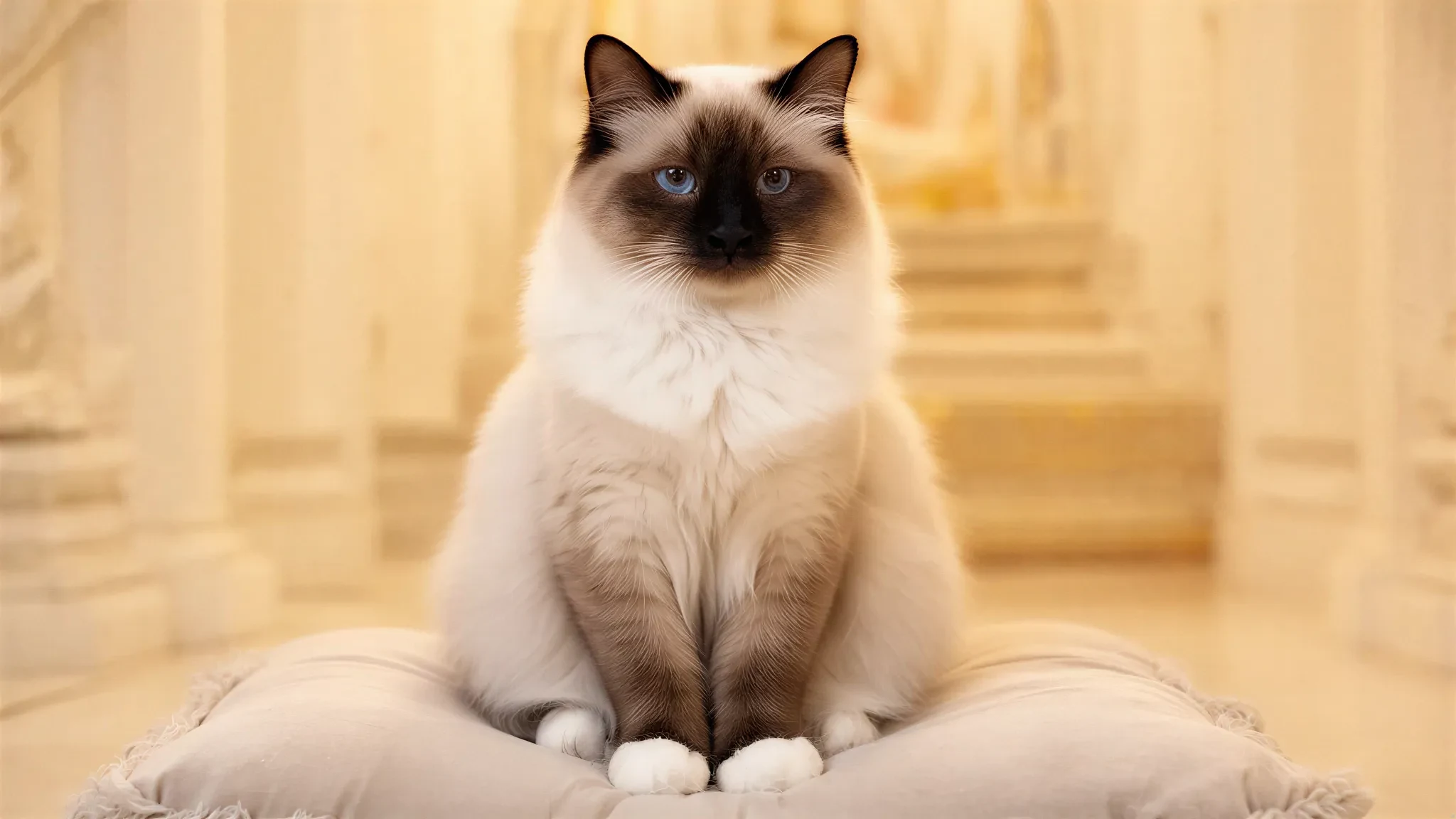
A Birman is a pointed, blue-eyed longhair whose white gloves are twenty points on the CFA standard, not a decoration you can skip. This site does not keep a numbered breed profile for them the way it does for some neighbors, so I am not going to invent a personality list or a lifespan range as if it lived in our table. The Cat Fanciers’ Association’s version is a temple legend you should treat as a legend, recognition in France in 1925, a near wipeout in the Second World War down to one breeding pair, a rebuild that used Persians and possibly Siamese, pure litters again in the early 1950s, United States imports in 1959, and CFA championship in 1967. Outcrosses now: none. If you wanted a Ragdoll, that is a different mitted idea. If you wanted a Burmese, that is Wong Mau, and she does not belong in this paragraph.
Quick Facts
| Attribute | Detail |
|---|---|
| Origin | Burma in legend; developed as a breed in France |
| Size | Medium (meet the adult; I will not invent pounds) |
| Coat | Semi-long, silken; CFA says it does not mat |
| Personality | CFA: soft chirps, patient with children, pair if they will be alone |
| Lifespan | CFA article: 15+ not unusual; I will not invent a site range |
| Care level | Medium (long coat, not a Persian mat factory) |
| Health to ask about | HCM testing (CFA future page) |
| Common names | Bella, Luna, Sage, Oliver |
History & Origins
The legend: a temple, a priest, a golden goddess, a cat named Sinh, a dying man named Mun-Ha, white gloves as a blessing. CFA tells it as legend. I will tell it as legend. I am not going to certify a miracle.
France recognized the breed in 1925. The Second World War nearly ended it. CFA: one breeding pair. Rebuild used Persians and possibly Siamese. Pure Birman litters again in the early 1950s. That Persian chapter is why you still ask about hearts and why a round face in an old photo is not a scandal by itself. It is also why this is not a random pointed longhair.
United States: 1959, Seipel, then Griswold. CFA championship: 1967. Outcrosses now: none. A seller offering a “Birman mix” as the same class is shopping a look.
They are not a Siamese. Colorpoint is shared ancestry in the rebuild story, not the same cat. Different body, different gloves, different conversation. They are not a Persian. The coat is silken, not a mat factory, and the face is not a smash.
Wong Mau is not this breed. She is the Burmese foundation. A page that put her here mixed two histories. I am not repeating that error.
They are not a Ragdoll. Mitted overlay is a different white-foot idea on a different body. Gloves and laces are this page. If a seller uses the words as synonyms, leave.
Personality & Temperament
CFA: soft chirps, not a Siamese speech. Patient with children. Do well as a pair if they will be alone. That is a people-oriented pointed cat with a quiet voice, not a Ragdoll you fold over your arm and not a Burmese who follows you into the shower.
A week in the house: morning chirp, a person who will sit, a window, an afternoon that is kinder with a second cat if you are gone, evening of being in the room. If you wanted opera, this is the wrong pointed cat. If you wanted a cat who cannot be left, a pair is the CFA hint.
Kids: patient helps. Gloves are not a reason to grab feet. An adult still owns the house. Best Cat Breeds for Families with Kids is the family-fit owner.
Indoor Cat Enrichment still applies. Bringing Home a New Cat still applies. A quiet cat in a bathroom may not yell. Check on them.
Soft chirps are easy to miss if you wanted a Siamese. Listen. Patient with children is CFA’s gift and not a stuffed-animal license. Gloves look like socks. Kids will grab socks. Teach hands before the cat has to.
A pair is husbandry when the days are long. Two sets of gloves is two sets of litter-box stains if you never scoop. Plan the box. Plan the comb. Plan who sits with them at 3 p.m. The temple legend will not do that work.
Physical Characteristics
CFA: gloves are twenty points. White feet. Laces up the back of the hind legs. Get them wrong and the cat is wrong for the class even if the rest is pretty. Meet the adult. I am not printing a fake pound range.
Blue eyes required. Other eye colors disqualify. That is not a suggestion. A gold-eyed “Birman” is a different conversation.
Coat silken, semi-long. CFA: does not mat. Comb it anyway. Points on a light body. Contrast is the postcard. A muddy point is still a cat; it may not be a show cat.
Body is not a Ragdoll slab and not a Siamese tube. Medium is the honest word until you sit with one. Type first. White feet second.
Points darken with age. A pale kitten is not a failed Birman. Contrast on the adult is the postcard. Gloves should still read as gloves when they stand. If you have to squint, ask why.
Laces up the back of the hind legs are part of the twenty points. Socks that stop at the ankle on the rear are not the same picture. Meet more than one adult in the room. A single pretty kitten is a photo.
Care Requirements
Grooming
CFA says the coat does not mat. Believe the silk, not a zero-comb fantasy. A few times a week is the usual, more if they get into something. They stay easier than a Persian because there is less coat to hold yesterday’s dinner. That is not zero work. Nails, ears, teeth still exist.
Feeding
I will not invent a cup amount. A longhair still hides a middle. Use How Much Should I Feed My Cat?. Weigh them. Feel the waist under the silk.
Exercise & Enrichment
Chirps want a landing pad. A pair if they will be alone is the CFA sentence. A wand still helps. A window still helps. Twenty minutes of nothing and an empty apartment is how a pointed cat becomes wallpaper.
They are not a Ragdoll you drape over an arm. They are not a Siamese you debate with at 5 a.m. Play still happens. A feather they can catch is better than a laser they cannot. If the only exercise is walking to the bowl, the silk will hide the middle until you pick them up. Pick them up.
Health Concerns
CFA’s future page names hypertrophic cardiomyopathy testing. Ask for the echo. Cornell’s cardiomyopathy page is the general library. Breathing, hiding, a cat who will not play — veterinarian.
CFA’s breed pages do not identify kidney disease, hip dysplasia, or corneal trouble as Birman-specific conditions. Ask what the breeder’s lines are screened for. “Birmans don’t have problems” is not a test result.
CFA’s article says living past fifteen is not unusual, and dying past twenty shows up as anecdote. That is not a numbered range I will print as a site fact. It is a reason to plan for an old pointed cat.
Heart scans are a calendar. Comb is a calendar. Pair-if-alone is a household calendar. Do not collapse them into “they’re easy longhairs.” Easy compared with a Persian is still a cat who needs a person.
A pointed cat in a sunny window will show more contrast. That is color, not a health test. Breathing at rest is the health test. If they open-mouth breathe on a cool day, veterinarian. I will not invent a dental line. Teeth still exist. Look.
I will not invent a price.
Is a Birman Right for You?
This breed fits people who wanted gloves, blue eyes, and a quieter pointed cat, and who will comb a coat that CFA says will not mat anyway. Households with kids who can be taught hands. Households that will get two if the days are long.
Who should pick a different cat: you, if you wanted a Ragdoll and thought mittens were gloves. You, if you wanted a Burmese and thought Wong Mau started this. You, if you needed a Siamese narrator. You, if a Persian face was the point. You, if one cat alone from 8 to 6 was the plan and a second was off the table.
Apartments work if you are home or they have company. Allergies: still a longhair; visit. A guest who “doesn’t like cats” will still meet this one if they sit down. Plan that. The chirp is quiet. The presence is not optional.
A first Birman is a reasonable adult if you can find one whose gloves you can see and whose echo you can date. A kitten is a guess about both. I would rather meet the mother walking than buy a photo of socks.
Finding a Birman
A serious breeder shows you gloves and laces on the adult, talks HCM, and does not mention Wong Mau as if she were theirs. Ask when the last outcross was — the honest answer is none now. Ask who sits with the cats when the house is empty.
Rescue gets pointed longhairs with white feet who may or may not be Birmans. An adult whose gloves you can see is better information than a kitten photo with socks.
Red flags: Wong Mau as origin, “it’s a Ragdoll with gloves,” no heart talk, kittens at six weeks, gold eyes sold as Birman, a Persian face called a feature.
Adopting vs. Buying from a Breeder still applies.
Meet the adult walking, chirping, and not hiding for the whole visit. If they never come closer, they may still be a Birman having a day. If the gloves are stained from a dirty litter box, that is husbandry, not type. Then decide.
The temple story is a story. Buy the cat in the room. A legend on a website is not a temperament test.
Gloves at twenty points means a breeder who shrugs at white feet is shrugging at the breed. Pretty points on tan feet are a different class.
The Persian rebuild is in the 1950s, not in your living room. You still ask about hearts because longhaired pointed cats are still cats. You do not skip the comb because CFA said silk.
There is no Birman name listicle on this site. Use the generator and the names below. I will not invent a second URL to make the footer match the other breed pages.
France 1925 is recognition. One pair after the war is why the rebuild used Persians and possibly Siamese. Pure litters in the early 1950s is why you can ask for a Birman now. Championship in 1967 is the CFA class. Outcrosses none now is the honest answer. A seller offering a “fresh outcross” as a feature is shopping a different decade.
Gloves and laces at twenty points. Sit on the floor and look at the feet. Stained gloves are a litter box. Missing gloves are a class problem. Blue eyes required. Gold eyes are a different cat even if the rest is pretty.
CFA says the coat does not mat. Comb it on the visit anyway. If they will not let you, believe them. Silk that has never seen a comb in a cattery will still need a comb in your house. A Persian face on a “Birman” is the rebuild showing up as a look. Type first.
Pair if they will be alone. That is not a sales trick for two kittens. It is CFA telling you the chirps want a landing pad. One statue in an empty apartment is how you get a pointed cat who waits by the door and then stops waiting.
HCM testing is the future-page sentence. Ask for the echo date, not a vibe. I will not invent kidney or hip lines to sound thorough. Ask what they actually scan. Then stay long enough to hear a chirp and to see the walk. Then decide.
Popular Birman Names
These exist in our name list. Buddha does not. I will not print a joke name I cannot stand behind.
Bella — Italian, beautiful
Luna — Latin, moon
Sage — Nature, wise, herb
Oliver — English, olive tree
Charlie — English, free man
Winston — English, joy stone
Milo — German, merciful
Daisy — English, day’s eye
Felix — Latin, happy, lucky
Max — Latin, greatest
Willow — English, willow tree
Jasper — Persian, treasurer
More in the Name Generator.
Frequently Asked Questions
Is a Birman the same as a Ragdoll?
No. Ragdolls are a mitted overlay on a large, laid-back body. Birmans are gloves and laces, a silken coat CFA says does not mat, and a different history. Blue eyes are required here; other eye colors disqualify. Different pages. A pointed cat with white feet is not automatically either.
Is Wong Mau a Birman?
No. Wong Mau is the foundation cat of the Burmese, not this breed. A page that assigned her here mixed two pointed-adjacent stories. If you wanted sable and gold eyes, that is the Burmese page.
Do Birman coats mat like a Persian?
CFA says the coat is silken and does not mat. That is not a Persian. It is also not zero grooming. Comb anyway. A silken coat still holds yesterday if you never look. They still need nails, ears, and teeth.
What health tests should a Birman breeder show me?
Ask about hypertrophic cardiomyopathy. CFA’s future page names HCM testing. Cornell’s cardiomyopathy page is the general library. I will not invent kidney, hip, or corneal disease as this breed’s lines. Ask what their lines actually scan.
Should I get two Birmans?
CFA says they are patient with children and do well as a pair if they will be alone. That is not a law. It is a warning if you work long days and wanted one quiet statue. A single Birman in an empty apartment is how the chirps have nobody to land on.
Meet the adult on the rug. Use CFA’s Birman profile to study the gloves before you book the visit; this archive does not have a Birman-tagged gallery. A second visit, after they have chirped and not hidden, is the temple-story version of a temperament test.