
Egyptian Mau Cat Breed Guide: Personality & Care
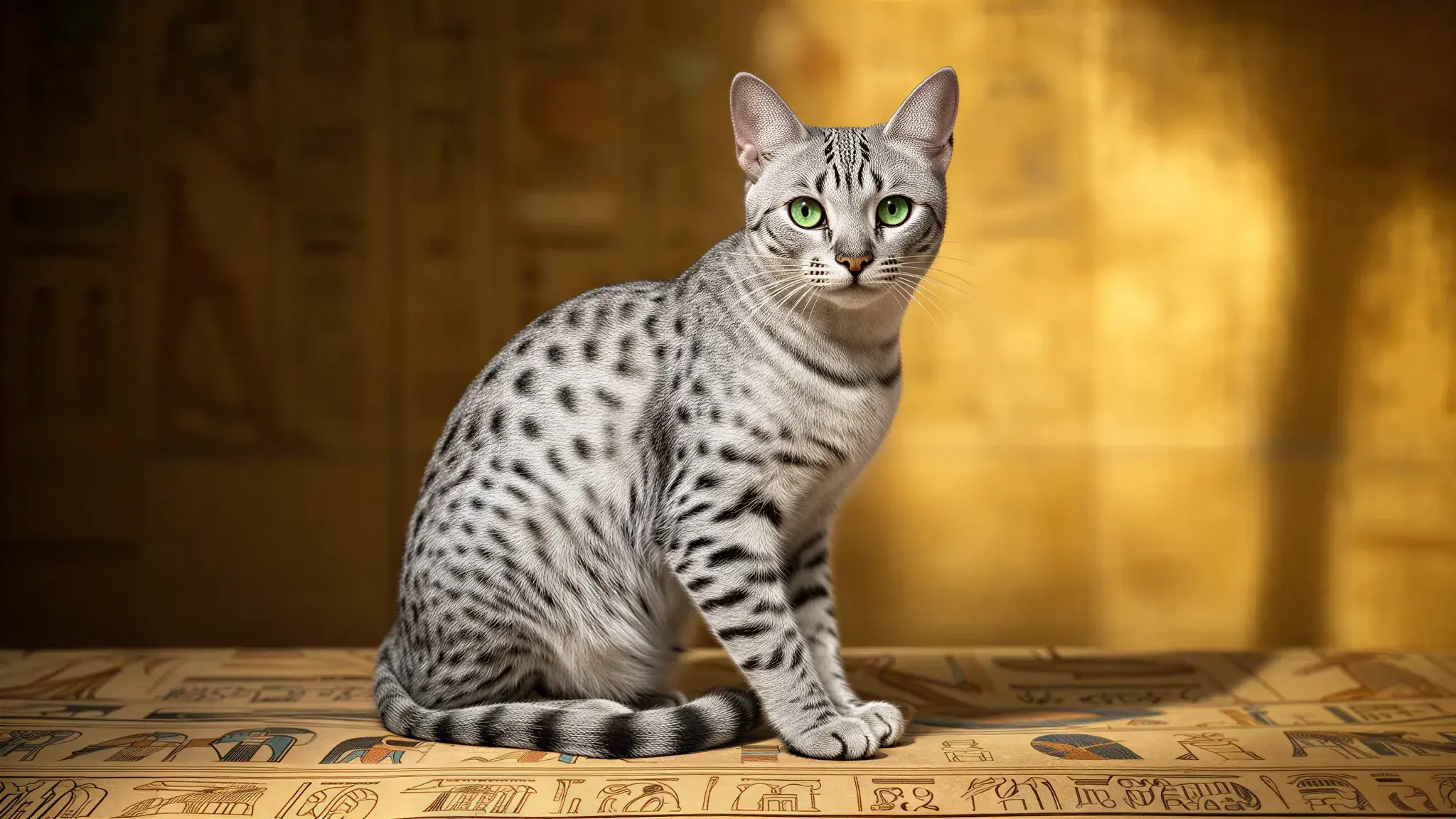
An Egyptian Mau is a spotted, medium, muscular cat that CFA calls the only naturally spotted domestic breed. The profile on this site lists them as loyal and intelligent, short coat, medium care, 12–16 years, with hypertrophic cardiomyopathy and asthma on the health line. Gooseberry-green eyes, mascara lines on the cheeks, random spots, and a loose flap of skin from flank to hind knee are the things you can actually see. If you wanted a spotted cat that was invented in a cattery last century, that is an Ocicat or a Bengal. This page is the natural-spot conversation.
Quick Facts
| Attribute | Detail |
|---|---|
| Origin | Egypt |
| Size | Medium (males usually larger; CFA wants balance over size) |
| Coat | Short; silver, bronze, or smoke with random spots |
| Personality | Loyal, intelligent |
| Lifespan | 12–16 years |
| Care level | Medium |
| Health to ask about | HCM, asthma; CFA also names PK deficiency and urinary stones |
| Common names | Spots, Mau, Pharaoh, Cleopatra — jokes. Use real names below. |
History & Origins
CFA’s breed page is the short version: the word Mau meant cat, or sun, in ancient Egypt. Spotted cats that look like this show up on papyri and frescoes from around 1550 B.C. That is not the same as a closed stud book from the New Kingdom. It is why people call them ancient. The modern breed in North America starts later.
Nathalie Troubetskoy, a Russian princess living in Rome, found spotted cats after the Second World War had wrecked European breeding programs. CFA says she emigrated to the United States in 1956 with three Maus and started the line that American fanciers actually descend from. CFA accepted the breed for registration in 1970 and advanced it to championship in 1977. CFA’s 1999 yearbook article fills in Fatima cattery, silver and bronze and smoke from those early cats, and later “Indian” imports in the 1980s that widened a tiny gene pool. I am not going to retell every grand champion. The import story is why a Mau is not a random tabby with extra spots.
CFA allows no outcrosses. New blood, when it happens, is supposed to come through the breed’s import rules, not a Bengal in the backyard. If someone is selling a spotted mixed cat as a cheap Mau, they are selling a story.
Personality & Temperament
Loyal and intelligent on our profile. CFA’s daily version is more specific: intensely devoted, extremely sharp senses, sensitive to your mood, fetch, sometimes a harness walk. Shoulder riders. Refrigerator vultures. Furry alarm clocks. They want in on the household, not a guest pass.
They are also strong-willed about who handles them and when. CFA says they may be cautious or reserved with strangers and fearless with their people. Quiet voices: chirps and chatter, not a Siamese opera. If you wanted a cat who loves every visitor on minute one, this is a slow hello, not a defective temperament.
Play is real. CFA documents interactive games. A bored Mau with that skin flap and those hind legs will invent a job you did not approve. Indoor Cat Enrichment is the setup. A studio and a laser they never catch is a bad match for an athletic spotted cat.
Kids: CFA calls them wonderful family pets with their people. An adult still owns the introductions. A reserved cat and a toddler who grabs spots are a conflict. Supervise.
The profile calls them the fastest domestic breed. I have not timed one. CFA’s athletic story is the one I will stand on: longer hind legs, that skin flap, a cat who looks on tip-toe at rest. Speed-myth marketing is how spotted mixes get sold as Maus. Watch this cat turn in a hallway. That is enough.
A Mau who grew up only in a bathroom cage may hide for a week. That is not “wild blood.” That is a cat who has not had a house. Bringing Home a New Cat is the first-month version. Give them a room. Kids who want to show the spots to everyone on day one will have to wait.
Physical Characteristics
CFA: active, colorful, medium, well-muscled, alert. Head a slightly rounded wedge, not full-cheeked. Ears medium to large, inner ear almost transparent shell pink, may be tufted. Eyes large, almond, slight slant — not round, not oriental. Hind legs longer, so they look a bit on tip-toe standing still. Feet small. Tail medium, thick at the base, slight taper.
The skin flap from flank to hind knee is in the standard. It is not an injury. CFA’s yearbook piece compares it to a cheetah’s extra skin for stride. I have not measured a stride. I will tell you the flap is how you tell a Mau from a spotted cat in a Facebook photo.
Pattern is 25 points, same as color. Random spots of unequal size and shape, all of equal merit if they are distinct. Forehead “M,” mascara lines on the cheeks, broken necklaces on the chest, vest-button spots on the belly, banded tail with a dark tip. Pencilled stripes instead of spots on the torso are a penalty. No spots is a disqualification.
Colors in championship: silver, bronze, smoke. Gooseberry green eyes — some green by eight months, full green by eighteen. Blue eyes DQ. White lockets DQ. CFA accepted blue on AOV status in 1997; AOV is not the kitten you were shown as a show silver.
I am not printing a fake pound range. Medium. Meet the cat. Look at whether the spots are spots.
CFA’s old yearbook split of registrations was roughly half silver, about 40 percent bronze, the rest smoke and black. Those are historical percentages, not a shopping quota. Black Maus exist in litters and are used in breeding; they are not the championship color you were shown in a silver photo. Blue went to AOV in 1997. If the kitten is blue and the seller says show, they are selling hope.
An Ocicat can wear spots and still be a different head, a different origin story, and a different page. Do not let a spotted kitten decide the URL for you.
Care Requirements
Grooming
Medium care is coat plus a cat who wants a job, not a daily table. Short coat with a sheen. Silver and bronze are dense and resilient in CFA’s language; smoke is silkier. A rubber brush when they shed. Spots do not mat. They still get greasy if you never touch them. Nails, ears, teeth still happen. This is not a Maine Coon ruff and it is not a Domestic Shorthair you can ignore until April.
Feeding
Athletic and medium is easy to overfeed if the house is snacks and the cat is a refrigerator vulture. Use How Much Should I Feed My Cat?. I will not invent a cup amount. Wet food helps any cat drink. Urinary stones are on CFA’s breed-future list; water is husbandry, not a diagnosis.
Exercise & Enrichment
Active, alert, agile. Fetch. A tree they can actually use. Height. A window. CFA mentions harness walks as a pleasure some of them take — that is not a requirement and not a promise yours will heel. If they cannot have a vertical life, pick a calmer short-hair.
Stairs, a window perch they can actually land on, and a person who will throw the toy back are the daily version. CFA mentions they may train you to fetch. That is a two-way street. A Mau who only gets a laser they never catch will invent a worse sport: counters, the turkey, your ankles at 5 a.m. Medium care includes that hour, not just the brush.
Health Concerns
The profile lists hypertrophic cardiomyopathy and asthma. CFA’s breed page adds pyruvate kinase deficiency, which can cause anemia, and urolithiasis — stones in kidneys and urinary tract. CFA’s 1999 article also named cardiomyopathy, asthma, luxating patella, and dystocia as problems that had shown up in some traditional lines when the gene pool was tiny. That is history, not a diagnosis of the kitten in front of you. Ask what they test.
Cornell’s HCM page is the general heart library. It names several breeds where HCM shows up more often. Egyptian Mau is not on that named list. Our profile still lists HCM. Ask for echocardiograms if the breeder talks hearts, and do not treat a genetic test as a crystal ball — Cornell says interpret those with a veterinarian.
Asthma: Cornell describes allergic lower-airway disease in cats, coughing, open-mouth breathing, a hunched posture. Some studies have suggested Siamese cats may be predisposed; Cornell says that is not proven. Mau is not named there. Our profile still lists asthma. Coughing that will not stop is a veterinarian the same week, not a spotted-cat personality.
PK deficiency is the test CFA actually flags. Ask whether the line is tested. I am not going to explain hemolytic anemia as if I ran a lab.
I will not prescribe inhalers, heart pills, or a stone diet. That is the vet.
Is an Egyptian Mau Right for You?
This breed fits people who want a spotted, loyal, athletic cat and will accept a slow hello with strangers. Households that like fetch. People who will ask about PK and hearts before they fall for mascara lines.
Who should pick a different cat: you, if you wanted a lap fixture who loves every guest. You, if you wanted spots and thought any spotted kitten was a Mau. You, if a reserved, strong-willed cat sounds like a flaw. You, if you needed a low-energy apartment cat. That job is closer to a British Shorthair. You, if the “wild look” was the whole want and you have not read the Bengal and Ocicat pages.
Best Cat Breeds for Families with Kids is the family-fit owner. A Mau can live with kids. The reserved-with-strangers line still applies.
First-cat households can do this if they will play and not force handling. A Mau is a worse first cat than a DSH only if you needed instant friendliness. Allergies are dander, not spots. Spend time with the actual cat.
Finding an Egyptian Mau
This is a minority breed. CFA’s old yearbook numbers were small; waiting for silver or bronze is normal. A serious breeder talks about PK testing, urinary history, and whether the kitten is actually a Mau — spots plus the flap plus the eye clock — not a tabby with a story.
Ask, out loud: what PK tests exist on the parents? Any stones in the line? Hearts? Can I see them move? Who are they reserved with?
Rescue gets Mau mixes and the occasional registered adult. An adult whose stranger-hello you can watch is better information than a kitten photo.
Red flags: no spots sold as a rare self, blue eyes on an “adult Mau,” Bengal papers, a seller who has never heard of pyruvate kinase, kittens going home at six weeks.
CFA still has an import path for street cats from approved countries, with paperwork the breed council secretary has to bless. That is how a closed breed adds blood without a Bengal outcross. A backyard spotted litter with no paperwork is not that path.
Adopting vs. Buying from a Breeder still applies.
A week in the house: morning chirp, a window, a fetch session if you will throw, a person they consider theirs, and a closed guest bedroom when strangers come. They may ride a shoulder. They may not. Reserved with the plumber is not a defect. If you need a cat who performs for every visitor, this is the wrong spotted breed.
Popular Egyptian Mau Names
The profile lists Spots, Mau, Pharaoh, and Cleopatra. Those are costume labels. I am not putting Pharaoh on a tag. Names you can actually shout:
Cleo — Greek, glory; closer to Cleopatra than a joke
Bastet — Egyptian, cat goddess; use it if you like it, not because the fresco required it
Osiris — Egyptian, god of the afterlife
Luna — Latin, moon; silver coats especially
Milo — German, merciful
Oliver — English, olive tree
Willow — English willow tree
Leo — Latin, lion
Jade — nature, green gemstone; the eye color, if it actually arrives
Iris — Greek, rainbow
More on Egyptian Mau cat names and the Name Generator. If the names listicle leans on Pharaoh, ignore those lines.
Frequently Asked Questions
Is an Egyptian Mau the same as an Ocicat or a Bengal?
No. CFA calls the Mau the only naturally spotted domestic breed. An Ocicat is a man-made spotted cat from Siamese-type programs. A Bengal comes from Asian leopard cat hybrids. Spots are not a shared pedigree. Meet the cat, then read those other guides if the wild look was the whole want.
When do Egyptian Mau eyes turn green?
CFA wants gooseberry green. Some green should be visible by eight months. Full green is expected by a year and a half. Amber in an adult is a fault. Blue eyes are a disqualification. Do not buy a kitten on eye color alone; the adult color is the standard.
Are Egyptian Maus good with children?
They can be, with their people. CFA says they are affectionate, loyal, outgoing, and fearless with their household, and may be cautious or reserved with strangers. Strong-willed about who handles them and when. Supervise. A reserved cat is not a toddler’s grab toy.
Do Egyptian Maus need a lot of grooming?
Medium care on a short coat. CFA describes a lustrous sheen, denser in silver and bronze, silkier in smoke. A rubber brush in shed season is the job. Spots do not add comb time. They still need nails, ears, and teeth. Medium is not Persian hours.
What health tests should an Egyptian Mau breeder show me?
Ask about pyruvate kinase deficiency, which CFA names as a heritable condition breeders test for, and about stones in the urinary tract. Our profile also lists hypertrophic cardiomyopathy and asthma. Cornell’s HCM and asthma pages are the general feline libraries. I am not going to invent a Mau-only treatment. Ask what the adults in the line actually did.
Go meet the adult’s profile in person, not the kitten. Watch how they greet a stranger. The Egyptian Mau gallery is here if you want the spots before you book the visit. A second visit, after they have seen you once, is the reserved-cat version of a temperament test. The first hello is not the whole cat.